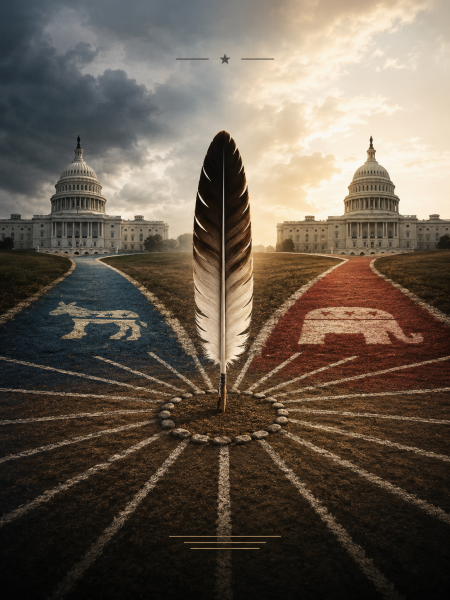
America has a strange political fantasy. Every few years someone declares that our biggest problem is having only two major political parties. “If only we had five parties,” they say. “Or ten. Then we’d finally have real representation.”
Really?
Let’s run a little experiment.
The United States already contains something remarkably similar: 574 federally recognized tribal governments. Each is sovereign. Each has its own leadership, history, priorities, and traditions. They aren’t Democrats. They aren’t Republicans. They’re independent governments.
And guess what?
They don’t agree on everything.
Not even close.
That reality became impossible to ignore in 2022 when the Department of the Interior ordered the removal of the word “squaw” from 643 geographic features across America. The federal government consulted nearly 70 tribal governments, received more than a thousand public comments, and openly acknowledged there were competing recommendations and differing opinions it had to reconcile.
That’s the part conveniently forgotten.
The public narrative suggested there was one unified Native American voice demanding one unified solution.
Reality was considerably messier.
Because reality usually is.
When you have hundreds of independent governments, consensus becomes increasingly difficult. Different histories produce different priorities. Different regions produce different traditions. Different cultures interpret words differently. Some communities welcomed the changes enthusiastically. Others questioned whether Washington should be making those decisions in the first place. Local residents often had opinions of their own.
Welcome to democracy.
The lesson isn’t about one particular word.
It’s about the illusion that adding more political factions magically creates harmony.
It doesn’t.
It creates more negotiation.
More disagreement.
More competing interests.
More compromise.
Political diversity is valuable, but let’s stop pretending diversity automatically produces consensus. Anyone who has ever sat through a homeowners association meeting should already know this. Multiply that by hundreds of sovereign governments and you’ve built a graduate-level course in disagreement.
The irony is almost entertaining.
Many Americans demand “more voices” in politics while simultaneously expecting those voices to speak in perfect unison.
Human beings simply don’t work that way.
Whether you’re talking about 574 tribal governments, 50 state governments, or millions of individual citizens, disagreement isn’t evidence that democracy is broken.
It’s evidence that free people have different ideas.
Perhaps the greatest mistake modern politics makes is assuming every demographic group should have one official opinion.
Women.
Veterans.
Christians.
Native Americans.
Rural Americans.
Urban Americans.
None of these groups are political hive minds.
They never have been.
Yet Washington increasingly behaves as though finding one spokesperson allows it to claim an entire population has spoken.
History suggests otherwise.
The lesson from America’s tribal governments isn’t that we need fewer voices.
Nor is it that we need dozens more political parties.
It’s that disagreement is inevitable whenever people govern themselves.
A republic isn’t built by eliminating disagreement.
It’s built by managing it respectfully, peacefully, smartly and humanely.
Maybe that’s the real lesson Washington keeps forgetting.
If you enjoyed this article, then please REPOST or SHARE with others; encourage them to follow AFNN. If you’d like to become a citizen contributor for AFNN, contact us at managingeditor@afnn.us Help keep us ad-free by donating here.
Substack: American Free News Network Substack
Truth Social: @AFNN_USA
Facebook: https://m.facebook.com/afnnusa
Telegram: https://t.me/joinchat/2_-GAzcXmIRjODNh
Twitter: https://twitter.com/AfnnUsa
GETTR: https://gettr.com/user/AFNN_USA
CloutHub: @AFNN_USA