Remember the 1980s?
Republicans and Democrats argued. Conservatives rolled their eyes at liberals. Liberals mocked conservatives. Thanksgiving dinners occasionally got awkward, and somebody’s uncle always had an opinion nobody asked for.
Then everyone went outside and played catch.
Politics wasn’t your identity. It was one piece of it.
Your tribe was your family. Your church. Your neighborhood. The guys you hunted with. The ladies in the church kitchen. The people who shoveled your driveway when the snow got deep.
Today?
Your tribe lives inside a six-inch screen.
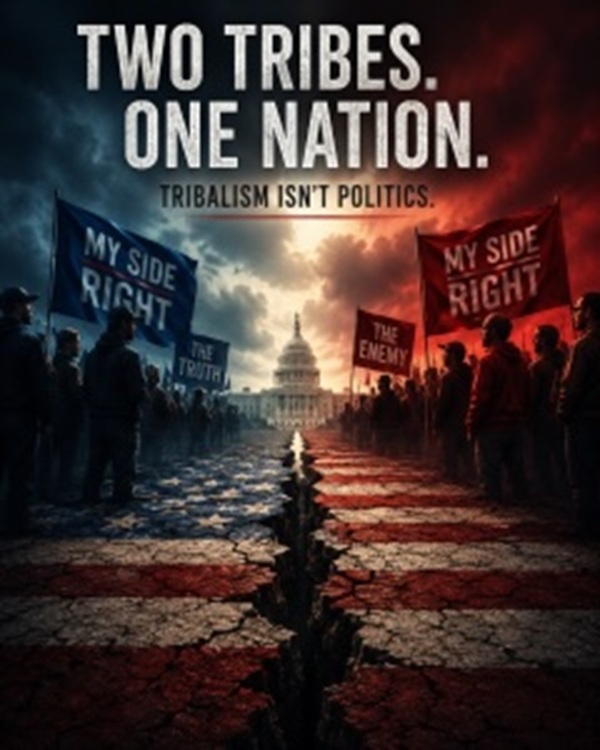
America’s political crisis isn’t that we have two parties. It’s that we’ve become two tribes.
Human beings are wired for tribalism. Long before there were Republicans and Democrats, there were clans, villages, kingdoms, and competing factions. Our ancestors survived because they knew who belonged to the tribe—and who didn’t.
That instinct never disappeared.
Technology simply found a way to monetize it.
Social media didn’t invent tribalism. It industrialized it.
The algorithm doesn’t care whether you’re conservative or progressive. It doesn’t care whether you’re right or wrong. It cares whether you’re angry enough to keep scrolling.
Outrage pays.
Fear pays.
Contempt pays even better.
Unlike the America many of us remember, today’s citizen doesn’t just hear what his neighbors think. He’s bombarded every hour with the most inflammatory examples of what the “other side” supposedly believes. Millions of people are exposed to the loudest voices, the dumbest takes, and the most outrageous behavior because those clips generate clicks.
Nobody goes viral for saying, “My political opponent made a reasonable point.”
Instead, every day becomes another reminder that “those people” are crazy.
Eventually something dangerous happens.
You stop seeing opponents.
You start seeing enemies.
History has shown repeatedly that once people begin viewing political opponents as enemies rather than fellow citizens, the risk of political violence increases. The United States has experienced attacks against elected officials, candidates, judges, activists, and public figures from people with a variety of ideological motivations. Every one of those incidents should concern Americans regardless of party because each chips away at the norms that make peaceful self-government possible.
This isn’t simply a left-wing problem or a right-wing problem.
It’s a tribalism problem.
And tribalism is remarkably effective at convincing otherwise decent people that bad behavior is justified—as long as their side benefits.
We’ve reached the point where many Americans instinctively defend outrageous conduct if it advances their tribe and condemn the exact same conduct when the other tribe does it.
That’s not principle.
That’s fandom.
Somewhere along the way, politics became sports.
The jersey matters more than the Constitution.
Winning matters more than truth.
Humiliating the other team matters more than solving the problem.
Our Founders understood something we’ve forgotten.
A constitutional republic depends upon citizens who share a common identity that rises above political disagreements. They expected fierce debate, but they also assumed Americans would recognize one another as countrymen first and partisans second.
That assumption is under enormous strain today.
If your highest loyalty is to a political tribe, every election becomes existential to your tribe’s existence.
Every compromise becomes betrayal.
Every opponent becomes evil.
And every loss feels intolerable.
No republic can thrive under those conditions for long.
Perhaps that’s why the question isn’t whether America needs more political parties.
It doesn’t.
Five parties can become five tribes just as easily as two parties become two tribes.
The real question is whether Americans still possess anything capable of uniting them above politics.
The Constitution.
The Bill of Rights.
Equal justice.
Freedom of speech.
The peaceful transfer of power.
The belief that your political opponent is still your fellow citizen. a human, an imager of God.
Those ideas once formed the civic glue that held together people who disagreed on nearly everything else.
Without them, we’re simply two tribes sharing the same ZIP code.
And history offers countless examples of how that story ends.
The cure isn’t another party.
It’s remembering we’re still one nation.
If you enjoyed this article, then please REPOST or SHARE with others; encourage them to follow AFNN. If you’d like to become a citizen contributor for AFNN, contact us at managingeditor@afnn.us Help keep us ad-free by donating here.
Substack: American Free News Network Substack
Truth Social: @AFNN_USA
Facebook: https://m.facebook.com/afnnusa
Telegram: https://t.me/joinchat/2_-GAzcXmIRjODNh
Twitter: https://twitter.com/AfnnUsa
GETTR: https://gettr.com/user/AFNN_USA
CloutHub: @AFNN_USA