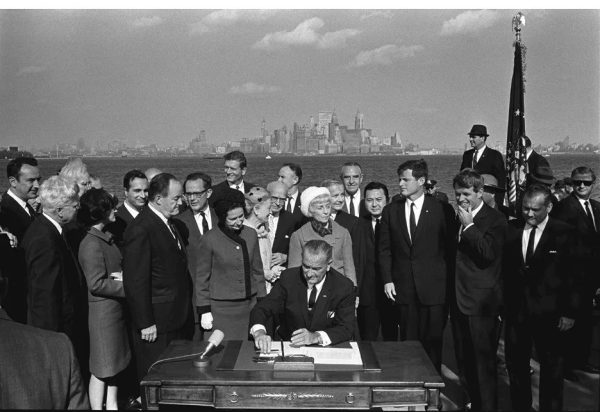
In the Clash Over Immigration, Part 4, we examined the collision of the 1) Hart-Celler Act, 2) cancellation of the Bracero program, 3) birthright citizenship, and 4) powerful factions driven by competing, narrow self-interests. This was the turning point for both legal and illegal immigration that is essentially in place today. As such, it is important to stop and record observations before moving on to the next chapter. While others may connect the dots differently, these are my observations.
Were the Consequences Intended or Unintended?
It is not entirely clear. The visual that comes to mind is a mosh pit of different factions, intent on their own narrow self-interest. Some were driven by the ideological fervor of the civil rights movement certain of their righteousness, oblivious to facts. Many Republicans and Democrats danced for donor dollars. Industry pogoed over the long-term steady flow of cheap labor. Anyone who raised concerns was slammed with the racist tag which silenced opposition.
One would expect the Johnson administration to balance the competing interests for the overall good of the country but unfortunately, they were in the mosh pit with everyone else, starry eyed over future Democratic voters. Chances are the factions were so blinded by their own self-interest, it was impossible for them to analytically consider the cumulative impact 10 years later much less 60.
Was the mosh pit entirely a free for all or did some know exactly what would happen if everyone got what they wanted? And if they knew, did they just watch the chaos or participate in its creation, knowing full well that the conditions were perfect for opportunity laden chaos?
A Symbiotic Relationship Between Industry and Government?
Was there a symbiotic relationship between industry and government – donor dollars in exchange for cheap illegal labor? Considering the inaction between the mosh pit of 1965 and 1986, it appears so. Whether intentional or not, we know with certainty that industries such as farming, meatpacking and construction shifted their business models to accommodate cheap illegal labor. Logic suggests they would not have done this unless they were confident there would be a steady long-term supply of illegal labor.
The historical record clearly points to a better solution – combine more humane versions of Operation Wetback and Bracero with mechanization. Instead, business models dependent on cheap illegal labor have been ingrained for decades. These are difficult and, for some, impossibly expensive to change. When we read today that illegal workers are so essential to industry that any disruption would be catastrophic, it behooves us to reframe it in the above light. A better question is “how can change occur without undermining necessary businesses and damaging the overall economy?”
The Meatpackers
Part 4 only touched on the highlights in the historical record. For more detail, I highly recommend reading the report on the meatpacking industry which shows how an entire industry transitioned from a union to illegal immigration model. Considering the outsize influence labor unions had on the explosion of illegal immigration, the irony cannot be ignored. It is highly unlikely this shift would have occurred if illegal workers were unavailable or were a short-term phenomenon.
Labor Unions
Union behavior deserves serious consideration since it appears deeply contradictory. While the actual motivations are unclear, we should be aware of the patterns. To protect domestic workers, unions supported strict limits on legal immigration in 1924 then reversed course in 1965 to support expansive immigration. They were instrumental in cancellation of Bracero and the illegal immigration that followed, but other than demanding border enforcement in the 1970s were rather silent about the massive increase in illegal workers, worker exploitation and displacement of domestic workers.
No definitive study exists on the domestic worker displacement by legal low-skilled chain migration, but anyone of an age has watched the demographic shift play out across entire industries over the last forty years. Where did the blue collar white and black workers go? Were their wages protected by the immigration policies unions supported? How many dropped out of the workforce entirely? I don’t have clean answers, but the pattern suggests a shift in priorities from the worker to the institution itself. The costs of their decisions landed on the people they were meant to support, the workers.
Great Society Welfare
Did Johnson’s vastly expanded Great Society welfare system turbocharge illegal and legal immigration? While proof is lacking, logic suggests the welfare safety net operated as an incentive to further migration. Before 1996, green card holders plus illegal immigrants with a US born baby could access welfare benefits reasonably soon.
Is this any different than the party machines in the days of Tammany Hall? Whether by design or by the collision of multiple policies, services and benefits were exchanged for reliable political loyalty on a grand scale. If so, taxpayers inadvertently funded Democratic party growth among immigrant communities. I also cannot help but wonder if welfare programs politically camouflaged the plight of displaced workers. In Nicholas Eberstadt’s book “Men Without Work”, he states “between 1965 and 2015, work rates for men twenty and older fell by over 13%.” Is displacement + welfare the reason why?
Emotional Levers
Labor unions and civil rights groups ramped up lobbying efforts to cancel Bracero in the 1950s. Then the AFL-CIO added its institutional weight in the early 1960s. The tipping point occurred when overwhelming public outrage joined the chorus. CBS aired “Harvest of Shame”, the day after Thanksgiving in 1960, an expose of bracero exploitation. Kennedy shifted, Johnson caved, Bracero was cancelled.
This is an important pattern to remember as we go forward. Unions wanted the entire Bracero program canceled and gained public support via stories on methodology. No one made the distinction.
Assimilation
History shows assimilation occurred over three to four generations when immigration paused long enough to allow absorption. The restrictionist policy of the 1924 Immigration Act (Part 1) revealed this pattern.
Since 1965 there has been no equivalent pause in legal or illegal immigration, a trend that accelerated dramatically under the Biden administration. Large immigrant ethnic groups with continuous annual additions show far slower assimilation. Of equal concern, the greater the cultural dissimilarity of the origin country, the slower the assimilation. We must consider that when we combine speed and scale with cultural dissimilarity, we could create permanent cultural gaps rather than generational ones. As unassimilated enclaves grow and gain political power, this could undermine the very culture that attracted these immigrants initially. This is a complex subject we will return to when we reach the present.
Ignoring the Elephant in the Room
During research, I noticed a curious thing. A number of papers discussed the ramifications of Bracero cancellation while omitting any serious discussion of the resultant illegal immigration and everything that followed from it. Industries that restructured around illegal labor. Welfare utilization that climbed sharply. Birthright citizenship converting illegal entry into legal chain migration. All elephants in the room. How could any research effort neglect to mention the advent of significant illegal immigration and its consequences? Did it become taboo? Why?
Necessity is the Mother of Invention
When Bracero was canceled, it appears mechanization was not feasible for many crops. The tomato industry is an exception, but it took notable foresight and time to achieve.
Today, 60 years after the cancellation, the growers remain largely dependent on hand labor, 40-45% of which are illegal workers. Mechanization has exploded across every other industry during that period. Logic suggests mechanization would have occurred decades earlier had the economic incentive existed. Without need, there was no invention.
With stricter border enforcement and the arrival of AI robotics, that trend is changing. A Delaware watermelon grower said out loud what the tomato timeline already proved: “Now even we’re looking at machine harvest of watermelons. Who would have ever thought? Because labor has become such an issue that we have to look at mechanization of everything.“
There is another factor that may have delayed earlier mechanization. What about the workers? If the growers did not ask this question years ago, it is certainly being asked now. Cheap illegal labor didn’t just stall mechanization; it created a human population whose entire livelihood depends on the system.
Mechanization will happen at some point. The illegal workers will either go home, be deported, go on welfare or fill other low-skilled work which could displace other workers. Pick your poison. We documented in Part 4 what happened to the domestic workers who were displaced by illegal workers. The displacement problem is compounding.
The lessons were available to the decision makers of the 1960s whose policies created this situation. Operation Wetback and Bracero proved in the 1950s that border control combined with a legal worker program worked. Those lessons were rejected. The consequences were entirely predictable.
Is it All Bad?
Supporters of high volume, long-term legal and illegal immigration suggest the economic benefits have offset the costs. Overall economic growth, entrepreneurship and certain cultural contributions are appropriately praised. Cheap illegal labor allowed industries to remain more competitive domestically and globally. Illegal immigrants did solve a real labor gap in the 1960s that was ignored then and curiously still dismissed by some today. While supporters say benefits outweigh costs, it is rare to see them outline these costs in detail.
So far, this series has documented substantial costs, briefly summarized below. How can we possibly seek workable solutions today without an honest examination of both benefits and costs? Unfortunately, the prevailing narratives and emotional stories focus on benefits, downplay costs and generally ignore who paid them.
Economic costs to domestic workers
- Wage suppression for low-skilled workers, documented by Borjas
- Displacement of blue-collar workers, disproportionately Black Americans
- 25% decline in employment among low-skilled Black workers (Borjas)
- 10% rise in incarceration rates among low-skilled Black workers (Borjas)
- Male work rate decline of 13% between 1965 and 2015 (Eberstadt)
Taxpayer costs
- Welfare utilization increase – AFDC, Food Stamps, Medicaid trend data
- Public services for settled illegal immigrant families
- Costs compounded through birthright citizenship and chain migration
- Potential cost of managing a large illegal worker population displaced by mechanization
Structural economic costs
- Stalled mechanization creating permanent labor dependency which could impact our competitive edge globally (especially as AI develops)
- Business model lock-in making enforcement now economically catastrophic
- Industries structurally incapable of reform without significant disruption
Political and social costs
- Perpetual manufactured crisis serving donor and electoral interests
- Displacement of domestic workers politically camouflaged by welfare
- Speed and scale of demographic change without assimilation expectation
The accountability gap
- No actor was ever required to account for systemic costs
- Costs consistently landed on those with the least political power
Summary
In summary, from the 1960s till the 1980s, every faction pursued their immediate interest, produced the opposite of their stated intention, and was never required to account for the consequences. The unions got wage suppression instead of wage protection. The civil rights activists got an exploited underclass instead of worker protection. The politicians got demographic transformation instead of demographic preservation. Only industry got what they wanted – cheap labor, any way they could get it.
The fact that critics were silenced, promises and results were diametrically opposed, and there was no subsequent course correction, raises serious red flags. The question to carry forward: is this simply what happens when factions driven by narrow, shortsighted self-interest gain control, or were the seeds being sown for something more deliberate?

Sue Seboda is a photographer, writer, and adventurer exploring nature, travel, and the human experience. From the wild beauty of the Everglades to thoughtful reflections on our changing world, my work invites you to see, think and connect.
DETAILS
Below is information for those who would like a deeper dive. Normally I include references in support of the information above. While I have done that, I have also included differing positions plus my view of same.
The earlier segments of this series provide helpful context to fully appreciate the above.
The Clash Over Immigration, Part 1
The Clash Over Immigration, Part 2
The Clash Over Immigration, Part 3
The Clash Over Immigration, Part 4
The Clash Over Immigration, Part 5-Article Above
The Clash Over Immigration, Part 6
If you enjoyed this article, then please REPOST or SHARE with others; encourage them to follow AFNN. If you’d like to become a citizen contributor for AFNN, contact us at managingeditor@afnn.us Help keep us ad-free by donating here.
Substack: American Free News Network Substack
Truth Social: @AFNN_USA
Facebook: https://m.facebook.com/afnnusa
Telegram: https://t.me/joinchat/2_-GAzcXmIRjODNh
Twitter: https://twitter.com/AfnnUsa
GETTR: https://gettr.com/user/AFNN_USA
CloutHub: @AFNN_USA