
The Bipartisan Pattern of Inaction
Welcome to Part 6. Parts 1 through 5 traced immigration history from the 19th century through the Johnson administration when our modern-day immigration system was established. Johnson canceled the Bracero legal farm worker program spurring substantial illegal immigration. This was done just prior to passage of the 1965 Hart-Celler Act that created chain migration via uncapped family reunification with no skill requirement. Birthright citizenship accelerated the consequences of both. Links for the previous articles are included in the details section and are recommended to gain historical context for what follows.
This installment picks up in the 1970s. Republican President Gerald Ford expressed concern about restricting legal immigration pathways from Mexico in legislation he signed. President Jimmy Carter’s Democratic administration then proposed formal legislation to mitigate growing illegal immigration. While Carter did not publicly connect the crisis to the failed policies of the Democratic Johnson administration, he clearly recognized the scale of the problem and stated it plainly. Congress failed to act on his proposals. We also examine how Carter’s 1980 Refugee Act not only failed to address high levels of illegal immigration but ultimately contributed to them. The roots of current immigration flash points can be found in this legislation.
A bipartisan pattern of tough talk but no action was firmly established in the 1970s.
Let’s dive in.
1976 Immigration and Nationality Act Amendments
The 1965 Hart-Celler Act’s 20,000 per country cap was initially only applicable to the Eastern hemisphere. In 1976, the same cap was applied to Western hemisphere countries. Therefore Mexico, with a century of massive circular labor migration into the US had the same cap as Luxemburg.
Ford’s signing statement included the following: “I am concerned, however, about one aspect of the legislation which has the effect of reducing the legal immigration into this country from Mexico. Currently about 40,000 natives of Mexico legally immigrate to the United States each year. This legislation would cut that number in half. The United States has a very special and historic relationship with our neighbor to the south. In view of this special status we have with the Mexican Government and the Mexican people, I will submit legislation to the Congress in January to increase the immigration quotas for Mexicans desiring to come to the United States.”
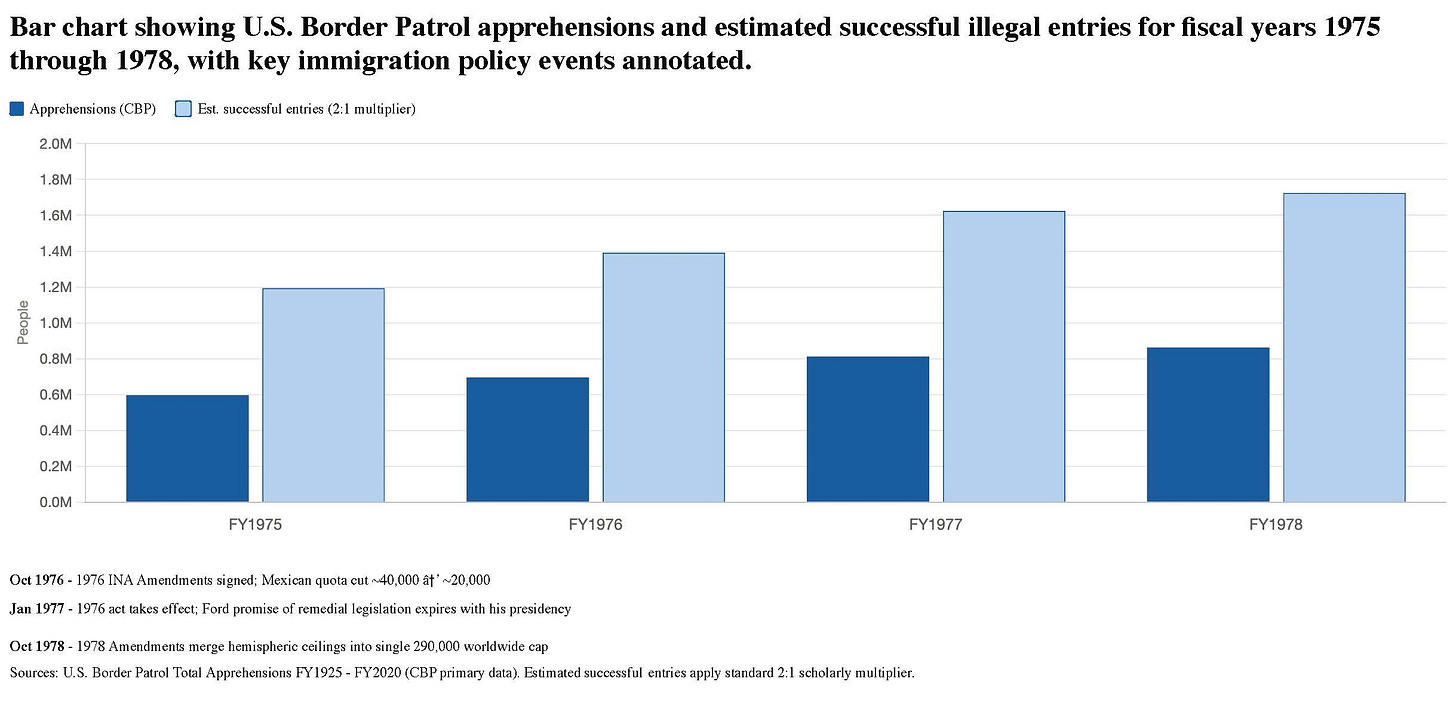
Ford was right to question the wisdom of reducing the level of legal immigration allowed from Mexico because it would likely increase illegal migration. But that ship had already sailed after Johnson canceled the Bracero program. Anyone who reviewed the data knew unequivocally that there were 696,039 border apprehensions the year Ford made the above statement, which meant approximately 1,400,000 people had successfully entered the country undetected. Ford’s worries were dwarfed by a far larger issue that he was unaware of or chose to overlook.
Ford left office a few weeks after the legislation went into effect. His promised legislation was never passed, he did not address the scale and trend of illegal immigration, nonexistent employer sanctions, lax border or interior enforcement. The results were no surprise:
1977 Carter’s Failed Attempt at Employer Sanctions, Border Control, and Amnesty
In 1976 the US Hispanic population was approximately 14.6 million concentrated in the border states or 6.5% of the total US population. Carter was elected in 1976 with 82% of the Hispanic vote with Ford receiving 18%. Carter’s overwhelming support from the Hispanic community helped deliver his narrow win in Texas. This was the last time a Democratic presidential candidate won Texas. In December of 1976 the Democrats formed the Congressional Hispanic Caucus.
Republicans had been actively courting the Hispanic voting bloc since 1967 with the formation of the Republican National Hispanic Assembly. Republican share of the Hispanic vote for Nixon in 1972 was 35%, up from 10% in previous cycles. The decrease to 18% in 1976 was a major setback. The battle for the Hispanic vote was on.
Meanwhile, the flow of illegal immigrants was becoming an unavoidable political liability. Carter stated on August 4, 1977, “Within this last decade, the problem of undocumented aliens or illegal aliens or undocumented workers has become increasingly severe. It now comprises a total of literally millions of people who have come into our country against the law and who are still in the United States. Last year alone, 875,000 undocumented workers were apprehended by the immigration officials, and the estimates are that only one out of three coming into our country are actually caught.
I’m today sending the Congress a message on this complex problem of undocumented aliens. As you may know, we’ve been studying this problem for the last several months, and the Congress has been working on it for the last several years.
I’m proposing actions that would meet four major needs: first of all, to regain greater control over our own borders; secondly, to limit employment opportunities of those who are illegally in our country and who are competing with American workers for scarce jobs; third, the registration and the regulation of the millions of undocumented workers who are already here; and, fourth, improving cooperation with countries from which these undocumented workers are coming into our own Nation.”
During the above speech Carter’s solution for the “registration and regulation” of illegal workers was a three-tiered amnesty program. The key recommendation to “limit employment” opportunities was sanctions against employers who hired illegal workers.
Congress refused to take up the bill due to opposition primarily from industry and Hispanic civil-rights groups who suggested it would lead to discrimination against workers who appeared foreign-born.
The very population involved in mass legal and illegal immigration had become enough of a political force and voting bloc to join forces with the already powerful farm lobbies to derail Carter’s proposal.
Recognizing what the Migration Policy Institute later described as the “no-win politics” of the issue, Ted Kennedy (who had assured the nation in 1965 that Hart Celler would not result in increased immigration and was to be the cosponsor of Carter’s above proposed bill) and other congressional leaders persuaded Carter to shelve legislation in favor of the establishment of the Select Commission on Immigration and Refugee Policy formed in 1978. The commissions offered their conclusions in 1981.
Just as Carter did in 1977, the commission’s 1981 report identified illegal immigration as the primary problem and recommended employer sanctions as necessary to reduce the illegal labor demand. The report became the blueprint for Republican President Reagan’s 1986 Immigration Reform and Control Act (IRCA) also known as Simpson-Mazzoli.
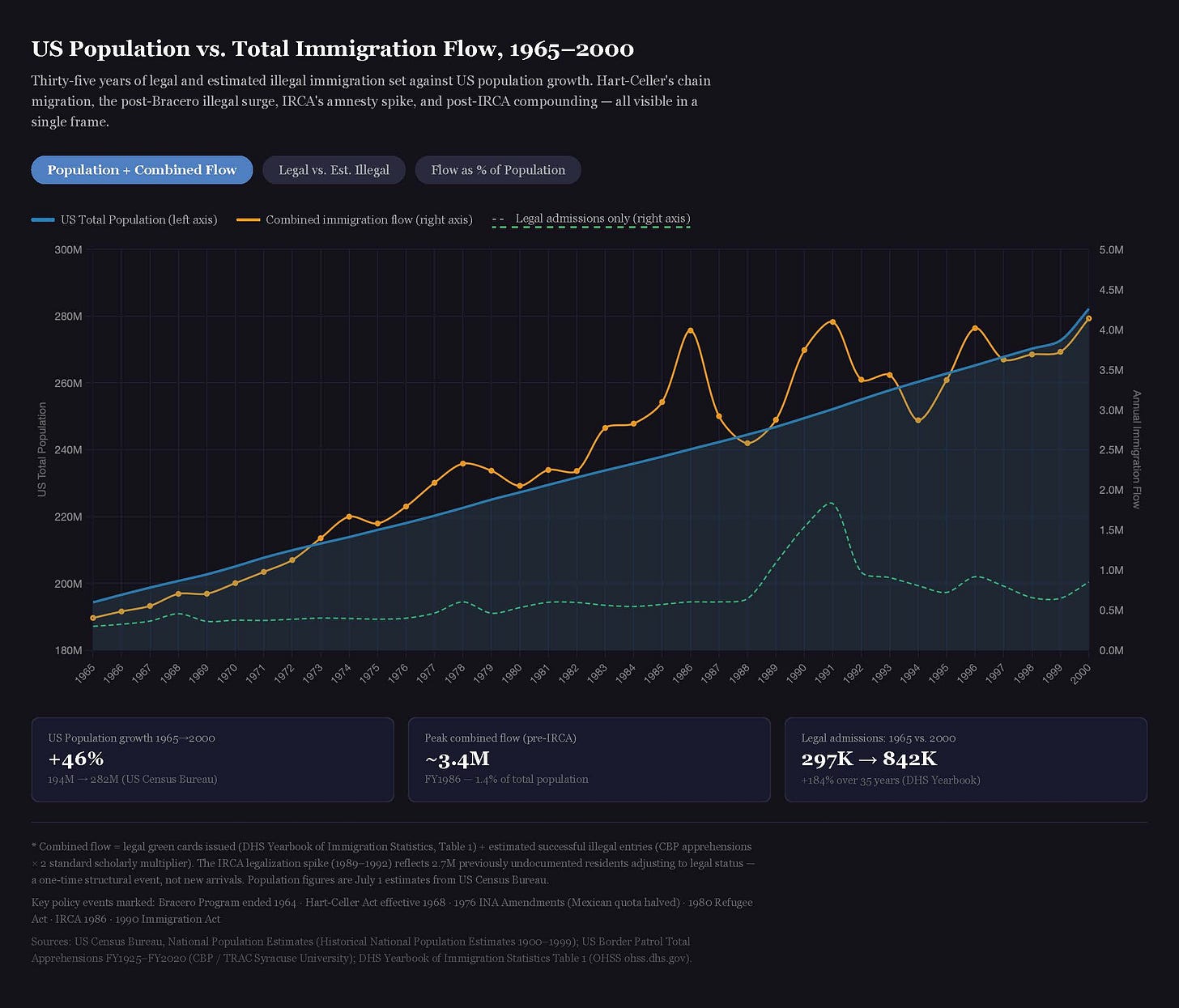
After the problem that Johnson created and Carter identified had compounded for years (illegal workers + birthright citizenship + chain migration), Reagan’s 1986 IRCA was passed with employer sanctions. Unfortunately, they were essentially toothless and the flow of illegal workers continued. We will cover the 1986 IRCA and the continuing pattern of inaction in Part 7.
It is important to understand that Carter’s 1977 proposal was not the first attempt to implement sanctions. Federal efforts to penalize employers of illegal workers date back to 1951 and 1952, when Democratic Senator Paul Douglas of Illinois introduced bills making it a felony for an employer to hire undocumented immigrants. It failed. The House passed employer sanctions bills in 1972 (H.R. 16188, the Rodino Bill) and in 1973 (H.R. 982). Neither received Senate action. In 1976, S.3074 was introduced and extensive hearings were held but the bill died. The 95th Congress in 1977 introduced H.R. 197 and several variations. No committee action was taken and all bills expired at the close of Congress.
Even though employer demand was a documented driver of illegal crossings, and sanctions had been proposed repeatedly across three decades, Congress had never delivered a floor vote in the Senate.
1978: INA Amendments
The 1978 law merged the separate hemispheric ceilings into a single worldwide annual ceiling of 290,000, then reduced to 270,000. The cap excluded immediate relatives of U.S. citizens and imposed a uniform preference system applied to every country in the same way.
The practical effect of “equality of treatment” was to restrict legal pathways from Mexico further.
The Refugee Act of 1980
Carter’s Refugee Act resulted in increased illegal and legal immigration and established the statutory framework for what would become known as “catch and release”. This is significant considering Carter’s clear identification of illegal immigration as a problem for the country. This act also established a funding mechanism that exploded in volume alongside immigration levels.
Because this law is one source of the current clash over immigration, it is essential to understand its provisions. Signed into law March 17, 1980, the stated goal of the Refugee Act was to create an orderly process to settle refugees permanently. The law was triggered by the flood of Vietnamese and Cambodian refugees after the Vietnam war.
Prior to this time refugees were admitted into the country primarily through presidential parole authority on a temporary basis. The 1980 Act created a mechanism for refugees to settle permanently. It also established a concurrent pathway for those seeking asylum to enter the country.
Even though surveys suggested most Americans opposed the bill, it passed the Senate 88-0 and the final vote in the House was 211-195.
Refugees. Once granted refugee status, within one year of arrival, refugees could apply for permanent resident status, and after five years as a permanent resident they could apply for citizenship. The number of refugees was capped at 50,000 for the first three years with the President having the ability to exceed it. Carter did so the first year and 231,700 refugees were admitted. After 1983, the cap was set annually by the President.
Asylum Seekers. During debate, the refugee portion of the bill was discussed extensively while the asylum portion was secondary. INS Acting Commissioner Doris Meissner at a 1981 Senate hearing stated the primary focus of the Refugee Act of 1980 was the overseas refugee admissions process. According to her written testimony, “The asylum process [for persons in or arriving in the United States] was looked upon as a separate and considerably less significant subject.“
The actual written document underlined Doris Meissner’s point. The asylum provisions added by the 1980 Act comprised three sentences of a 17-page document that created a detailed architecture built around the refugee resettlement:
(a) The Attorney General shall establish a procedure for an alien physically present in the United States or at a land border or port of entry, irrespective of such alien’s status, to apply for asylum.
(b) Asylum granted may be terminated if the alien is no longer a refugee due to changed circumstances.
(c) A spouse or child of an alien granted asylum may be granted the same status.
While it took decades for the above to be exploited at scale, one sentence buried in a broader bill, barely discussed, converted apprehension at the border from likely removal to probable release, making an already broken border even less of a barrier. What came to be known as “catch and release” was born.
There was no cap established on the number of people who could apply for asylum. The procedural details were to be determined by the Attorney General, not Congress. Anyone who claimed they were afraid to return to their home country was released into the country to await their asylum hearing. Or if they were in the country illegally (e.g. overstay or cross at an illegal point of entry), the law allowed this individual to apply for asylum any time after entry. In 1996, this open-ended provision was reduced to one year.
Asylum claims are referred to as affirmative or defensive. “Affirmative” refers to those who proactively seek asylum either at the border or at some point after entering the country. “Defensive” refers to those immigrants here illegally who claimed asylum after they were caught and before deportation. A defensive asylum claim would stop the deportation proceedings.
Upon an application for asylum, whether affirmative or defensive, the individual avoids deportation until the asylum hearing (5+ years) and is eligible for a work permit after 180 days, emergency Medicaid, state and local welfare funding in some locales. If they have a child while waiting for their hearing, she or he is an American citizen via birthright citizenship, and the family can then access federal welfare services through the child. Note the law was modified in 1996 to facilitate the cancellation of deportation protections for invalid asylum claims. The first time that law was utilized was in 2025.
Prior to the 1980 Refugee act, asylum was granted on a very limited ad hoc basis and not tabulated. This bill plus subsequent legislation and Supreme Court opinions led to the following volumes in FY2023:
- It was several decades before there was broad usage of the asylum system. Only 68,000 asylum applications were filed in FY2013 out of approximately 414,397apprehensions. Illegal entry that avoided any legal process was easier. Of the approximately 414,397 apprehended at the border that year, plus an unknown number who crossed undetected, only 68,000 used the asylum mechanism. However, the passage of subsequent legislation created specific legal advantages that smugglers learned to exploit and after 2013 word spread through migrant networks. By the Biden administration it was the default mechanism. A companion piece entitled “How a Broken System Got Worse: The Asylum Mechanics Behind Today’s Border Crisis” explains in detail the compounding legislation and how it was leveraged.
- 747,000 asylum applications filed FY2023.
- 851,000 defensive asylum cases were pending as of Q3 FY2023 and over 1,000,000 affirmative cases at US Citizenship and Immigration Services (USCIS) for a combined total of approximately 1.85 million asylum cases pending at the end of FY2023.
- Of the estimated 1.85 million cases pending in FY2023, immigration courts took up only 220,590 cases. Of those, 70% were closed without ever being heard on the merits. Cases were not adjudicated for a variety of reasons including failure to appear, prosecutorial discretion dismissals, withdrawn cases, and administratively closed cases parked indefinitely off the docket. Removal orders were issued for those who failed to appear, however, prior to the Trump administration’s 2025 enforcement surge, actual removals were rare. Those with administratively closed cases retained protection from deportation. Those whose cases were dismissed or withdrawn lost that protection but without removal orders faced no enforcement consequence. The practical outcome across all non-adjudicated categories was effectively the same — people remained in the country regardless of their technical legal status. Once they had a child, they could plug into the legal immigration system plus access federal and state welfare services.
- Of the 30% of cases that were heard (66,177 out of 220,590) 14% were granted asylum and 16% were denied asylum. Those denied asylum received removal orders, but appeal rights could extend for years, and prior to 2025 even final orders were seldom executed against non-criminals. Only 66,177 cases were actually heard out of 1.85 million pending cases.
- In FY2023 there was a 5+ year average for an asylum case to be heard.
One imprecise sentence buried in a 1980 refugee bill led to a system where people could enter the US with provisional legal status for at least five years but more likely indefinitely. Birthright citizenship guaranteed their children citizenship which allowed the family to access federal and state welfare services. Once 21, via the uncapped provisions for immediate family members in Hart-Celler, the child can sponsor their parents, many of whom were never entitled to receive asylum in the first place. Upon receiving their green cards, the parents can sponsor extended relatives under the capped portion of the 1965 bill.
Funding Mechanism. The 1980 Act also established a federal funding mechanism to settle refugees and those who were granted asylum. The Office of Refugee Resettlement (ORR) was created to oversee the domestic resettlement program who then contracted with outside groups, now generally referred to as non-governmental organizations (NGOs) to provide resettlement services. These groups, called VOLAGs or voluntary agencies, were bipartisan and primarily religious organizations of various faiths such as Catholic Charities, Lutheran Immigration and Refugee Service, Church World Service and Episcopal Migration Ministries. They were initially paid $900 per refugee and those granted asylum.
ORR’s budget in FY2023 was $10.9 billion. Note the VOLAGs routinely lobbied for higher refugee ceilings that increased their revenue. As bipartisan religious groups (Catholic, Protestant, Jewish, evangelical) their funding stream became viewed as “untouchable” politically. This is reminiscent of the “no win” politics of enforcing employer sanctions referenced above. Whether intentionally or unintentionally another self-perpetuating system was created that was politically toxic to modify. This changed under the Trump administration when funding to these organizations was removed.
Summary
Ford’s valid concern about reducing legal pathways from Mexico rings hollow considering the far larger levels of illegal immigration which he did not address. Perhaps he silently justified his lack of action by believing that the Mexican migration was and would remain circular, a concept challenged in earlier sections of this series. We will never know for sure.
On the other hand, Carter clearly defined the problem as illegal immigration and offered solutions but neither Carter, his administration nor Congress had the political will to follow through. Advocacy groups representing both the legal and illegal immigrant population had also become powerful enough to block employer sanctions based on claims of discrimination and racism. Stated more bluntly, the people who entered by the millions (illegally and legally), settled and had children, had gained enough political power to protect their current status. Either intentionally or unintentionally, they also ensured the continued flow of illegal workers.
Congress and Carter caved to the pressure from industry and Hispanic advocacy groups over the will of the people. Did anyone ask if the positions of the advocacy groups were a win-win for them and the country? Or only a win for them and the politicians who appeased them?
Instead of a rational conversation about labor demand, advocacy groups, assimilation, the financial and cultural impacts of illegal immigration, mechanization, etc, the Carter administration allowed one sentence to be inserted into the 1980 Refugee Act, with almost no congressional attention, that cracked open an already broken border. Of equal consequence was the shift to “catch and release” with provisional legal status. Did the legislators realize this single sentence would essentially grant provisional legal status to the workers who crossed the border illegally?
When I learned attempts in the 1970s to correct the consequences of Johnson-era legislation had failed, while legislation that essentially protected illegal immigration succeeded, I was incredulous. At some point a fair-minded reader must ask whether this was bumbling negligence or the results were the actual intent. This question becomes more pointed when one fully understands the compounding effects of illegal immigration, birthright citizenship, the Hart-Celler Act and welfare. At what point did failing to close a known open window become indistinguishable from choosing to leave it open?
The pattern is now crystal clear. Contrary to their public statements, legislative policy combined with the deliberate lack of enforcement delivered compounding levels of both legal and illegal immigration. Neither party walked the talk. In Part 7 we will learn how this same pattern continued under Republican President Reagan…
DETAILS
- As we discussed in Part 5 there are many who support 3-4 million immigrants entering the country annually and the benefits these people bring to our communities. Please consider reading the section titled “Is It All Bad” in Part 5which discusses something that has been missing from this debate: a comprehensive cost-benefit analysis.
- Immigration history is long and detailed. I chose to focus on the legislation above because of how it morphed into a big component of the current immigration crisis. 1) Ford’s silence on illegal immigration continued a pattern. 2) Carter’s failed 1977 legislation carried on the same pattern of inaction and was essentially the precursor to Reagan’s 1986 IRCA, another very important milestone in immigration history. 3) The three sentences allowing asylum claims that Carter allowed into the 1980 Refugee Act did not create the current crisis by themselves, but they started something moving that subsequent legislation, court decisions, and deliberate inaction would accelerate for the next four decades.
- For those who would like more detail on the legislation that impacted the rate of asylum requests over the years, please consider this companion piece: “How a Broken System Got Worse: The Asylum Mechanics Behind Today’s Border Crisis”.
- Our legislative immigration policy (or lack thereof), in combination with birthright citizenship and the welfare safety net have brought us to where we are today. After the completion of this series, I will offer my two cents on the recent Supreme Court decisions regarding immigration and birthright citizenship. This series did not include the statutory language Congress codified in 1940 and carried into the INA in 1952 regarding birthright citizenship. This information will be included in my opinion piece on the subject.
- The CBP historical apprehensions charts are worthy of study. Note the rate of illegal immigration was often estimated based on apprehensions. Until about 2000, the scholarly and accepted estimate of successful illegal entrants was twice the number of apprehensions.
- The Migration Policy Institute (MPI) is the source of much of the asylum data above. In the MPI’s Outmatched report: “To improve border management, the United States needs a functioning asylum system so that people eligible for protection can receive it, and those who are ineligible can be quickly removed after fair review of their claim. There is widespread recognition that the asylum system is being used by substantial numbers of people without meritorious protection claims because they have no other means by which to immigrate to the United States for work or the opportunity to join family members. In response, the Biden administration has used its parole authority to significantly expand lawful pathways to channel intending migrants through safe, orderly, and humane processes so that they do not seek to enter without authorization.” MPI is a pro-immigration organization that supported more avenues for immigrants to enter for work or family reunification as a solution to reduce the substantial number of false asylum claims clogging the system.
- This MPI article explains the failure of Carter’s proposed 1977 legislation, the establishment of the commission and their final report spearheaded by Sen. Alan Simpson (R-WY) and Rep. Romano Mazzoli (D-KY): “Their bipartisan leadership led to the passage and signing by President Ronald Reagan of the 1986 Immigration Reform and Control Act (IRCA). As one of the most consequential pieces of immigration legislation in recent history—for the first time recognizing the need to holistically address the existing unauthorized population and immigration enforcement—its origins are a further lasting contribution of the Carter legacy.” As we will discover in Part 7, their enthusiasm for this bill was misguided.
- 7.7.26 As we learned above, judges who administratively close a case before hearing it are essentially granting an illegal alien the ability to stay in the country whether their asylum case was legally valid or not. This article by Center for Immigration Studies discusses the legal challenges to this practice.
The earlier segments of this series provide helpful context to fully appreciate the above.
The Clash Over Immigration, Part 1
The Clash Over Immigration, Part 2
The Clash Over Immigration, Part 3
The Clash Over Immigration, Part 4
The Clash Over Immigration, Part 5
The Clash Over Immigration, Part 6-Article Above
If you enjoyed this article, then please REPOST or SHARE with others; encourage them to follow AFNN. If you’d like to become a citizen contributor for AFNN, contact us at managingeditor@afnn.us Help keep us ad-free by donating here.
Substack: American Free News Network Substack
Truth Social: @AFNN_USA
Facebook: https://m.facebook.com/afnnusa
Telegram: https://t.me/joinchat/2_-GAzcXmIRjODNh
Twitter: https://twitter.com/AfnnUsa
GETTR: https://gettr.com/user/AFNN_USA
CloutHub: @AFNN_USA