Everyone talks about rare earth minerals, lithium, and strategic supply chains. Politicians wring their hands over dependence on foreign nations while pundits debate the next technological revolution.
Meanwhile, one of America’s oldest strategic mineral reserves has been sitting quietly beneath Michigan’s Upper Peninsula for thousands of years.
Not decades.
Not centuries.
Thousands of years.
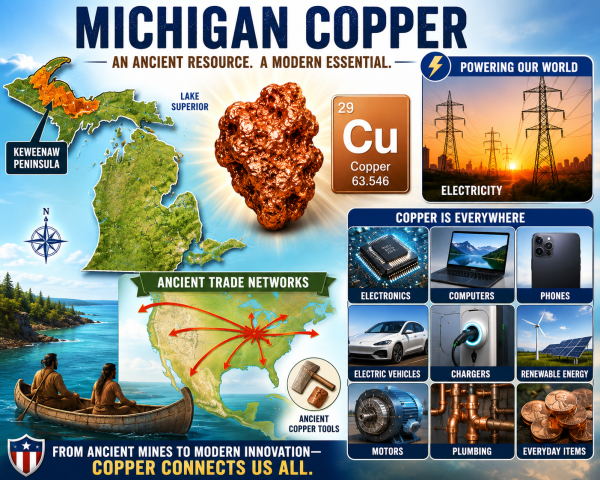
Long before Rome, before Greece reached its height, before the Iron Age, and while much of humanity was still figuring out how to turn rocks into tools, Indigenous miners were already extracting native copper from Michigan’s Keweenaw Peninsula and Isle Royale.
Archaeologists have documented thousands of prehistoric mine pits throughout the Lake Superior copper district. Using stone hammers weighing up to 30 pounds, fire, wooden wedges, and determination, these ancient miners extracted nearly pure native copper from exposed veins. Unlike much of the world, they didn’t need sophisticated furnaces or chemical processing. Nature had already done the refining. They could just start shaping the metal with a heavy rock.
Most of us were never taught this in school.
Instead, history often skips from Egyptian pyramids to Greek philosophers and Roman legions, barely mentioning that North America possessed one of the world’s richest native copper deposits—and that people were mining it roughly 6,000 years ago.
Copper wasn’t just another shiny rock.
It launched civilization.
Historians refer to this period as the Copper Age, or Chalcolithic. It marked humanity’s first successful transition from stone to metal. Eventually, craftsmen discovered that mixing copper with tin created bronze, ushering in the Bronze Age and changing warfare, agriculture, engineering, and commerce forever.
In other words, there is no Bronze Age without copper.
The Bronze Age wasn’t a miracle. It was the next chapter in a story that copper had already begun.
Michigan happened to possess one of the greatest chapters of that story.
The evidence suggests prehistoric trade networks stretched hundreds—and perhaps more than a thousand—miles across North America. Copper from the Lake Superior region has been identified in artifacts found far from its source. Long before interstate highways or railroads, valuable materials were already changing hands across vast distances.
Archaeologists have identified Great Lakes copper artifacts from Michigan as far south as the Gulf Coast, west into the Great Plains, east through the Ohio Valley and Appalachians, and north into Ontario—evidence of trade networks spanning well over 1,000 miles during the Archaic period. While not every artifact has been chemically sourced, the distribution strongly suggests that copper from the Keweenaw Peninsula and Isle Royale moved across much of eastern North America thousands of years before European contact.
Some researchers have proposed that Michigan’s native copper may have reached the Mediterranean during the Bronze Age, citing the large amount of prehistoric copper mined, ancient copper-carrying shipwrecks, and debated chemical similarities between some artifacts.
Our ancestors understood something we’ve begun to forget.
Strategic resources matter.
Fast-forward to the nineteenth century.
The Keweenaw Peninsula became one of the richest copper-producing regions on Earth. Mines like Quincy and Calumet & Hecla helped wire America for electricity. Telegraphs. Telephones. Electric motors. Generators. Power grids. Industrial machinery.
Modern America quite literally ran on Michigan copper.
Then came the inevitable headline: “The mines are exhausted.”
Not exactly.
The easy copper was exhausted.
That’s an important difference.
As mining chased deposits deeper underground, costs rose. Meanwhile, enormous open-pit mines in Arizona, Utah, Chile, and Peru produced copper more cheaply. Economics—not geology—closed most of Michigan’s mines.
Today, Isle Royale is protected as a national park. The Keweenaw still holds significant copper resources, much of which remains in the ground because extracting it isn’t currently economical or is restricted by policy.
Some see that as lost opportunity.
I see something else.
A strategic reserve.
Every electric vehicle requires substantially more copper than a conventional automobile. AI data centers consume staggering amounts of electrical infrastructure. Wind turbines, solar farms, transformers, electric motors, precision-guided weapons, radar systems, naval vessels, satellites, and virtually every circuit board on your desk depend upon copper.
There is no modern digital economy without it.
You can replace steel.
You can replace aluminum.
You cannot simply wish copper away.
Here’s the irony.
For years we’ve happily imported strategic minerals while congratulating ourselves for “saving the environment.” Yet the result is often that the environmental footprint simply moves overseas, while America becomes increasingly dependent on foreign supply chains.
Meanwhile, beneath the forests of Michigan’s Upper Peninsula lies a resource that has served humanity for six millennia.
Perhaps leaving much of it untouched isn’t entirely a mistake.
Maybe future generations—with cleaner mining technology, better environmental safeguards, and greater strategic necessity—will appreciate that we didn’t extract every last pound simply because we could.
Sometimes conservation isn’t just about protecting forests.
Sometimes it’s about protecting options.
Our ancestors recognized copper’s value when mammoths had only recently disappeared from North America.
Nineteenth-century miners recognized its value when they electrified a nation.
Twenty-first-century engineers recognize its value every time they design another electric vehicle, smartphone, data center, or weapons system.
Michigan’s ancient copper isn’t merely history.
It is one of America’s oldest strategic assets—one we’ve been relying on for over 6,000 years and may someday be grateful we didn’t completely expend.
Because civilizations rise on ideas.
But they run on materials.
If you enjoyed this article, then please REPOST or SHARE with others; encourage them to follow AFNN. If you’d like to become a citizen contributor for AFNN, contact us at managingeditor@afnn.us Help keep us ad-free by donating here.
Substack: American Free News Network Substack
Truth Social: @AFNN_USA
Facebook: https://m.facebook.com/afnnusa
Telegram: https://t.me/joinchat/2_-GAzcXmIRjODNh
Twitter: https://twitter.com/AfnnUsa
GETTR: https://gettr.com/user/AFNN_USA
CloutHub: @AFNN_USA