Walk through any bookstore and you’ll find shelves overflowing with books promising the secret to happiness. Scroll social media and you’ll discover thousands of self-appointed gurus explaining how to manifest wealth, optimize your mindset, or “live your best life.” Every generation invents a new philosophy, packages it in fresh marketing, and declares it revolutionary.
Then, a few years later, another bestseller replaces it.
Yet there is one book that stubbornly refuses to disappear.
The Bible.
Not because governments preserved it. Quite the opposite. Empires tried to destroy it. Kings outlawed it. Dictators confiscated it. Skeptics mocked it. Intellectuals predicted its demise. Meanwhile, civilizations rose and fell like waves against a cliff, while this ancient collection of writings simply remained.
Why?
Perhaps because it is asking the questions every human being eventually asks.
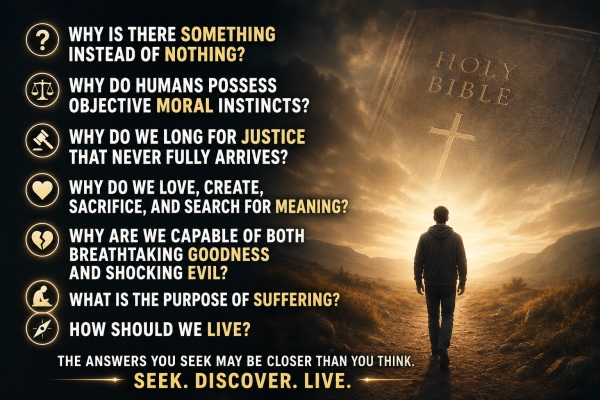
Why is there something instead of nothing?
Science is extraordinary at explaining how the universe behaves. It tells us about gravity, stars, DNA, quantum mechanics, and black holes. But it doesn’t answer why anything exists at all. Why is there a universe instead of absolute nothingness? Why does reality exist?
The Bible begins by answering the question before asking another.
“In the beginning…”
Not an accident.
Not randomness.
An intentional Creator.
Why do humans possess objective moral instincts?
Nearly every culture agrees that courage is admirable, betrayal is contemptible, and murder is wrong.
But why?
If morality is merely a social invention, then slavery wasn’t objectively evil—it simply became unpopular. The Holocaust wasn’t wrong—it merely violated someone’s opinion.
Most people instinctively reject that conclusion.
The Bible explains why.
Justice isn’t invented by humanity.
It reflects the character of God.
Why do we long for justice that never seems to arrive?
History is littered with tyrants who died comfortably in bed while their victims were buried anonymously.
Every one of us has experienced the frustration of watching evil prosper.
The Bible doesn’t pretend justice always arrives on our timetable. Instead, it makes the audacious claim that history itself is moving toward an ultimate accounting where every injustice is finally addressed.
Without that hope, justice becomes little more than wishful thinking.
Why do we love…create…sacrifice…and search for meaning?
No animal writes symphonies.
No chimp paints the Sistine Chapel.
No whale composes poetry wondering about eternity.
Humans alone obsess over purpose.
We build cathedrals.
We risk our lives for strangers.
We create art that outlives us.
We dream about immortality while knowing we will die.
The Bible says this isn’t an evolutionary glitch.
It’s evidence that we were created for something beyond survival.
Why are we capable of breathtaking goodness…and shocking evil?
Every generation believes education, technology, or politics will finally fix humanity.
Then another war begins.
Another genocide unfolds.
Another corruption scandal erupts.
The problem has never been a shortage of information.
It’s the human heart.
The Bible diagnosed this thousands of years before modern psychology existed. Humanity isn’t simply ignorant.
We’re broken.
That’s an uncomfortable diagnosis—but history has repeatedly confirmed it.
What is the purpose of suffering?
Modern culture promises comfort.
The Bible promises purpose.
That’s a profound difference.
Everyone suffers.
Disease.
Loss.
Failure.
Death.
The question isn’t whether suffering comes.
The question is whether it means anything.
Scripture insists suffering can refine character, expose idols, strengthen faith, deepen compassion, and redirect our lives toward what truly matters.
That doesn’t make pain enjoyable.
It makes pain meaningful.
How should we live?
This may be the most important question of all.
Our culture answers:
“Follow your heart.”
History offers a different warning.
Human hearts have justified every atrocity imaginable.
The Bible instead points toward something harder—and far more enduring.
Seek truth.
Practice humility.
Love sacrificially.
Forgive.
Pursue justice.
Serve others.
Fear God.
These principles have guided saints, scholars, scientists, soldiers, farmers, kings, and ordinary families for thousands of years.
They don’t promise an easy life.
They promise a meaningful one.
Here’s the irony.
Most critics of the Bible spend their lives arguing with its answers.
Few spend much time wrestling with its questions.
Maybe that’s why this ancient book still outsells every modern philosophy. It doesn’t begin with slogans or political tribes. It begins by confronting the deepest mysteries of existence—and then invites the reader to examine its claims for themselves.
You don’t have to accept every conclusion the Bible reaches.
But if you’re intellectually honest, you owe it to yourself to engage with the questions it asks.
Because before deciding whether the Bible is true, you first have to answer a more uncomfortable question:
If not this…what better explanation accounts for reality, morality, purpose, suffering, and the human condition?
For over three thousand years, billions of people have concluded they found those answers between the covers of a single book.
Perhaps that’s why, despite every attempt to replace it, ridicule it, censor it, or bury it…
People keep opening it.
If you enjoyed this article, then please REPOST or SHARE with others; encourage them to follow AFNN. If you’d like to become a citizen contributor for AFNN, contact us at managingeditor@afnn.us Help keep us ad-free by donating here.
Substack: American Free News Network Substack
Truth Social: @AFNN_USA
Facebook: https://m.facebook.com/afnnusa
Telegram: https://t.me/joinchat/2_-GAzcXmIRjODNh
Twitter: https://twitter.com/AfnnUsa
GETTR: https://gettr.com/user/AFNN_USA
CloutHub: @AFNN_USA