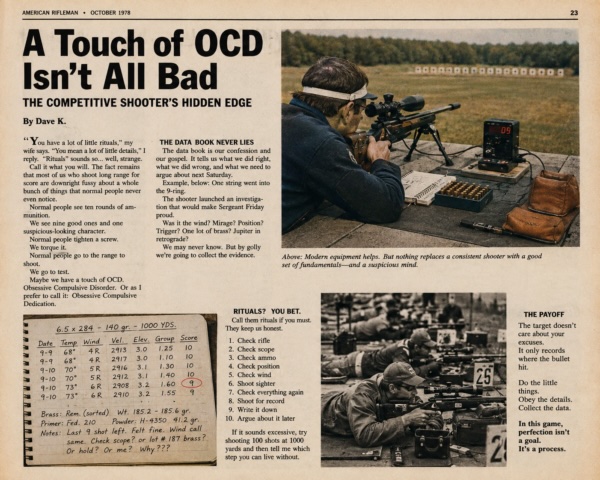
There is something psychologically wrong with long-range competitive marksmen.
I don’t mean wrong wrong. Nobody needs to call the authorities. But spend enough time on a 1000-yard firing line and you’ll eventually realize you’ve assembled a remarkable collection of otherwise functional adults who are deeply concerned about things normal human beings cannot even see.
Welcome to Compulsive Precision Disorder.
CPD isn’t a real psychiatric diagnosis, obviously. It’s the unofficial condition afflicting people who voluntarily spend entire weekends trying to make several pieces of metal, brass, copper, lead, glass, and gunpowder perform exactly the same way over and over again.
The symptoms usually begin innocently.
You buy a rifle.
Then you discover your ammunition shoots 1.2 MOA.
This becomes unacceptable.
Soon you’re weighing powder charges to +/-0.010 of a grain. Then you’re sorting bullets. Then brass. Then you’re measuring cartridge overall length with a comparator because apparently measuring it the normal way is something peasants do.
Eventually you’re sitting at the kitchen table staring suspiciously at ten cartridges that appear absolutely identical to every other human being on Earth.
But you know better.
One of those little bastards is different. It’s gonna $%W$ my score!!!
Competitive shooting rewards precisely the personality traits that make ordinary people wonder whether you’ve perhaps taken the hobby too seriously.
Repetition? Excellent.
Perfectionism? Even better.
Attention to microscopic details? That’s practically a prerequisite.
A normal person fires a shot into the 9-ring and thinks:
“That’s pretty good.”
A competitive marksman fires a 9 and immediately launches a congressional investigation.
Was it wind?
Position?
Trigger control?
Cheek pressure?
Mirage?
Did the bipod load change?
Did the temperature increase three degrees?
Was cartridge number 17 from that suspicious batch of brass?
Could Jupiter’s gravitational influence have changed since the previous shot?
There must be an explanation because accepting “I screwed up” should only occur after every other scientific possibility has been eliminated.
Then there is the equipment ritual.
Scope checked.
Ammo checked.
Action checked.
Torque checked.
Position checked.
Wind checked.
Scope checked again.
Why did we check the scope twice?
Because between the first and second check something theoretically could have happened.
That’s called risk management.
The truly afflicted eventually discover chronographs.
This is where the condition becomes serious.
Suddenly ammunition doesn’t merely shoot well. It has it’s own data.
Average velocity.
Extreme spread.
Standard deviation.
Temperature.
Round count.
Vertical dispersion.
Soon two grown men are standing behind the firing line discussing whether an SD of 8.7 is really acceptable when Dave got 6.4 last Tuesday.
Nobody outside competitive shooting would voluntarily participate in this conversation.
Yet there is a reason all this insanity works.
Precision rifle competition is fundamentally the art of eliminating variables.
The rifle needs to return to the same place. The ammunition needs to behave the same way. The shooter’s body needs to behave the same way. The trigger needs to break the same way.
Again.
Again.
Again.
Again.
The sport rewards the person capable of performing something incredibly repetitive with extraordinary consistency while noticing tiny deviations before they become large ones.
In almost any other environment, obsessing over three millimeters of elbow placement might seem peculiar.
At 600 yards, three millimeters can become points.
That’s the superpower.
Competitive marksmen aren’t necessarily obsessed with perfection because they’re crazy.
They’re obsessed with perfection because the target keeps receipts.
You can tell yourself that shot was good.
The electronic target does not care.
9.9
You can explain that the wind changed.
Still a 9.
You can mention that your rifle normally shoots half-MOA.
Wonderful. Who Cares? Still a 9.
Perhaps that’s why competitive shooting attracts engineers, machinists, soldiers, scientists, mechanics, reloaders, tinkerers, and the particular species of human who cannot walk past something slightly crooked without wanting to straighten it.
The game converts compulsive attention to detail into points.
So maybe long-range competitive marksmen aren’t abnormal after all.
Maybe we’ve simply discovered the one environment where repeatedly measuring things, checking things, adjusting things, recording things, and becoming irrationally irritated by deviations measured in thousandths of an inch is considered completely reasonable behavior.
Every competitive marksman has a little Compulsive Precision Disorder.
We weigh powder to the kernel, measure groups with calipers, torque screws to inch-pounds, record the weather, analyze statistics, and perform essentially the same ritual before every shot.
In normal society, this behavior might raise questions.
In long range marksmanship, we call it fundamentals.
If you enjoyed this article, then please REPOST or SHARE with others; encourage them to follow AFNN. If you’d like to become a citizen contributor for AFNN, contact us at managingeditor@afnn.us Help keep us ad-free by donating here.
Substack: American Free News Network Substack
Truth Social: @AFNN_USA
Facebook: https://m.facebook.com/afnnusa
Telegram: https://t.me/joinchat/2_-GAzcXmIRjODNh
Twitter: https://twitter.com/AfnnUsa
GETTR: https://gettr.com/user/AFNN_USA
CloutHub: @AFNN_USA