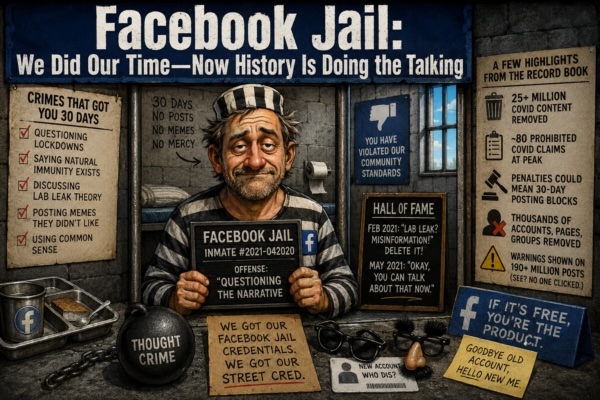
Some of us didn’t just survive COVID.
We did time.
Facebook time.
Thirty days in the digital hoosegow. No posting. No commenting. No sharing that meme your buddy sent you at 2:00 in the morning. You’d open Facebook, stare through the bars, and discover that apparently you had become too dangerous to society to comment on your cousin’s picture of a bass.
We earned our Facebook Jail credentials.
We got our street cred.
Some people collected multiple sentences. Repeat offenders. Hardened criminals. Digital recidivists.
Our offense?
Sometimes misinformation. Sometimes a joke. Sometimes questioning whatever the Officially Approved Truth™ happened to be that particular Tuesday.
And Facebook wasn’t screwing around. Meta says it ultimately removed more than 25 million pieces of COVID-related content, maintained roughly 80 prohibited COVID claims, and operated a penalty system that could escalate to lengthy restrictions, including 30-day posting blocks.
Some of us eventually developed prison-escape techniques.
New account.
Different email.
Different profile picture.
Hello, fellow Facebook users. I am definitely a completely different Deighv.
Then came the humiliating part: rebuilding the friend list.
Hey Bob, it’s me again.
Facebook killed the other me.
Please accept my friend request.
Again.
You became the digital equivalent of a fugitive sneaking back across the border wearing sunglasses and a fake mustache.
And then Facebook committed the cardinal sin of any business:
It started making the product miserable for the product.
Because we should never forget one of the great rules of the internet:
If the service is free, you’re probably the product.
Facebook wasn’t operating a charity so Aunt Linda could post pictures of her grandkids. Meta’s business depended overwhelmingly on advertising. Our attention, engagement, interests and behavior helped make the machine valuable to advertisers.
And eventually Facebook started reconsidering how aggressively that machine should punish its products.
In 2023, Meta announced changes to Facebook’s penalty system, explicitly acknowledging that it didn’t always get moderation decisions right and that the old system could impose lengthy restrictions quickly.
Well, welcome aboard.
Some of us had figured that out somewhere around Day 17 of our sentence.
But the greatest exhibit in the Facebook Jail Hall of Fame remains COVID’s origin.
In February 2021, Facebook specifically prohibited claims that COVID-19 was “man-made or manufactured.”
That was misinformation.
Dangerous.
Delete it.
Then May arrived.
Facebook announced that because investigations into COVID’s origins were continuing, it would no longer remove the claim that COVID-19 was man-made or manufactured.
Ladies and gentlemen, behold the fastest scientific rehabilitation program in history.
FEBRUARY 2021:
YOU HAVE VIOLATED OUR COMMUNITY STANDARDS.
MAY 2021:
Upon further review, carry on.
Apparently science advanced approximately 30 Facebook Jail days at a time.
Now, let’s be fair. There was spectacular stupidity circulating during COVID. The internet produced enough nonsense to power Las Vegas.
But that’s exactly the point.
Facebook wasn’t merely filtering obvious lunacy. It constructed an enormous system for deciding which claims involving a rapidly developing scientific event were acceptable for billions of people to discuss.
And sometimes the official answer changed.
That’s how science works.
The uncomfortable part is what happened to people who asked certain questions before the answer changed.
Their sentence didn’t magically disappear.
Facebook didn’t send them a certificate:
Congratulations! The question for which we punished you is now permissible. Please accept 500 complimentary FarmVille coins for the inconvenience.
Nothing.
The Ministry of Truth simply updated the bulletin board.
And eventually even the extraordinary COVID censorship apparatus began winding down. Meta later asked its Oversight Board whether those special rules should continue, explaining that COVID had caused the company to create an unprecedented policy under which entire categories of claims could be removed.
Which brings us to the part that isn’t funny.
Who decides what the next Official Truth™ is?
And more importantly:
Who watches the people deciding it?
Facebook is a private company. It has every right to establish rules for its platform within the law. Advertisers also have every right to buy advertising.
But enormous communications platforms wield enormous power over what people encounter, what gets amplified, what gets buried and sometimes what gets removed.
That power deserves scrutiny.
And we should distinguish the documented concern from the accusation we can’t prove.
We shouldn’t claim that Facebook simply changes “the truth” because a political candidate slips Zuckerberg a sack of money. Political advertising and influence are legitimate subjects for scrutiny, but that’s different from evidence that a candidate literally purchased Facebook’s definition of truth.
The stronger argument doesn’t need that allegation.
The power itself is the problem.
What prevents tomorrow’s moderation policy from being influenced by political pressure?
Government pressure?
Corporate pressure?
Advertiser pressure?
Institutional groupthink?
Fear of bad publicity?
Or simply another room full of extremely confident people who turn out six months later to have been extremely confidently wrong?
That’s the lesson worth carrying forward from COVID.
Don’t replace misinformation with censorship.
Replace bad information with better information.
Show the evidence.
Show the sources.
Argue.
Mock us if we’re wrong.
Fact-check us.
Put the competing evidence right underneath our stupid meme.
But be extraordinarily cautious about building a machine capable of deciding which questions billions of human beings are permitted to ask.
Because those of us who earned our Facebook Jail street cred learned something valuable.
Facebook eventually gives you your account back.
It doesn’t give you those 30 days back.
And never forget:
When the service is free, you’re the product.
A smart product should occasionally ask who’s reading the owner’s manual.
If you enjoyed this article, then please REPOST or SHARE with others; encourage them to follow AFNN. If you’d like to become a citizen contributor for AFNN, contact us at managingeditor@afnn.us Help keep us ad-free by donating here.
_________________________________
Substack: American Free News Network Substack
Truth Social: @AFNN_USA
Facebook: https://m.facebook.com/afnnusa
Telegram: https://t.me/joinchat/2_-GAzcXmIRjODNh
Twitter: https://twitter.com/AfnnUsa
GETTR: https://gettr.com/user/AFNN_USA
CloutHub: @AFNN_USA