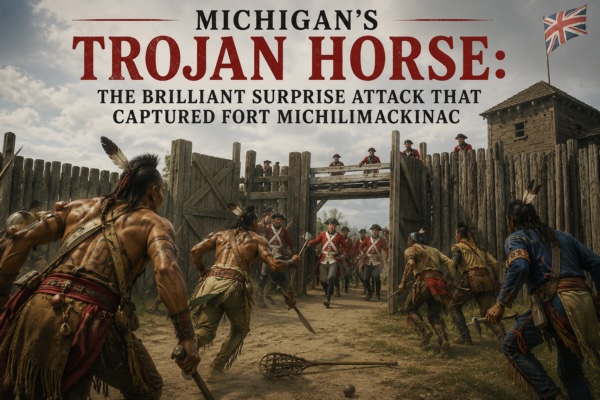
If you think Michigan history is mostly lumber camps, automobiles, and guys arguing about whether the Upper Peninsula belongs to Wisconsin, allow me to introduce you to June 2, 1763—the day roughly 400 Ojibwe warriors demonstrated that deception, surprise, and an enemy commander’s refusal to believe his own intelligence reports can be a devastating combination.
The battlefield was Fort Michilimackinac, located at present-day Mackinaw City—not Mackinac Island. The French had built the post and turned it into one of the great trading crossroads of the upper Great Lakes. Then France lost the French and Indian War, the British arrived in 1761, raised their flag, and apparently assumed everyone would simply adjust to the new management.
Everyone did not adjust to the new management.
The British inherited French forts without necessarily inheriting the relationships the French had spent decades building with the Native nations. British policies changed, tensions grew, and across the Great Lakes and Ohio country resistance exploded in what we commonly call Pontiac’s War. Michilimackinac was sitting right in the middle of it.
And here comes the part every retired military officer will recognize.
The commander was warned.
Alexander Henry, the British fur trader later wrote that trader Laurent Ducharme explicitly warned Captain George Etherington that a plot existed to destroy the garrison and the English in the upper country. Etherington didn’t merely disregard the intelligence. According to Henry, he became irritated by it and threatened to send the next person bringing him such a story to Detroit as a prisoner.
Henry himself estimated that about 400 Native warriors were gathered around the fort and also warned Etherington.
Etherington essentially laughed it off.
Somewhere, 263 years later, every intelligence officer who has ever briefed a commander who already knew what he wanted the answer to be just felt a disturbance in the Force.
The Ojibwe now had a problem. Fort Michilimackinac was surrounded by wooden palisades and occupied by armed British soldiers. Charging the gate would be a terrible idea.
So they didn’t charge the gate.
They scheduled a sporting event.
On June 2, Ojibwe and Sauk players gathered outside Michilimackinac for a game of baggatiway, an Indigenous ball game related to what we now call lacrosse. The game was reportedly staged in honor of King George III’s birthday.
That is a particularly magnificent piece of eighteenth-century misdirection.
The British came out to watch. Captain Etherington and Lieutenant William Leslye were themselves outside the fort observing the game. The gates were open. The garrison was relaxed. Everything looked normal.
Meanwhile, weapons had been concealed nearby.
The game became increasingly energetic. Players raced back and forth. Then the ball went toward the fort.
Players naturally went after it.
Except this wasn’t just a ball game anymore.
Weapons appeared.
Warriors surged through the entrance.
And Fort Michilimackinac went from peaceful sporting event to close-quarters combat in approximately the amount of time it takes someone to say:
“Wait…where did he get that tomahawk?”
The British never had the opportunity to organize a proper defense.
Captain Etherington—the man who had dismissed the warnings—was captured almost immediately.
Within minutes, 15 British soldiers were dead and Fort Michilimackinac was in Ojibwe hands. Mackinac State Historic Parks describes the operation quite accurately as a “skillfully executed surprise attack.”
Think about what just happened militarily.
The Ojibwe didn’t possess artillery. They didn’t breach the palisade. They didn’t conduct a prolonged siege. They didn’t have to defeat the British defenses because they convinced the British not to use them.
That is beautiful tactical simplicity.
Instead of attacking the fort, they attacked the assumptions of the people inside it.
The British believed the gathering was peaceful.
They believed the game was a game.
They believed the fort was secure.
They believed the intelligence reports were exaggerated.
And every one of those assumptions became a weapon pointed back at them.
Then there’s Alexander Henry.
Henry wasn’t standing around enjoying the game when everything erupted. He was inside the fort writing letters when he heard the commotion. Suddenly the trading post outside his door had turned into a battlefield.
Imagine that moment.
One minute you’re doing eighteenth-century paperwork.
The next minute people are running past your window with tomahawks.
Henry fled and found refuge in the home of French-Canadian trader Charles Langlade. Eventually he was discovered and taken prisoner.
And now the story takes another remarkable turn.
Before the attack, an Ojibwe man named Wawatam had formed a relationship with Henry and adopted him as a brother. Henry later described Wawatam arriving with his family and gifts and explaining that he had dreamed of adopting an Englishman into his family.
That relationship may have saved Henry’s life.
Wawatam intervened for him, and Henry eventually lived among the Ojibwe. Instead of becoming another forgotten casualty of the attack, he survived to record what happened and leave us one of the most fascinating firsthand accounts of life in the eighteenth-century Great Lakes.
The consequences reached far beyond one wooden fort in northern Michigan. Michilimackinac’s capture was part of a much larger Indigenous resistance against British expansion following the collapse of French power. The British eventually returned in 1764, and Michilimackinac again became a major center of the Great Lakes fur trade.
But the lesson of June 2, 1763, hasn’t aged a day.
Never underestimate somebody defending his homeland.
Never assume technological superiority guarantees security.
Never mistake familiarity for safety.
And when several people independently tell you that 400 armed men outside your fort might be planning something, perhaps don’t threaten to arrest the next guy who mentions it.
Most importantly, Fort Michilimackinac reminds us that Michigan wasn’t some quiet wilderness waiting for history to arrive.
History was already here.
Empires collided here. Native nations fought for sovereignty here. French traders, British soldiers, missionaries, voyageurs and Native families moved through the Straits because this narrow piece of water was strategically important long before anyone thought about building a bridge across it.
And on one June afternoon in 1763, one of the most important forts in the upper Great Lakes was captured without artillery, without a siege, and without smashing down the gate.
The attackers simply convinced the defenders to leave it open.
Then they brought the ball inside.
And that is some seriously cool Michigan history.
If you enjoyed this article, then please REPOST or SHARE with others; encourage them to follow AFNN. If you’d like to become a citizen contributor for AFNN, contact us at managingeditor@afnn.us Help keep us ad-free by donating here.
_________________________________
Substack: American Free News Network Substack
Truth Social: @AFNN_USA
Facebook: https://m.facebook.com/afnnusa
Telegram: https://t.me/joinchat/2_-GAzcXmIRjODNh
Twitter: https://twitter.com/AfnnUsa
GETTR: https://gettr.com/user/AFNN_USA
CloutHub: @AFNN_USA