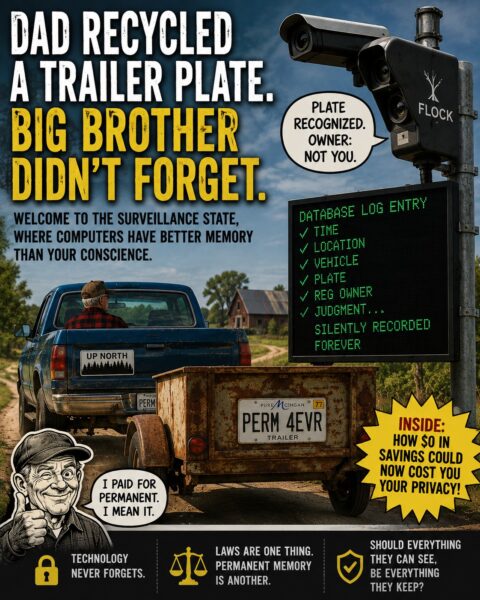
My dad came from a generation that regarded the words “permanent trailer plate” as something approaching a sacred covenant between a man and his government.
Permanent.
As in forever.
As in, “I already paid you people.”
Now, hypothetically speaking, suppose Dad eventually got another little utility trailer. Maybe the first trailer rusted into the Michigan soil. Maybe its wheel bearings achieved escape velocity somewhere outside Hillman. Maybe it simply returned to the earth from whence all northern Michigan utility trailers eventually came.
Dad still had a perfectly good license plate.
You can probably see where this is going.
Was moving that plate to another trailer technically the correct procedure?
Probably not.
Would Dad have regarded purchasing another “permanent” plate as evidence that the English language had ceased to have meaning?
Absolutely.
This wasn’t necessarily the criminal mastermind at work. There was no dimly lit warehouse, burner phone or international trailer-registration cartel.
There was just a working-class guy looking at a perfectly serviceable piece of government-issued aluminum he’d already paid for and thinking:
That’ll work.
Welcome to 2026.
Today, Dad’s little act of rural fiscal conservation has potentially entered the age of automated license-plate readers, interconnected databases and computers capable of remembering things human beings never bothered remembering.
A Flock camera can photograph license plates, record when and where vehicles pass and characterize vehicles. The camera itself isn’t necessarily sitting there with your DMV file and family tree. But law enforcement has access to other authorized databases containing vehicle-registration information.
And that’s where the philosophical question gets interesting.
Imagine a truck pulling a trailer past a camera. There are potentially two license plates, two registration records and one physical combination traveling down the highway.
Truck belongs to Smith.
Trailer plate belongs to Jones.
Or the registration comes back to a trailer that doesn’t seem to correspond with what is rolling behind the truck.
A human deputy sitting beside the road in 1987 might never have noticed. He probably wouldn’t have cared unless there was some reason to stop the vehicle in the first place.
The computer doesn’t get bored.
It doesn’t look away.
It doesn’t forget.
And increasingly, that is the privacy question Americans need to be discussing.
This isn’t really about whether Dad should have gone to the Secretary of State and spent the money to register the replacement trailer correctly. He should have.
The interesting question is whether every minor violation that was once practically invisible should become permanently detectable simply because technology has made detection cheap.
There is a profound difference between a police officer seeing something suspicious and investigating it and building a technological environment in which everyone’s ordinary movements can be recorded, searched and reconstructed later.
For most of American history, privacy wasn’t created entirely by law.
Some of it came from friction.
Following someone required manpower. Checking plates required effort. Remembering where somebody’s pickup was Tuesday afternoon required an actual human being who saw it Tuesday afternoon.
Government theoretically possessed considerable investigative authority, but exercising that authority cost something.
Technology is removing that friction.
A camera doesn’t need overtime.
A database doesn’t need coffee.
An algorithm doesn’t say, “I’m not spending twenty minutes investigating whether Earl’s 1993 Harbor Freight trailer has the correct plate.”
It simply remembers.
And that creates a strange new world where activities that were always technically discoverable can potentially become automatically discoverable.
Those aren’t necessarily the same thing.
The Fourth Amendment was written in an age when government surveillance required actual human effort. The Founders never had to contemplate thousands of cameras capable of creating searchable records of ordinary citizens traveling around the country.
That doesn’t automatically make license-plate readers unconstitutional. Courts have generally recognized that license plates displayed on public roads aren’t secret information.
But constitutional minimums aren’t the only standard citizens are allowed to care about.
We can also ask:
How much surveillance do we actually want?
There should be a difference between technology used to find a stolen vehicle, locate an abducted child or identify a dangerous fugitive and technology quietly becoming a historical database of everybody who drove past the hardware store.
Those are dramatically different social bargains.
Maybe Dad’s wandering permanent trailer plate deserves a $50 ticket.
Fine.
But I’m not convinced that protecting society from the Great Northern Michigan Trailer Plate Recycling Conspiracy requires building a technological infrastructure capable of reconstructing everyone’s movements.
Because surveillance systems rarely become less capable.
Databases rarely decide they’ve collected enough information.
And government rarely wakes up one morning and announces:
“You know what? We probably know enough about these people.”
Dad’s generation occasionally bent minor bureaucratic rules because they were broke, practical and living in a world where government generally didn’t have the technological ability—or inclination—to examine every mundane detail of their lives.
Today we increasingly have that ability.
Whether we should routinely use it is a different question.
Maybe the most American answer isn’t smashing cameras or pretending laws don’t matter.
Maybe it’s demanding boundaries.
Use powerful surveillance tools for legitimate public-safety purposes. Require accountability. Keep audit logs. Limit retention. Restrict fishing expeditions. Punish misuse. And periodically force government to justify why particular information needs to be collected and retained at all.
Because the question isn’t whether Dad’s trailer plate was technically correct.
It probably wasn’t.
The question is whether we want to build a society in which a computer notices everything Dad did.
The government has always had laws.
What it hasn’t always had is a perfect memory.
And we should probably decide how much memory we’re willing to give it before the answer becomes:
Permanent.
_________________________________
If you enjoyed this article, then please REPOST or SHARE with others; encourage them to follow AFNN. If you’d like to become a citizen contributor for AFNN, contact us at managingeditor@afnn.us Help keep us ad-free by donating here.
_________________________________
Substack: American Free News Network Substack
Truth Social: @AFNN_USA
Facebook: https://m.facebook.com/afnnusa
Telegram: https://t.me/joinchat/2_-GAzcXmIRjODNh
Twitter: https://twitter.com/AfnnUsa
GETTR: https://gettr.com/user/AFNN_USA
CloutHub: @AFNN_USA