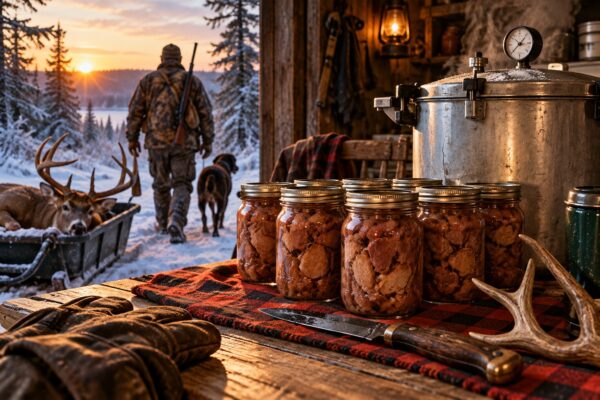
There was a time when putting meat in the freezer was not part of deer season.
There wasn’t a freezer.
For generations of American hunters and farm families, harvesting a deer was only half the job. The other half was figuring out how to make November’s bounty feed the family in January, February and March. Meat was salted, smoked, dried and eventually canned. Somewhere along the way, however, pressure canning became one of those old skills that many Americans decided Grandma could take with her.
Maybe we should have kept that one.
Today, most of us process a deer, wrap it in freezer paper, write “BACKSTRAP” or “BURGER” on the package with a Sharpie and throw it into a chest freezer. It works wonderfully—right up until the electricity doesn’t.
Canned venison doesn’t care.
No electricity. No freezer. No generator. No extension cord running across the garage during a three-day winter outage. You have a glass jar sitting peacefully on a shelf containing already-cooked meat.
In other words, our grandparents had an MRE before the Army invented the MRE.
And theirs tasted better, and certainly didn’t have any chemicals grandpa couldn’t pronounce.
Pressure-canning venison is remarkably straightforward when you follow a modern tested process.
For the easiest method, raw-packed venison chunks, the National Center for Home Food Preservation says to use high-quality chilled meat, remove excess fat, place the raw pieces into jars with one inch of headspace, and add salt if desired. You don’t even add water or broth. The venison produces its own juices during processing. Quart jars are processed for 90 minutes in a pressure canner at the pressure appropriate for the canner type and elevation.
That’s about as uncomplicated as food preservation gets.
Trim it. Cut it. Pack it. Pressure-can it. Put it on the shelf.
Months later, pop the lid and you’ve got the beginning of venison stew, soup, tacos, sandwiches, gravy over potatoes or about anything else your deer-camp imagination can produce.
The important word, however, is pressure.
Venison is a low-acid food. It cannot safely be preserved using ordinary boiling-water canning. Proper pressure and processing time are what allow low-acid foods such as meat to be safely canned. The required pressure also changes with elevation and with whether you’re using a dial-gauge or weighted-gauge canner.
This isn’t the place for Grandpa’s “that’s probably close enough” cedar savage engineering.
One of the neat things about pressure canning is that the equipment doesn’t necessarily have to be new, or expensive.
Keep your eyes open at estate sales and garage sales and you may discover one of those enormous old cast-aluminum pressure canners that looks like something salvaged from a 1950s school cafeteria.
Don’t laugh.
Some of those old beasts are wonderful pieces of equipment.
But age demands inspection. Make sure the canner is actually designed for pressure canning, identify the manufacturer and model, and inspect its sealing surfaces, gasket if it uses one, vent, safety components and pressure-control system. Dial gauges need to be accurate; Michigan State University Extension notes that dial gauges should be checked and that damaged or dried gaskets can prevent a canner from maintaining pressure. Common sense for once from a liberal university…
And make sure you’re using the correct weight or pressure regulator for that particular canner.
YouTube can be tremendously useful for watching someone demonstrate how a pressure canner works, especially if you’ve never used one. But use videos for technique, not for inventing processing times. Get the actual time, pressure and elevation requirements from USDA, the National Center for Home Food Preservation, Michigan State University Extension or another research-based source.
Botulism is an exceptionally poor area for culinary experimentation. If your canned venison gives you double vision, droopy eyelids, slurred speech, and trouble swallowing, that isn’t the beginning of a good deer-camp story. That’s botulism—put down the jar and go directly to the ER; you can argue about Grandpa’s canning recipe later. Good news is we have modern meds to fix you, you probably won’t die.
This is where folklore sometimes outruns science.
You’ll hear stories about somebody opening Grandma’s canned venison after five, eight or ten years and eating it without trouble. That doesn’t establish a recommended storage life.
The sensible modern approach is much simpler: properly process it, store it in a cool, dark, dry location, date every jar and rotate your inventory. Home-canned food is generally recommended for use within about one year for best quality. But, there really isn’t an expiration date if the pressure remains.
That doesn’t mean a properly sealed jar magically becomes bad on its first birthday. It means “eat what you store and store what you eat” is just way smarter than trying to establish a world record for the oldest jar of venison in Michigan.
Harvest another big fat doe next fall and replenish the pantry.
There is also something satisfying about looking at a shelf filled with food that you personally harvested and preserved.
You know exactly where it came from, it’s not “mystery meat.
No refrigeration is required to keep that shelf running. A winter storm doesn’t threaten it. A freezer failure doesn’t ruin it. And when you’re tired, hungry and staring into the pantry wondering what’s for dinner, a jar of venison represents most of the hard work already completed.
That’s preparedness without buying a bucket of something called “Patriot Tactical Survival Stroganoff” with a 30-year shelf life.
It’s simply food.
Maybe that’s the part we’ve forgotten.
Our ancestors weren’t necessarily “preppers.” They were people who understood that summer gardens fed winter families and November deer fed people long after the snow arrived.
Technology made those skills less necessary, many have been forgotten.
It didn’t make them useless.
So this deer season, maybe put something besides antlers and packages of burger away.
Find some old Mason jars. Dust off that pressure canner. Read the modern USDA instructions. Watch somebody experienced demonstrate the process. Start small and learn how it’s done.
Someday the power may go out.
Or maybe it won’t.
Either way, you’ll still have dinner.
If you enjoyed this article, then please REPOST or SHARE with others; encourage them to follow AFNN. If you’d like to become a citizen contributor for AFNN, contact us at managingeditor@afnn.us Help keep us ad-free by donating here.
Substack: American Free News Network Substack
Truth Social: @AFNN_USA
Facebook: https://m.facebook.com/afnnusa
Telegram: https://t.me/joinchat/2_-GAzcXmIRjODNh
Twitter: https://twitter.com/AfnnUsa
GETTR: https://gettr.com/user/AFNN_USA
CloutHub: @AFNN_USA