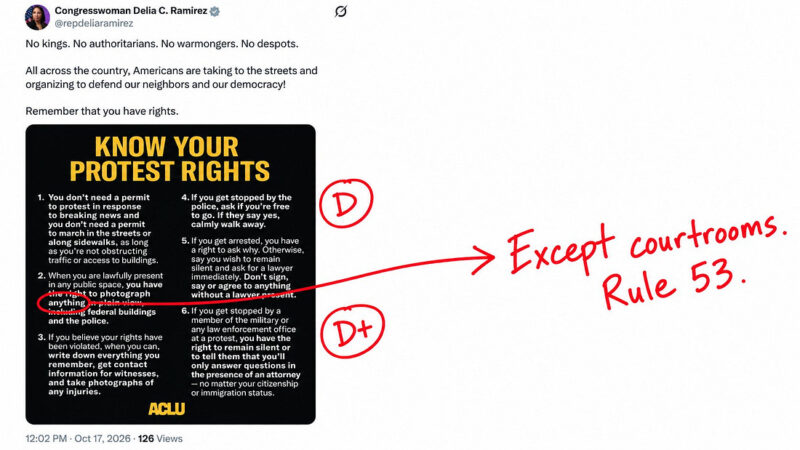
Federal criminal courtrooms are public. Rule 53 bans cameras in them. I graded all six points on your card like a lab report. Two pass. Four can get your followers arrested.
Before anybody in the replies calls me anti-protest… I’m a medically retired Army medic. I swore an oath to defend your right to stand on a sidewalk and call the President anything you want. I also think a member of Congress handing out legal advice ought to hand out ALL of it. Slight oversight!
Every case and statute below is real. Look them up yourself. That’s the assignment.
POINT 1: “You don’t need a permit to protest in response to breaking news and you don’t need a permit to march in the streets or along sidewalks, as long as you’re not obstructing traffic.”
Grade: D.
Congresswoman, a march IN THE STREET is the traffic obstruction. That’s what streets are for.
Your own city disagrees with your card. Chicago Municipal Code 10-8-330 requires a parade permit when a march needs a street closed or traffic stopped. Chicago fast-tracks it for breaking news, but fast-tracked is still a permit. Section 10-8-334 requires advance notice for some sidewalk assemblies. Los Angeles Municipal Code 103.111 waives the filing deadline for breaking news, not the permit. National Park Service land, 36 C.F.R. 2.51: permit required unless your group is 25 or fewer in a designated area.
The Supreme Court has upheld fair permit systems since Cox v. New Hampshire (1941). In Thomas v. Chicago Park District (2002), it upheld permits for park events over 50 people. That case has YOUR city’s name on it.
To be fair, D.C. Code 5-331.05 really does exempt spontaneous protests. So your card is accurate in Washington and a coin flip in Chicago.
By the same logic, I’m printing a card for drivers: you don’t need a license to drive in response to breaking news, as long as you don’t hit anybody. It’s just common sense.
This card couldn’t pour water out of a boot with the instructions printed on the heel.
POINT 2: “You have the right to photograph anything in plain view, including federal buildings and the police.”
Grade: C-.
The core is right. Recording police in public is protected: Glik v. Cunniffe (1st Cir. 2011), ACLU of Illinois v. Alvarez (7th Cir. 2012, your circuit), Fields v. City of Philadelphia (3d Cir. 2017). The Second Circuit joined in August with Massimino v. Benoit, No. 25-1104, and wrote that the right is “not limitless.” Mr. Massimino won the right… and still lost his case.
“Anything” and “any public space” are where your card writes checks your followers can’t cash. Federal Rule of Criminal Procedure 53 covers the courtroom. Inside federal buildings, 41 C.F.R. 102-74.420 generally allows lobbies and hallways, but an agency’s office space needs that agency’s permission. Under 18 U.S.C. 795, photographing designated military installations without permission is a federal crime. And Alvarez, the case from your own circuit, says officers can still keep you back to protect a scene. A camera doesn’t make you a ghost.
As a legal shield, that word “anything” is about as useful as a screen door on a submarine.
POINT 3: Write everything down, get witnesses, photograph injuries.
Grade: A-.
I’d give my own students this advice. The minus is what you left out. Evidence is not a lawsuit. In Egbert v. Boule (2022), the Supreme Court refused to let a man sue a federal agent for damages over First Amendment retaliation. If the badge is federal, your notebook might get you a story. Maybe not a check.
POINT 4: Ask if you’re free to go. If yes, calmly walk away.
Grade: B.
Good advice. Now what happens when the officer says no?
Terry v. Ohio (1968) allows a brief detention on reasonable suspicion. In your own state, 725 ILCS 5/107-14 lets an officer demand your name, your address, and an explanation of what you’re doing during a lawful stop. Refusing alone isn’t automatically obstruction, per People v. Fernandez, 2011 IL App (2d) 100473. Giving a FAKE name is its own crime under 720 ILCS 5/31-4.5.
Other states go further. Nevada’s NRS 171.123 requires a detained person to give a name, and the Supreme Court upheld that in Hiibel v. Sixth Judicial District Court (2004). My state, Ohio, has R.C. 2921.29. Texas has Penal Code 38.02 after an arrest. The stop itself has to be justified, Brown v. Texas (1979), but “say nothing at all” can buy you a night in a cell in a lot of America.
POINT 5: If arrested, ask why, say you wish to remain silent, ask for a lawyer, don’t sign or say anything.
Grade: C+.
You can ASK why. In Devenpeck v. Alford (2004), the Supreme Court said it has never held that an officer must tell you the reason on the spot. Some states require it by statute, like California Penal Code 841. Most of your followers don’t live in California.
“Say you wish to remain silent” is close. Close gets people convicted. In Berghuis v. Thompkins (2010), a suspect sat mostly silent for nearly three hours, answered one question, and the answer came in at trial. Silence alone doesn’t invoke anything. In Davis v. United States (1994), “Maybe I should talk to a lawyer” didn’t count as asking for one. The words that work: “I am invoking my right to remain silent. I want a lawyer.” Then actually stop talking.
Light travels faster than sound, which is why some rights cards look bright until you read them.
“Don’t say anything” also skips two details. Routine booking questions fall outside Miranda (Pennsylvania v. Muniz, 1990), and the Fifth Amendment protects your words, not your blood or your fingerprints (Schmerber v. California, 1966). And you left the most useful case off the card entirely. Riley v. California (2014): police generally need a warrant to search your phone after an arrest. That one belongs in big yellow letters.
POINT 6: Stopped by the military or law enforcement at a protest, you can stay silent “no matter your citizenship or immigration status.”
Grade: D+.
The core is true. Wong Wing v. United States (1896) gave noncitizens on American soil criminal-procedure protections. Here’s the rest of the page you tore out:
o 8 U.S.C. 1304(e): adult noncitizens must carry their registration documents. Staying quiet doesn’t cover leaving them at home.
o 8 U.S.C. 1362: in removal proceedings you may have a lawyer “at no expense to the Government.” The kid reading your card thinks a lawyer is on the way. In immigration court, nobody is sending one.
o 18 U.S.C. 1001: staying silent is legal. Lying to a federal agent is a felony.
o The Posse Comitatus Act, 18 U.S.C. 1385, and 10 U.S.C. 275 keep federal troops out of ordinary policing, except where Congress carved out exceptions like 10 U.S.C. 252-253. Your card warns about soldiers stopping protesters and never mentions the law that limits exactly that.
That is not a rights card. That is a scare card. Only a snollygoster (a shrewd, unprincipled politician, look it up) prints one of those with a congressional seal behind it.
Now the part that actually matters. When your card is wrong, who goes to jail?
Not you.
What’s next, a member of Congress charged with assaulting federal officers outside an ICE facility… wait, I’m being told that already happened. Your colleague Rep. LaMonica McIver pleaded not guilty to three federal counts from Delaney Hall in Newark in May 2025. On August 26, the Third Circuit refused to throw the case out. She faces up to 17 years. She also has a congressional salary, a former U.S. Attorney as her lawyer, and a fundraising page. The 19-year-old holding your card outside Broadview has a phone at 9 percent.
Salt Lake City, June 14, 2025, the very first No Kings day. According to the widow’s lawsuit, Utah organizers recruited armed volunteer “peacekeepers,” some less than 24 hours before the march. One of them, Matthew Alder, fired three shots at a man carrying a rifle and killed a bystander, Afa Ah Loo, a fashion designer and father of two. Prosecutors charged Alder with manslaughter. His lawyer calls it a tragedy, not a crime. The national movement disowned the Utah chapter. And today, the No Kings rallies are back in Salt Lake City.
Portland, March 28, 2026, No Kings night. Protesters broke through the gates at the ICE facility and burned flags.
I’ve written about this pattern before. The people at the top hand out the slogans. The people at the bottom absorb the consequences. Then the fundraising email goes out. Quinn’s First Law of Liberalism: liberalism always generates the exact opposite of its stated intent. A “know your rights” card that leaves out the rules is how a peaceful Saturday ends with a mugshot. All hat and no cattle, Congresswoman, and your followers are the ones paying for the hat.
And “our democracy”? The word democracy appears zero times in the Constitution. Article IV, Section 4 guarantees every state a republican form of government. You swore an oath to that document. It’s only four pages.
Here’s the card I’d hand my own students. Free. No logo required.
o Small group, public sidewalk, people can still get by: usually no permit. Street, park, stage, sound system, or a big crowd: check your city’s permit rules first.
o Record police from where you’re allowed to stand. Stay back. Hands to yourself. No cameras in courtrooms.
o Stopped? “Am I free to go?” If not, many states require your name. Never give a fake one.
o Arrested? “I am invoking my right to remain silent. I want a lawyer.” Then stop talking.
o Don’t unlock your phone for them. Riley v. California says they need a warrant.
o Not a citizen? You can stay silent, but carry your papers and never lie to a federal agent.
o Police order the crowd to disperse? Leave. Argue it in court, not on the curb.
Somewhere out there a tree is producing oxygen for your communications staff, and it owes itself an apology.
But what do I know, I’m only a teacher who read the case law before handing it to a teenager.
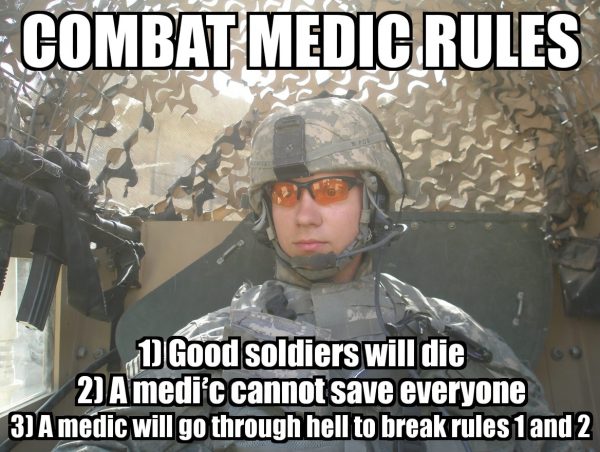 Mike Borowski is a medically retired Army combat medic with 23 years of service, including a combat deployment to Iraq, and a high school Anatomy and Physics teacher at a high-need Career Technical district in Northeast Ohio — where he also wrote and published the textbooks for both courses. He runs “Bski’s Classroom,” a platform dedicated to cutting through political noise with data, history, and the kind of blunt honesty that comes from someone who has seen both war and the American classroom up close.
—
X (Twitter): x.com/BskiMike22802
Substack: substack.com/@bskimike22802
YouTube: www.youtube.com/@BskiMike22802
AFNN: https://afnn.us/author/mikeborowski/
If you enjoyed this article, then please REPOST or SHARE with others; encourage them to follow AFNN. If you’d like to become a citizen contributor for AFNN, contact us at managingeditor@afnn.us Help keep us ad-free by donating here.
Substack: American Free News Network Substack
Truth Social: @AFNN_USA
Facebook: https://m.facebook.com/afnnusa
Telegram: https://t.me/joinchat/2_-GAzcXmIRjODNh
Twitter: https://twitter.com/AfnnUsa
GETTR: https://gettr.com/user/AFNN_USA
CloutHub: @AFNN_USA