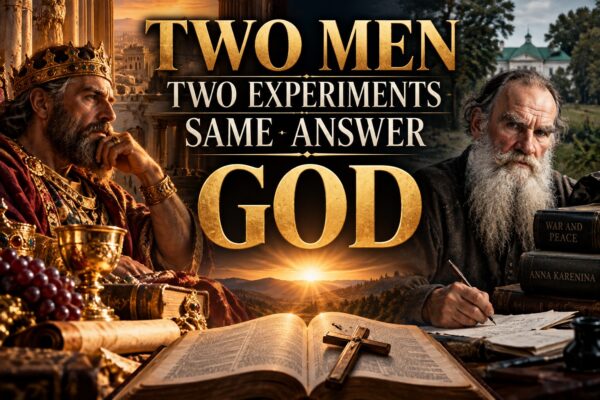
I spent enough years as an Army math geek to appreciate data. One data point is interesting. Two independent data points, that produce the same result? Now you’ve got my attention.
So consider two men separated by centuries, cultures, languages, and circumstances.
One is the voice of Ecclesiastes, traditionally identified with Solomon: a king with wealth, power, women, servants, property, education, political authority, and pretty much every other box ancient civilization had labeled SUCCESS.
The other is Leo Tolstoy.
Tolstoy wasn’t exactly eating ramen noodles while waiting for his big break. He was Count Leo Tolstoy—Russian aristocracy (before the Soviet Union). He inherited an estate. He served as an Army officer. He fought in the Crimean War. He married, fathered thirteen children, became wealthy, and wrote War and Peace and Anna Karenina.
Imagine reaching the top of the mountain and discovering somebody forgot to put anything up there.
That’s essentially what happened to both men.
Ecclesiastes describes the experiment explicitly. The writer pursued pleasure. He drank wine. He built houses. He planted vineyards and gardens. He accumulated servants, livestock, silver, gold, singers, possessions and lots of women as concubines.
Then he looked at the pile.
“Vanity of vanities… all is vanity.”
The Hebrew word is hevel. We translate it as “vanity,” but it carries the sense of vapor or breath.
That’s better.
The things aren’t necessarily bad. They’re just temporary.
Money is real. Your career is real. The house is real. The trophy on the shelf is real. Your reputation is real.
But breathe onto a window on a January morning.
There it is.
Then it’s gone.
Tolstoy ran essentially the same experiment a few thousand years later.
He had wealth. Check.
Women and pleasure. Check.
Military adventure. Check.
Marriage and children. Check.
Intellectual achievement. Check.
Professional accomplishment? The man wrote War and Peace. That’s not exactly getting Employee of the Month at Walmart. Check.
Fame? Big freaking check.
And then, around middle age, Tolstoy encountered the same problem Ecclesiastes couldn’t solve.
Death.
What exactly was all this for if he was going to die?
That’s the problem nobody puts on the motivational poster.
We’re told to climb the ladder. Work harder. Get promoted. Buy some acreage. Build the house. Get another degree. Win the championship. Make some money. Get your name published somewhere.
Fine.
Suppose you do.
Then what?
Tolstoy discovered that success doesn’t answer that question. In some ways, success makes the question worse because you’ve eliminated the convenient excuse that happiness is waiting at the next rung.
There’s always another promotion until there isn’t.
Another medal until there isn’t.
Another paycheck until there isn’t.
Eventually you reach the last rung of the ladder and discover the ladder itself is leaning against a hearse.
Ecclesiastes got there first.
The wise man dies.
The fool dies.
The rich man dies.
The poor man dies.
The famous man dies.
The guy nobody remembers dies.
That’s not nihilism. It’s reality.
And here’s where our two data points become interesting.
Neither man concluded that the answer was more stuff.
Neither said he simply needed a larger house, another woman, another title or another accomplishment.
They looked beyond the experiment.
God.
Ecclesiastes closes the loop plainly:
“Fear God, and keep his commandments: for this is the whole duty of man.”
Tolstoy’s theological road was considerably messier. He eventually disagreed profoundly with institutional Christianity and developed interpretations of Christ that orthodox Christians would dispute. But his existential conclusion is still fascinating.
The answer wasn’t another novel.
It wasn’t another estate.
It wasn’t another award.
It wasn’t another intellectual theory.
It was God.
More specifically, Tolstoy became obsessed with actually living what Christ taught, rather than merely belonging to a civilization that called itself Christian. Not sure that was entirely healthy either.
And maybe that’s the uncomfortable part.
Because most of us are still conducting the experiment.
We tell ourselves one more accomplishment will finally settle something inside us.
A newer house.
A better car.
Another promotion.
Another zero in the retirement account.
Another trophy.
Another hundred acres.
There’s nothing inherently wrong with those things. Ecclesiastes doesn’t really say there is. In fact, it repeatedly tells us to enjoy the good things God gives us.
The mistake is asking temporary things to perform an eternal job.
They can’t.
That’s hevel.
Vapor.
Two men. Two civilizations. Two radically different lives. Both had opportunities most human beings throughout history could barely imagine. Both climbed about as high as their respective worlds allowed.
And both eventually looked around and asked the same question:
Is this it?
Their theology isn’t identical. Their circumstances certainly aren’t identical. But the direction of their conclusions is difficult to ignore.
Perhaps that’s worth considering before spending your entire life climbing.
Because there’s nothing worse than reaching the top of the ladder only to discover that the thing you’ve been looking for was never at the top.
It was above it. Perhaps “hell on earth” is simply an appetite that can never be satisfied—forever seeking from the world what can only be found in God.
If you enjoyed this article, then please REPOST or SHARE with others; encourage them to follow AFNN. If you’d like to become a citizen contributor for AFNN, contact us at managingeditor@afnn.us Help keep us ad-free by donating here.
Substack: American Free News Network Substack
Truth Social: @AFNN_USA
Facebook: https://m.facebook.
Telegram: https://t.me/
Twitter: https://twitter.com/AfnnUsa
GETTR: https://gettr.com/user/AFNN_
CloutHub: @AFNN_USA