If you want to know how a civilization changes, don’t listen to what it says.
Look at what it builds.
In 1956, the United States Army created the U.S. Army Marksmanship Unit. It wasn’t built so soldiers could collect trophies. It was built because Army leadership understood that competition produced better shooters, better instructors, better tools, and ultimately better soldiers.
Two years later, Air Force Chief of Staff General Curtis LeMay reached the same conclusion. He established the U.S. Air Force Marksmanship School, directed every Air Force base to field a five-man skeet team, and championed widespread skeet facilities across the Air Force because he believed a military should actually master its small arms.
That wasn’t an accident.
It was policy.
The men leading America’s armed forces had survived World War II and Korea. They didn’t need consultants to explain what won wars. They knew. They had buried enough friends to understand that marksmanship wasn’t a hobby. It was life insurance.
So America built rifle ranges.
America built skeet fields.
America built pistol ranges.
Military installations hosted thriving gun clubs. Families shot together. Weekend competitions filled the firing lines. The military didn’t apologize for encouraging people to become exceptional with firearms.
It celebrated it.
Now look around.
Drive through today’s military installations and ask a simple question.
Where did all the public ranges go?
Many have disappeared.
The familiar explanation is always delivered with the confidence only bureaucracy can muster.
Lead contamination.
Environmental compliance.
Risk management.
Land use.
Budget priorities.
Every closure sounds perfectly reasonable by itself.
Stack enough “reasonable” decisions together and you wake up decades later wondering why an institution built to fight wars has fewer places for its own people to voluntarily practice the skills of war.
That isn’t modernization.
That’s a shift in values.
Today’s military still contains some extraordinary warriors, instructors, and combat leaders. Nobody should confuse criticism of institutional priorities with criticism of the men and women who serve.
But institutions reveal what they truly value by where they invest time, money, and leadership.
The military of LeMay’s era invested in ranges.
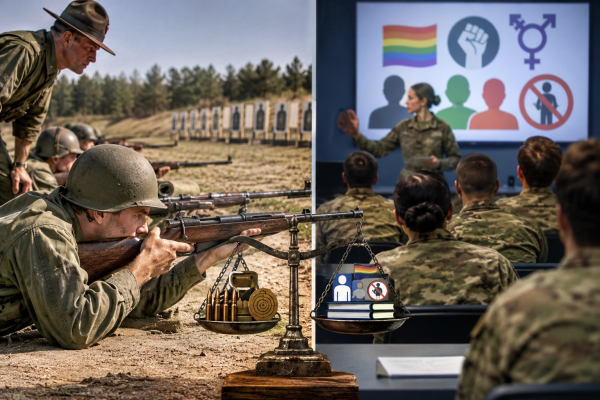
Today’s military invests enormous effort in administrative compliance. Service members complete required training covering topics such as cybersecurity, equal opportunity, sexual assault prevention, ethics, suicide prevention, and many other institutional requirements established by law and policy.
Some of those subjects address real problems.
That isn’t the point.
The point is that priorities are measured in hours.
Every mandatory briefing competes with time on a range.
Every additional online module competes with live-fire training.
Every closed skeet field sends a message, whether anyone intended it or not.
The message is simple.
This no longer matters as much.
LeMay would have found that astonishing.
The generation that built the AMU would have found it incomprehensible.
They believed military organizations existed to cultivate warriors.
Today’s institution often behaves as though the greatest threat is not losing the next war but failing the next inspection, violating the next environmental regulation, or creating the next administrative headache.
That may reduce institutional risk.
It does not automatically increase combat effectiveness.
The irony is almost painful.
America possesses the most technologically advanced military in human history.
Stealth aircraft.
Artificial intelligence.
Hypersonic weapons.
Space-based sensors.
Yet somewhere, eventually, an American will still have to shoulder a rifle, steady his breathing, press a trigger, and hit another human being before that human being hits him.
The battlefield has never cared about fashionable management philosophies.
It has always cared about competence.
The officers who rebuilt America’s military after World War II understood that reality. They built institutions that rewarded excellence with a rifle instead of treating it as a public-relations liability.
Somewhere along the way, we started dismantling many of those institutions and congratulating ourselves for doing it.
We called it modernization.
We called it progress.
History may eventually call it something else.
It may simply call it forgetting that the first duty of a military is not to manage risk.
It is to win wars.
If you enjoyed this article, then please REPOST or SHARE with others; encourage them to follow AFNN. If you’d like to become a citizen contributor for AFNN, contact us at managingeditor@afnn.us Help keep us ad-free by donating here.
Substack: American Free News Network Substack
Truth Social: @AFNN_USA
Facebook: https://m.facebook.com/afnnusa
Telegram: https://t.me/joinchat/2_-GAzcXmIRjODNh
Twitter: https://twitter.com/AfnnUsa
GETTR: https://gettr.com/user/AFNN_USA
CloutHub: @AFNN_USA