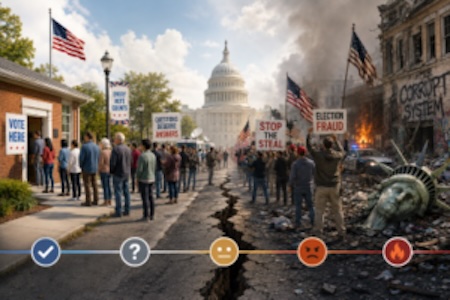
The danger to a republic is not simply election fraud, administrative errors, poor procedures, or partisan accusations. The real danger begins when a significant portion of the population no longer believes that elections are legitimate.
A constitutional republic does not function through force alone. It functions because citizens agree to accept the outcome of elections, even when their preferred candidate loses. The peaceful transfer of power depends upon a shared belief that the process was fundamentally fair and that political authority is derived from the consent of the governed.
When that belief disappears, every institution begins to weaken.
If citizens conclude that elections cannot be trusted, the consequences extend far beyond a single campaign or a disputed vote count. The legitimacy of elected officials comes into question. Laws passed by those officials are viewed as illegitimate. Courts become suspect. Administrative agencies are seen as extensions of political power rather than neutral institutions.
The narrative quickly becomes destructive and self-reinforcing:
The government is corrupt.
The government is incapable.
The government selectively applies the law.
The government is therefore unworthy of exercising authority.
Once that conclusion takes hold, citizens begin to withdraw their consent. Compliance with laws becomes conditional. Political opponents stop viewing one another as fellow citizens and begin viewing each other as enemies. Public discourse deteriorates into accusation and retaliation.
History demonstrates that democracies and republics rarely collapse overnight. More often, they erode gradually through declining institutional trust, increasing polarization, and the widespread belief that established systems no longer deserve respect. Political scientists have repeatedly identified trust as one of the essential foundations of democratic legitimacy. When trust in elections declines, satisfaction with democracy itself also declines.
Importantly, this problem is not limited to actual election misconduct. Research suggests that perceptions of electoral malpractice can be just as damaging as proven misconduct because legitimacy depends not only on legal procedures but also on public confidence in those procedures.
The final destination is not reform. It is chaos.
A republic cannot survive indefinitely if half the country believes elections are stolen while the other half believes concerns about election integrity are themselves an attack on democracy. In that environment, civility disappears. Trust disappears. Consensus disappears.
The Constitution remains on paper, but the social contract that gives it meaning begins to unravel.
The greatest threat, therefore, is not merely a flawed election. The greatest threat is a nation that no longer believes its elections are worthy of trust.
That is not a political problem.
That is an existential one.
If you enjoyed this article, then please REPOST or SHARE with others; encourage them to follow AFNN. If you’d like to become a citizen contributor for AFNN, contact us at managingeditor@afnn.us Help keep us ad-free by donating here.
Substack: American Free News Network Substack
Truth Social: @AFNN_USA
Facebook: https://m.facebook.com/afnnusa
Telegram: https://t.me/joinchat/2_-GAzcXmIRjODNh
Twitter: https://twitter.com/AfnnUsa
GETTR: https://gettr.com/user/AFNN_USA
CloutHub: @AFNN_USA