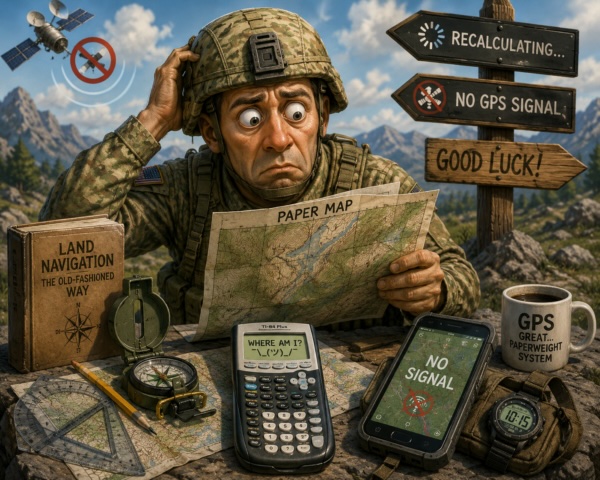
As a retired Army officer, I find myself caught between two competing truths.
First, technology is one of the greatest force multipliers in human history. I wouldn’t trade my GPS, smartphone, ballistic calculator, laser rangefinder, thermal optics, or modern communications equipment for the tools I used 30 years ago.
Second, I worry we’ve become so dependent on technology that we’ve forgotten how to function without it.
And that’s dangerous.
Anyone my age probably remembers hearing the same line in school:
*”You won’t always have a calculator with you.”*
Then you got to college.
Suddenly, you weren’t allowed to solve engineering problems *without* a calculator.
The irony wasn’t lost on me.
An advanced engineering problem might take 15 minutes with a calculator and half a day without one. The calculator wasn’t the problem. The problem was forgetting the mathematics behind the calculator.
An engineer still has to know when the answer is nonsense.
Negative 400 tons of concrete? You’d better question that calculation.
The machine can perform the arithmetic.
It can’t provide judgment.
Psychologist Lisanne Bainbridge described this phenomenon in 1983 as the “ironies of automation.” The better automation becomes, the less frequently humans practice the very skills the automation replaced. Unfortunately, the moment those skills become necessary is usually when the automation fails.
The military has known this for centuries.
Actually, make that millennia.
The principles of war taught in American military schools have roots stretching back more than 2,500 years. Sun Tzu discussed them around 500 BC. Vegetius wrote about them in the fourth century. Napoleon applied them. Jomini organized them. The U.S. Army formally adopted its modern version in 1921.
Every lieutenant who attended a military school could recite them from memory.
MOSSMOUSE.
Mass.
Objective.
Security.
Surprise.
Maneuver.
Offensive.
Unity of command.
Simplicity.
Economy of force.
For years, one principle in particular was treated almost like a historical relic.
Mass.
Concentrate overwhelming combat power at the decisive place and time.
Simple.
Obvious.
Ancient.
Apparently, also easy to forget.
For decades, precision weapons gave us the illusion that precision could replace mass.
One smart bomb instead of fifty dumb bombs.
One missile instead of a battery of artillery.
One drone instead of an entire reconnaissance element.
And then reality arrived.
Wars consume ammunition at horrifying rates.
Factories matter.
Supply chains matter.
Production capacity matters.
Stockpiles matter.
You can own the most sophisticated missile in the world, but if you have 400 when the war requires 4,000, your technology isn’t nearly as impressive as the sales brochure suggested.
Then there’s simplicity.
I’m convinced this may be the most neglected principle of all.
We’ve built weapons systems that rely on satellites, software, encrypted networks, cloud computing, specialized maintenance, proprietary electronics, international supply chains, and contractors scattered across half a dozen countries.
That’s incredible.
It’s also fragile.
A World War II tank crew could repair an astonishing number of failures with basic tools and a little creativity.
How many modern systems can be repaired with a wrench and a screwdriver?
Even the Navy recognized this problem.
In 2006, the Naval Academy removed celestial navigation from the curriculum. Why wouldn’t they? GPS was everywhere.
Then something interesting happened.
The Navy brought celestial navigation back in 2015.
Why?
Because somebody finally asked an uncomfortable question.
What happens when GPS disappears?
Midshipmen once again started learning how to navigate by the stars because naval leaders realized that jamming, cyberattacks, satellite failures, and electronic warfare weren’t hypothetical scenarios anymore. They were real threats.
Think about that for a moment.
One of the most technologically advanced military organizations on Earth looked backward to move forward.
They rediscovered a lesson their ancestors never forgot.
Always have a backup.
This isn’t just a military problem.
It’s a cultural problem.
How many people can read a paper map?
How many can navigate with a compass?
How many can perform arithmetic without a smartphone?
How many children know how to locate information in a library?
How many of us can remember a phone number that isn’t stored in a contact list?
We’ve outsourced memory.
We’ve outsourced navigation.
We’ve outsourced calculation.
We’re beginning to outsource judgment.
That’s the part that concerns me.
Because war has an annoying habit of exposing our assumptions.
GPS gets jammed.
Networks fail.
Batteries die.
Supply chains collapse.
Software crashes.
And then we’re forced to remember the skills we abandoned.
I am not arguing for a return to slide rules, paper charts, and Morse code.
Technology isn’t the enemy.
Technology is a tool.
Use the calculator.
Use the GPS.
Use the ballistic computer.
Use artificial intelligence.
Absolutely.
But never surrender the fundamental knowledge that allows you to function when those tools fail.
Marksmanship may be the most visible example of what we’ve gained through technology—and what we’ve quietly allowed to disappear. During World War II, American soldiers routinely trained and qualified at distances that would surprise many people today. Army rifle training emphasized shooting from multiple positions at distances extending to 500 yards, while instruction often covered the fundamentals of engaging targets even farther away. Marines preserved that tradition for generations, routinely qualifying at 200, 300, and 500 yards with iron sights. Wind, elevation, sight adjustments, and positional shooting weren’t specialized skills reserved for competitive marksmen. They were considered fundamental soldiering skills.
Ironically, modern technology should make today’s rifleman better than ever. Optical sights, laser rangefinders, ballistic calculators, and sophisticated ammunition have dramatically increased individual capability. Yet technology can also become a shortcut that bypasses understanding. A ballistic computer can generate a firing solution in an instant, but it can’t teach a shooter why the bullet landed where it did. That’s the difference between possessing a tool and mastering a craft. The rifleman who understands trajectory, wind, and marksmanship fundamentals—and then adds technology on top of those skills—is far more capable than the rifleman who has simply rented his competence from a battery.
Our grandparents understood redundancy.
They kept paper maps in the glove compartment.
They stocked spare parts.
They stored ammunition.
They taught manual skills.
Modern systems are optimized for efficiency.
Older systems were optimized for survival.
Those are not the same thing.
Maybe that’s the lesson we’re rediscovering.
The Romans understood it.
Napoleon understood it.
The Army wrote it down in 1921.
And a century later, we’re slowly remembering what they already knew.
A truly advanced military isn’t the one that fights spectacularly when everything works.
It’s the one that can still fight when nothing does.
And that might be the most important lesson we’ve forgotten.
_________________________________
If you enjoyed this article, then please REPOST or SHARE with others; encourage them to follow AFNN. If you’d like to become a citizen contributor for AFNN, contact us at managingeditor@afnn.us Help keep us ad-free by donating here.
_________________________________
Substack: American Free News Network Substack
Truth Social: @AFNN_USA
Facebook: https://m.facebook.com/afnnusa
Telegram: https://t.me/joinchat/2_-GAzcXmIRjODNh
Twitter: https://twitter.com/AfnnUsa
GETTR: https://gettr.com/user/AFNN_USA
CloutHub: @AFNN_USA