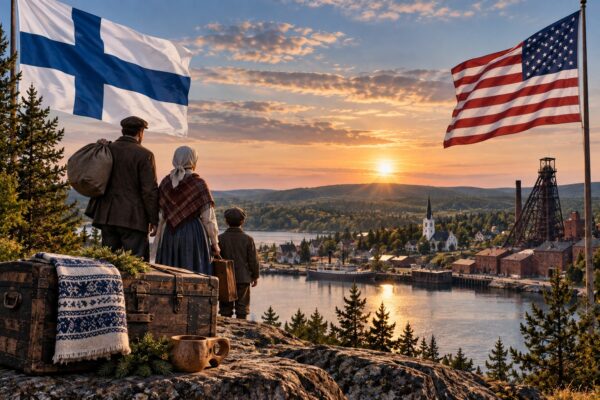
If you drive through Michigan’s Upper Peninsula long enough, sooner or later you will encounter a last name containing more vowels than seems reasonably necessary, somebody who considers 20 degrees “pretty nice out,” and a small wooden building where people voluntarily sit in 180-degree heat.
Welcome to Finnish America.
The Finnish influence on northern Michigan is so deeply embedded that it is easy to forget how it got there. The story stretches from nineteenth-century Finland through Russian rule, American copper mines, labor battles, socialism, churches, independence, civil war and finally the Second World War.
And surprisingly, some of the arguments those immigrants brought with them sound remarkably familiar today.
Finnish immigration to America began as a trickle during the mid-1800s. Finland wasn’t yet an independent country. Since 1809 it had existed as the autonomous Grand Duchy of Finland within the Russian Empire.
Some of the earliest Finnish arrivals were sailors. By the 1860s, Michigan copper companies were recruiting Finns who had already migrated to northern Norway. Soon letters began traveling home describing wages and opportunities in America. Once a few Finns found work they wrote home: essentially, come here; there’s work. New immigrants often went directly to communities where relatives or people from their Finnish village already lived.
Poor farming conditions, population growth and limited opportunities pushed young Finns—particularly from western Finland and Ostrobothnia—to look overseas. Between 1870 and 1920, approximately 340,000 Finns immigrated to the United States. In the 1870s and 1880s, roughly 40 percent of Finnish Americans lived in Michigan, primarily working in mining and logging.
Then Russia provided another incentive.
Beginning especially in 1899, the Russian government intensified efforts to integrate Finland more tightly into the empire, a period remembered as Russification. Political pressure and disputes over a military draft added another reason for Finns to leave.
The Upper Peninsula must have seemed strangely familiar.
Cold winters? Check.
Endless forests? Check.
Rocky soil, lakes and mosquitoes capable of carrying away small livestock?
Close enough to home.
More importantly, there were jobs.
Copper mining transformed the Keweenaw Peninsula beginning in the nineteenth century, attracting immigrants from across Europe. Finns became particularly important to the workforce. By 1905, approximately one-third of the newer workers at the Quincy Mine were Finnish.
Communities developed around places such as Calumet, Hancock, Negaunee, Ishpeming and Ironwood, while other Finns moved into logging and farming. By the 1900 census, approximately 19,000 Finnish-born people lived in Michigan.
They brought more than strong backs.
Finnish immigrants had exceptionally high literacy rates. They created newspapers, schools, churches, temperance societies, cooperative businesses and social organizations. The first Finnish-American newspaper appeared in Hancock in 1876, and Suomi College was established there in 1896. It eventually became Finlandia University, which existed 126-years until closing in 2023.
But they also brought politics.
Finnish America gradually developed an extraordinary cultural divide.
On one side were religious and generally more conservative Finns whose communities revolved around Lutheran churches, family and private property.
On the other were Finns attracted to labor organizing, socialism and eventually, in some cases, communism. Their community centers were often workers’ halls rather than churches. The Library of Congress traces this religious-versus-labor division among Finnish Americans to the 1890s.
These weren’t abstract debates.
Finnish immigrants frequently worked dangerous jobs underground, in forests and factories. Labor disputes concerned wages, hours, working conditions and who controlled the wealth created by industrialization. Socialist organizations consequently became influential in some Finnish-American communities, including Michigan.
Meanwhile, Finland itself exploded.
Russia collapsed in 1917. Finland declared independence on December 6, 1917, but almost immediately descended into the Finnish Civil War of 1918 between socialist Reds (communist) and government Whites (capitalist).
For Finnish Americans thousands of miles away, those divisions could become intensely personal.
America didn’t erase the old arguments. It gave them a new address.
Finland eventually stabilized as an independent republic, but history wasn’t finished with it.
In November 1939, the Soviet Union invaded Finland, beginning the Winter War. Suddenly many old political divisions among Finns became less important than national survival. Finnish Americans rallied to help their ancestral homeland. Former President Herbert Hoover headed the Finnish Relief Fund, while Finnish Americans supplied aid and some volunteers.
The war also gave the world one of Finland’s more colorful contributions to military vocabulary: the Molotov cocktail, named with characteristically dark Finnish humor after Soviet (Russian) foreign minister Vyacheslav Molotov.
By World War II, however, mass Finnish immigration to America had largely ended. Restrictive U.S. immigration laws beginning in the 1920s sharply reduced the great European migration.
The Finns were already here.
Their fingerprints remain all over the Upper Peninsula.
The sauna (sow-nuh) may be the most obvious survivor, but Finnish heritage runs considerably deeper. There are Lutheran churches, family farms, cooperative traditions, Finnish surnames, foods, music, festivals and an enduring attachment to the concept of SISU —roughly meaning determination, resilience and the willingness to keep going when common sense suggests quitting.
That may be one of Finland’s greatest gifts to Michigan.
The Finns also left us something less comfortable but equally valuable: a historical reminder that America’s arguments over capitalism, socialism, labor, religion, private property and the proper role of government are not new.
Finnish immigrants were wrestling with those questions in Michigan mining towns more than a century ago. Some believed prosperity came through private ownership and individual initiative. Others believed industrial capitalism concentrated too much power in the hands of mine owners and corporations and looked toward unions, cooperatives or socialism.
They argued about it in newspapers, churches, union halls and probably across dinner tables.
Sound familiar?
Yet something remarkable happened over the generations.
Their children became Americans.
The old divisions gradually softened. Finnish Americans became farmers, miners, businessmen, teachers, Soldiers and community leaders. Churches and workers’ halls that once represented competing visions became pieces of a shared heritage.
Perhaps that is the most American part of the story.
People arrived carrying old-world struggles, political disagreements, faith, language and customs. America didn’t require them to forget where they came from. Instead, over generations, those traditions became threads woven into something larger.
Today, when somebody in Michigan’s Upper Peninsula fires up the sauna, serves Finnish food, celebrates Finnish heritage or simply refuses to quit when the weather turns miserable, they are carrying forward a story nearly two centuries in the making.
The Finns came looking for opportunity.
They found copper, timber, hardship, freedom, arguments—and eventually a home.
And Michigan is far richer because they stayed.
If you enjoyed this article, then please REPOST or SHARE with others; encourage them to follow AFNN. If you’d like to become a citizen contributor for AFNN, contact us at managingeditor@afnn.us Help keep us ad-free by donating here.
Substack: American Free News Network Substack
Truth Social: @AFNN_USA
Facebook: https://m.facebook.com/afnnusa
Telegram: https://t.me/joinchat/2_-GAzcXmIRjODNh
Twitter: https://twitter.com/AfnnUsa
GETTR: https://gettr.com/user/AFNN_USA
CloutHub: @AFNN_USA