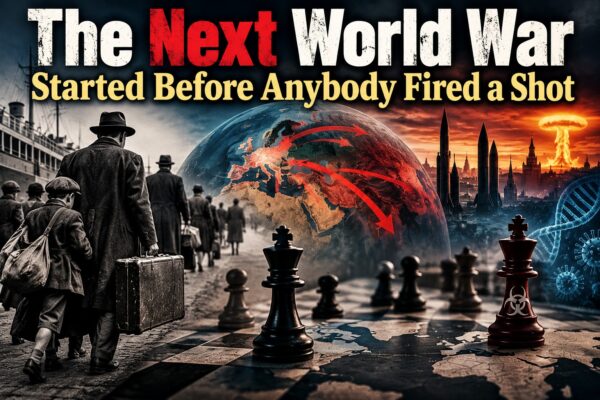
We have a bad habit of dating wars by the first explosion.
World War II began September 1, 1939, because that is when German troops crossed into Poland. Nice clean date. Easy West Point MilArt test question.
History isn’t nearly that tidy.
Long before Poland, people were already voting with their feet. After Hitler came to power in 1933, hundreds of thousands of Jews sought to escape Nazi Germany; ultimately more than 340,000 Jewish refugees fled Germany and Austria. Scientists, professors, doctors, businessmen, artists and intellectuals were among those pushed out of Central Europe.
The shooting hadn’t started yet.
But something had.
That’s worth remembering because perhaps one of the best indicators of a civilization’s trajectory isn’t its stock market or the number of tanks parked in the motor pool.
Watch where its smartest people are going.
Army guys have a wonderfully bureaucratic acronym for nearly everything, including national power: DIME — Diplomatic, Informational, Military and Economic. Army doctrine explicitly taught that these instruments are interconnected and that military power shouldn’t be considered separately from the others.
Yet civilians tend to recognize war only when the M shows up.
Bombs fall? Now we call it a War.
Banks get isolated, trade routes squeezed, technology denied, alliances rearranged, populations manipulated and economies strangled?
Apparently this is just Tuesday.
Clausewitz understood the larger point two centuries ago: war serves political purposes. Military force isn’t the objective. It’s another means of obtaining the objective when the other tools aren’t getting the desired result.
Which brings us to game theory.
Every nation is playing poker while simultaneously trying to figure out what cards everyone else thinks it has. Your decision depends upon my decision, which depends upon what I think you’ll do after seeing what I did.
Simple.
Except there are nuclear weapons on the table.
Richard Nixon understood something wonderfully uncomfortable about deterrence: being perfectly predictable isn’t always advantageous.
H.R. Haldeman later described Nixon’s strategy as the Madman Theory—convince Hanoi and Moscow that Nixon might actually become irrational enough to escalate dramatically, perhaps even toward nuclear weapons. Nixon later disputed Haldeman’s version, so historians shouldn’t treat every detail as settled fact. But declassified records show that perceptions of Nixon as a “madman” really did enter administration discussions about escalation.
That’s game theory with mushroom clouds.
A nuclear weapon doesn’t have to explode to have strategic value. In fact, its greatest value may come from everybody desperately wanting to ensure it never explodes.
Which raises an uncomfortable question.
What replaces the nuclear bomb when nuclear weapons become too terrible to use?
Public Warning: Here we leave history and enter deliberate speculation.
Imagine some future strategist staring at the nuclear problem.
ICBMs are expensive. Satellites see them. Radar detects them. Launches have signatures. Nuclear detonations aren’t particularly subtle.
So our fictional Dr. Strangelove starts thinking smaller.
Biology.
Perhaps someday biotechnology becomes sophisticated enough that someone imagines a pathogen preferentially affecting people with particular genetic characteristics. Forget whether that could actually be engineered reliably today. This is a thought experiment, not a laboratory manual.
On the PowerPoint slide, it looks brilliant.
Cheap.
Deniable.
No missile warning.
No crater.
Perhaps no obvious return address.
Then Mother Nature walks into the briefing room and kicks over the slide projector.
Humans aren’t genetically separated into tidy little boxes. Populations mix. Pathogens evolve. People board airplanes. Biology doesn’t salute flags or stop at checkpoints.
The designer’s “perfect weapon” becomes his own nightmare.
And there is the lesson:
The most dangerous weapon humanity invents may not be the one capable of destroying the enemy. It may be the one whose inventor mistakenly believes he can control it.
This is where my recent trip through Michigan’s Upper Peninsula got me thinking.
The history of Finnish immigration, Karelia, European upheaval and two world wars isn’t just interesting stuff printed on plaques beside old log cabins.
It’s data.
Economic collapse moves populations. Political instability moves capital. Persecution moves intellectuals. War moves everybody who still can.
But here’s the ugly part.
Leaving requires resources.
Money. Education. Transportation. Connections. Skills somebody somewhere else wants.
The rich can move their money.
Engineers can move their careers.
Doctors can move their practices.
Young workers can move their labor.
The desperately poor may simply be stuck.
So economic collapse can produce a vicious feedback loop: the people most capable of helping rebuild a society may also possess the greatest ability to abandon it.
That’s brain drain.
And it can happen before the war.
Put all these ideas together and the picture gets uncomfortable.
DIME tells us conflict doesn’t require bullets.
Clausewitz tells us military force exists in service of political objectives.
Game theory tells us every player’s decision changes everyone else’s calculations.
Nuclear deterrence tells us weapons can exert enormous power without being fired.
Madman theory tells us even the perception of irrationality can become a strategic instrument.
And migration tells us ordinary people may detect danger before governments admit anything is wrong.
None of this means another world war is inevitable.
It means we’re looking for wars in the wrong place.
We look for tanks crossing borders.
Maybe we should also watch capital moving, scientists leaving, supply chains breaking, alliances shifting, currencies weakening, propaganda intensifying and governments increasingly reaching for economic coercion.
Those aren’t proof that war is coming.
They’re instruments on the dashboard, what we called “early warning indicators.”
And perhaps that’s the real reason to study history.
Not so we can memorize when the last war started.
So we might recognize the next one before somebody fires the first shot.
This is a 3-Part series. Links for this and subsequent parts are listed below and go live on the states indicated.
October 8, 2026: DIME Part I: The Next World War Started Before Anybody Fired a Shot
October 9, 2026: DIME Part II: When People Begin Voting With Their Feet
October 10, 2026: DIME Part III: Follow the Money
If you enjoyed this article, then please REPOST or SHARE with others; encourage them to follow AFNN. If you’d like to become a citizen contributor for AFNN, contact us at managingeditor@afnn.us Help keep us ad-free by donating here.
Substack: American Free News Network Substack
Truth Social: @AFNN_USA
Facebook: https://m.facebook.
Telegram: https://t.me/
Twitter: https://twitter.com/AfnnUsa
GETTR: https://gettr.com/user/AFNN_
CloutHub: @AFNN_USA