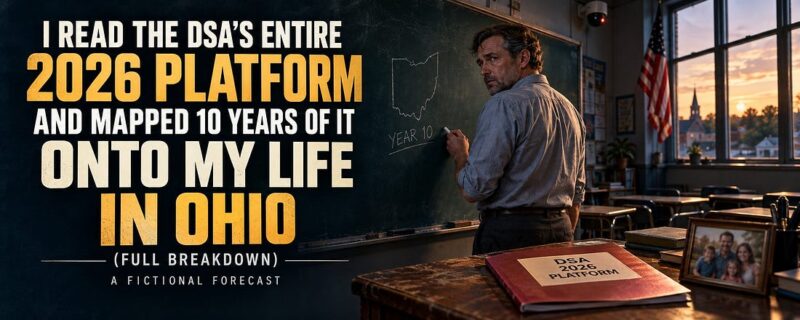
THE QUIET OHIO
A student asked me a question last spring that I still can’t shake.
We were finishing a unit, and I had gone off on one of my tangents (my students will tell you this happens roughly every eleven minutes). I was talking about how republics fall. Not with armies. With paperwork. A girl in the third row put her hand up and asked, very quietly, “Mr. Bski, could that happen here?”
I gave her the teacher answer. I said our system was built to make it very, very hard.
That was true. It still is. But I went home that night and couldn’t stop thinking about the word “hard.” Hard isn’t impossible. Hard just means it takes longer, and it takes more people looking the other way.
Then this summer, the Democratic Socialists of America released their new platform, “Workers Deserve More,” and told the country that candidates who want their endorsement are expected to support it. So I read it. All of it. Twice. The second time with a highlighter.
I teach physics. My entire job is taking a starting condition and a set of forces and predicting where the object lands. So I did that. I took their platform as the forces, the last hundred years of history as the data, and my own life as the starting condition.
The object is my family. We live in Ohio.
What follows is a forecast. I made up the story. I did not make up the platform, and I did not make up a single piece of the history. Every year of my story has a history lesson after it, about a real country where real people were just as sure as you are that it could never happen to them. The receipts, and the places I think I could be wrong, are at the bottom.
One more thing before we start. I am not saying the DSA is the Nazi Party, and I am not saying your Democrat neighbor is Mussolini. I’m saying something more boring and more frightening than that. Every one of those regimes, left or right, used the same floor plan to take power. The label on the door changed. The floor plan never did.
Let’s walk through the house.
It starts with a crisis. Pick one. A bank panic. The grid going down in February. Another virus. The kind of event that makes tired, scared people say “just fix it, I don’t care how.”
Quinn’s Law #4 says liberalism only succeeds when the public is scared into believing it won’t survive without it. The crisis did the scaring. The campaign did the rest.
Election night, I sat on my couch with the TV on low so it wouldn’t wake the kids. Republicans had stayed home because the nominee wasn’t exciting enough. (That part is on us, and I’ll own it.) Plenty of regular Democrats voted for friendly faces in thirty-second ads and never opened the platform.
DSA-endorsed candidates took the House. Then the Senate. Then the White House.
I actually laughed at one point. My wife asked what was funny. I told her they had just won the Senate on a promise to get rid of the Senate, and won the White House on a promise to replace the President. It’s like electing a team captain who campaigned on canceling the team. And winning. Because the other team’s fans were watching a different channel.
She didn’t laugh. In hindsight, she was the smartest person in the room.
HISTORY CLASS: NOBODY GETS ELECTED DICTATOR
Here’s the part they skip in school. Almost nobody in modern history seized total power by kicking in the front door. They were invited in.
In October 1922, Benito Mussolini’s Blackshirts marched on Rome. The army could have stopped them in an afternoon. Instead, King Victor Emmanuel III picked up the phone and asked Mussolini to form a government. The March on Rome was mostly theater. The appointment was perfectly legal.
Fun fact, and I mean that in the least fun way possible: before Mussolini invented Fascism, he was one of Italy’s most prominent socialists. He edited the Socialist Party’s newspaper, Avanti!, until the party threw him out in 1914. The man didn’t change his tools. He changed his flag.
Eleven years later in Germany, Adolf Hitler’s party peaked at about 37 percent of the vote in July 1932. Never a majority in a free election. On January 30, 1933, President Paul von Hindenburg appointed him Chancellor anyway, because a room full of establishment men in nice suits were absolutely certain they could control him.
37 percent. A fractured opposition. A crisis. And a lot of people who assumed the guardrails would hold on their own.
File that away. It comes back.
— YEAR TWO: THE PAMPHLET —
The DSA doesn’t say “defund the police” anymore. That’s 2020 talk, and it polled about as well as a root canal. The 2026 platform says “abolishing the carceral forces of the capitalist state” instead.
If you skipped the sociology minor, that’s police and prisons. Same casserole. Fancier dish.
It came to Ohio the way everything from Washington comes: attached to money. Want your highway dollars? Your school lunch dollars? End cash bail, send most 911 calls to unarmed “care responders,” and hit your decarceration numbers. Our county took the money. Every county took the money. Nobody in Ohio turns down a check. We’re practical people.
That October, my neighbor’s house got broken into while his wife was home alone. She hid in the bathroom with her phone and listened to a man walk through her kitchen. The care responder showed up two hours later with a pamphlet about trauma-informed healing.
I was an Army medic. I was a civilian paramedic. I know exactly how long two hours is when somebody is scared, or bleeding, on a kitchen floor. It is forever, plus a little.
Nobody was charged. There was nobody left whose job it was to charge anybody.
Meanwhile, everybody acted like this was brand-new thinking. On January 10, 1963, Rep. A.S. Herlong Jr. of Florida read a list of 45 Communist Goals into the Congressional Record. Number 38: transfer some of the powers of arrest from the police to social agencies. Sixty-three years ago. Somebody turned in the same homework with a new cover page and a nicer font, and the teacher still gave it an A.
And we’d already run the experiment. In 2021, Minneapolis voters were asked to replace their police department with a Department of Public Safety. In the city where George Floyd died, about 56 percent said no. In 2020, Seattle’s CHAZ/CHOP declared itself police-free. It lasted roughly three weeks. Two teenagers, Lorenzo Anderson, 19, and Antonio Mays Jr., 16, were shot and killed inside it.
What’s next, a crowd burns a police station to the ground and the news calls it mostly peaceful… oh wait. Minneapolis, Third Precinct, May 2020. Never mind.
HISTORY CLASS: POLICE NEVER STAY ABOLISHED
Here’s the pattern nobody wants to hear. When you tear down the neutral police, the space doesn’t stay empty. Something always moves in. And what moves in answers to the party, not the law.
In March 1917, Russia’s new revolutionary government dissolved the Tsar’s police and replaced them with a “people’s militia.” It sounded wonderful. Nine months later, in December 1917, Lenin created the Cheka, the secret police that became the KGB. Russia went from “no more police” to the most feared police force on earth in less than a year.
In Italy, before Mussolini ever took office, his squadristi (armed party gangs) were already doing the “policing” in towns where the state had stepped back. They broke strikes, burned newspapers, and beat opponents while the government shrugged.
In Germany, Hitler’s SA brownshirts were deputized as auxiliary police in Prussia in February 1933. Party thugs, now wearing armbands that said “police.”
You never actually get a world without police. You get a world where the police belong to somebody.
— YEAR THREE: THE FORM —
The national firearms registry came with a teddy bear on the envelope. We just want to know who’s armed. For the children.
Ohio’s constitution, Article I, Section 4, says the people have the right to bear arms for their defense and security. Washington called language like that “a product of its time.” Communist Goal #29: discredit the Constitution as inadequate and old-fashioned. They didn’t even have to update the wording.
I read the registry bill three times. Then I did what I make sophomores do with every lab report. I looked for the source. There wasn’t one. No criminologist. No data set. No study showing that a list of law-abiding owners slows down criminals who will never fill out a form in their entire lives. Just a slogan and a deadline.
So I posted about it. The post got a little gray box: “This content has been reviewed for community standards.” I posted again. Gray box. Fourteen-day suspension. Then thirty. Then the account was simply gone, like it had never existed, along with every single person who used to read it. Including, I’m guessing, some of you.
I still had my guns. For now.
HISTORY CLASS: THE LIST COMES FIRST
Germany’s Weimar Republic, a democracy, passed a firearms law in 1928. Permits. Registration. Police records. It was sold as public order by perfectly reasonable people in perfectly reasonable suits, to stop street fights between communists and Nazis.
Five years later, the Nazis didn’t need to build a list. They inherited one.
Alfred Flatow won Olympic gold for Germany in gymnastics at the very first modern Olympics, in 1896. He was a national hero. He was also Jewish, and he registered his pistols exactly the way the law told him to. In 1938, after the regime barred Jews from owning weapons, that paperwork told the police which door to knock on. He died in the Theresienstadt camp in 1942.
His crime was following the rules.
Venezuela tells the same story with a different flag. Hugo Chávez took office in 1999. His government banned the commercial sale of guns and ammunition in 2012, thirteen years later, after he already controlled the legislature and the courts. Disarmament is almost never the first step of a takeover. It’s the step you take once the people can no longer stop you.
— YEAR FOUR: THE LESSON —
Education is supposed to be a state and local job. The word “education” doesn’t appear anywhere in the U.S. Constitution. Go look. I’ll wait. But money has gravity, and Washington had all the mass in the solar system.
The speech rules arrived as “anti-harassment” requirements tied to federal education dollars. First schools. Then workplaces. Then “public discourse,” which nobody could define, which was the entire point.
That spring, I taught my usual lesson on the Weimar Republic. Same lesson I’ve taught for years. Inflation, crisis, the 37 percent, the Enabling Act.
The same girl from the third row raised her hand again. Older now. She asked, “Mr. Bski, isn’t that kind of what’s happening now?”
The room went dead silent. Every kid in there looked at me, and then every kid in there looked at the camera in the corner.
I said, “What do you think?” Which is what good teachers say. She told me what she thought. It was smart and it was careful and it was honest.
Three days later I got a formal notice. Someone had reported the lesson as “politically divisive content.” The district called it a values alignment issue. I sat in my truck in the parking lot for twenty minutes before I could drive home.
The union didn’t say a word. The union had endorsed all of it. Honestly, I think the union would have endorsed gravity being optional if the right office sent the press release with a free lunch.
Communist Goal #17: get control of the schools. You don’t need a revolution for that one. You need a hiring committee and a training module nobody’s allowed to skip.
Quinn’s Law #12 says liberals don’t debate; they silence you, because if they debated, they’d lose. The midterms that year had the lowest turnout of my life. It is very easy to win an argument when the other side has been flagged, suspended, and written up.
HISTORY CLASS: THEY ALWAYS COME FOR THE TEACHERS
In April 1933, Germany passed the Law for the Restoration of the Professional Civil Service. Teachers were civil servants. Jewish teachers and politically “unreliable” teachers were pushed out. Within a few years, nearly every teacher left in Germany belonged to the National Socialist Teachers League. Not because they all believed. Because they all had mortgages.
Mussolini’s Italy made every university professor swear a loyalty oath to the Fascist regime in 1931. Out of roughly 1,200 professors, about a dozen refused. A dozen. Everybody else signed and went back to class.
Mao’s Cultural Revolution turned students against their own teachers, publicly humiliating and beating them as “class enemies.” Universities shut down for years.
I’ve stood in front of a classroom in a war zone. In Iraq, I walked girls to school so they wouldn’t be killed for wanting an education. I know what it looks like when the people with power decide which questions children are allowed to ask. I never thought I’d see a small, polite, paperwork version of it in my own building.
— YEAR FIVE: THE ALLOCATION —
The platform calls for public ownership of “the largest corporations and essential industries.” They started with the utilities. Then the hospitals. Then anything they called “strategic,” which turned out to mean anything they wanted.
Ohio runs on plants, shifts, and overtime. When the government owns the plant, the plant answers to a committee instead of a customer. The guys I went to school with stopped talking about overtime and started talking about “allocations.” I had never heard a grown man in Ohio say “allocation” with a straight face. Now I heard it at the gas station.
I picked up a second job at a warehouse. My pension got “temporarily restructured,” which is a phrase I now hate in both directions. A car making a noise I chose not to investigate. Kids who stopped asking for things because they had figured out the answer before they asked.
And every night on the news, somebody calmly explaining that the problem was not enough of the thing that caused the problem.
Quinn’s Law #10: liberals never think what they’re doing is wrong; they only think they haven’t done enough of it yet.
HISTORY CLASS: THE PROMISE AND THE BILL
Venezuela tried this with more oil than Ohio will ever see. Chávez’s early programs genuinely reduced poverty while oil prices were high. Then the prices fell, and the machine had nothing left to run on. From 2013 into the early 2020s, Venezuela’s economy shrank by roughly three quarters, one of the worst peacetime collapses in modern history. Inflation topped 130,000 percent in 2018. Nearly 8 million people left. Teachers who once made a few hundred dollars a month ended up making a few dollars.
Fascist Italy had its own version. Mussolini organized the economy into state-run “corporations” where government, business, and unions were all supposed to work together under the party. The state took control of huge pieces of industry through an agency called IRI. On paper, beautiful harmony. In practice, the party decided who won.
Want a live demo instead of a history lesson? Look at France this week. France hasn’t balanced a budget since 1974. Its government spends about 57 percent of its entire economy. Now that reality has forced cuts, reports out of France show hundreds of high schools disrupted, thousands of students detained, hundreds of police officers hurt, and schools set on fire… to protest cuts to the school budget.
Burning down the school to protest the school budget is what I’d call a runaway feedback loop. Every fire makes the next cut bigger, which justifies the next fire. In my lab, that’s the moment the extinguisher comes off the wall.
— YEAR SIX: THE BALLOT WITH A HOLE IN IT —
Article V is the only legal way to change our Constitution. Two-thirds of both houses of Congress, then three-fourths of the states. And the Framers made one clause nearly bulletproof: no state loses its equal vote in the Senate without its own consent.
Good luck getting Wyoming to vote itself out of the room. Good luck getting Ohio.
The DSA knows that. Which is why the platform doesn’t ask for an amendment. It calls for a whole new constitution and a “democratic socialist republic.” You can’t amend your way there. You have to tear the old one up and start over.
Here is what their own document lays out, and what the new charter looked like in my story:
o The Senate: abolished. Ohio’s two senators, gone.
o The House: NOT abolished. Expanded, elected by proportional representation, and made the only thing left standing.
o The Electoral College: abolished.
o The President: replaced by an executive “chosen by and subordinate to Congress.” One of the people who helped draft it said they pictured something more like a prime minister, and joked they could call it the “head honcho or whatever.” The leader of the free world, named with a shrug.
o The Supreme Court: replaced by a judiciary chosen by and subordinate to that same Congress.
Read those last two slowly. If the judges answer to the legislature, who do you sue when the legislature tramples your rights? The legislature. In front of judges the legislature picked. Who keep their jobs as long as the legislature stays happy with them. That’s like the other team’s mom holding the whistle.
The last President of the United States signed the bill that ended the job. The pen was made from recycled plastic. The livestream got more views than the bill got debate.
The first time I walked into a voting booth with no President on the ballot, I just stood there. The poll worker, a sweet retired lady I’ve known for years, asked if I needed help. I said no ma’am. I didn’t need help. I needed a time machine.
What’s next, a political group writes down a plan for Congress to pick your president for you… wait, I’m being told they published it in July. With a webinar.
HISTORY CLASS: THE CONSTITUENT ASSEMBLY TRICK
This is the history lesson that made the hair stand up on my arms, because it is not a metaphor. It already happened.
In 1999, newly elected President Hugo Chávez asked Venezuelans to vote for a “constituent assembly” to write a brand-new constitution, outside the old amendment process. Voters said yes. His allies won nearly every seat in the assembly. The assembly declared itself above the existing government and started taking over the courts and sidelining the elected Congress.
And the new constitution it wrote? It abolished Venezuela’s Senate. Replaced the two-chamber Congress with a single National Assembly.
I am not making that up. Go look it up. Then come back and read the DSA platform again.
In 2004, Chávez’s legislature expanded the Supreme Court from 20 justices to 32 and filled the new seats with loyalists. In 2009, voters approved removing presidential term limits. And in 2017, when the opposition finally won the National Assembly, Nicolás Maduro simply created another constituent assembly with supreme powers and went around them.
Russia ran the trick the other way. In November 1917, Russians elected a Constituent Assembly. Lenin’s Bolsheviks won only about a quarter of the vote. The assembly met in January 1918. Lenin shut it down after one day. One day. That was the last free national election Russia would see for over seventy years.
The lesson is simple. When someone tells you the old constitution is the problem and a new one will finally be “democratic,” check who is going to be holding the pen.
— YEAR SEVEN: THE KID —
I had a student. Farm kid from southern Ohio. Quiet. He didn’t fit any of the boxes on the forms. He just liked physics, the way some kids like baseball.
One afternoon he raised his hand and asked why the universe is expanding.
Best question anybody had asked me all year. I started to answer. Then I stopped. I looked at the camera in the corner of the room. I thought about the notice in my file from Year Four. I looked back at him. I looked at the camera again.
Then I gave him the approved answer, the short one, and left out everything that might start a conversation I wasn’t allowed to finish.
He nodded. He didn’t ask another question.
He never asked another question.
I’ve been a medic, a soldier, a paramedic, and a teacher. I have seen some terrible things. I have held pressure on wounds that I knew weren’t going to close. That moment in my classroom is the one I’d take back if I could. A sixteen-year-old learning that curiosity is dangerous, and learning it from me.
HISTORY CLASS: SILENCE IS THE LAST STEP
Every one of these regimes eventually reached the point where it didn’t need to arrest many people anymore. People did the work themselves.
East Germany’s Stasi ran a network of informants so vast that, by some estimates, there was roughly one informant for every sixty or so citizens. Neighbors reported on neighbors. Spouses reported on spouses. After the Wall fell, people read their files and found out who had been watching them. Sometimes it was their best friend.
Aleksandr Solzhenitsyn spent eight years in the Soviet Gulag for criticizing Stalin in a private letter. He later wrote that the line between good and evil runs through every human heart. The system didn’t need everyone to be evil. It needed everyone to be quiet.
That’s how it ends. Not with a bang. With a kid who stops raising his hand.
— YEAR EIGHT: THE VOTE OHIO NEVER GOT —
Here’s a real fact most Ohioans don’t know. Every twenty years, our state constitution automatically puts one question on the ballot: do you want to call a convention and rewrite the whole thing? It last came up in 2012. Voters said no. It’s due again in 2032.
In my story, it never shows up. Under the new national charter, the “democratic” thing to do was to bring state constitutions in line with the federal one. A state that can say no is a state that gets in the way.
To be fair, especially to my Democrat readers: a one-house legislature by itself is not tyranny. Nebraska has had one since 1937, and it’s a perfectly normal place with excellent steak. But Nebraska kept an elected governor, independent courts, and a federal government with its own brakes.
The danger is never one change. It’s piling every change into the same room. Madison saw this coming in Federalist No. 47: “The accumulation of all powers, legislative, executive, and judiciary, in the same hands, whether of one, a few, or many, and whether hereditary, self-appointed, or elective, may justly be pronounced the very definition of tyranny.”
Look at that one word near the end. Elective. Madison already answered the “but it’s more democratic!” argument. In 1788. With a quill.
HISTORY CLASS: THE STATES GO FIRST
On March 31, 1933, one week after the Enabling Act, Germany passed a law “coordinating” the states with the national government. The state parliaments were reshuffled to match the national vote. A year later, they were abolished entirely. Germany’s states had been around for centuries. The Nazis dissolved them as independent governments in about a year.
They had a word for this: Gleichschaltung. It means “bringing into line.” Every independent institution, from state governments to chess clubs, either got in line or got closed.
Federalism isn’t some dusty civics term. It’s the reason a bad idea in Washington can’t automatically become a bad idea in Columbus. Take it away, and there’s nowhere left to stand.
— YEAR NINE: ONE ROOM —
ICE: gone, with blanket amnesty, straight from the platform. The Department of War: defunded, also straight from the platform. China, Russia, and Iran did not get the memo, and they were not impressed by our pamphlets.
I served in Iraq. I know what it costs to be ready. I also know what it costs to not be, and the second bill is always bigger, and it’s always paid by somebody’s kid.
The biggest companies: owned by the room. Prices: set by the room. Shortages: blamed by the room on “hoarders,” which is what you call a person who bought two jars of peanut butter. The black market became the real economy, just like it did in Moscow and Caracas. The connected ate well. Everybody else got really good at waiting in line.
Madison built the whole system on one idea in Federalist No. 51: “Ambition must be made to counteract ambition.” House against Senate. Congress against President. Courts against both. States against Washington. Every one of those counterweights was gone.
And here’s the part that should bother everybody, left or right. It didn’t take tanks. It took votes. Grant conditions. A new charter. Forms. Deadlines. Little gray boxes. And a lot of good people deciding it was easier to keep their heads down.
HISTORY CLASS: THE ENABLING ACT
On March 23, 1933, the German Reichstag voted on the Enabling Act, which let Hitler’s cabinet pass laws without the parliament. It passed 444 to 94. Legally. With armed SA men lining the hallways, and with the Communist deputies already arrested or in hiding.
The only party that voted no as a bloc was the Social Democrats. Their leader, Otto Wels, stood up in that room and told Hitler to his face that he could take their lives and their freedom, but not their honor. Remember his name. He was a socialist, and he was one of the bravest men in that building. That’s exactly my point: this was never about which team you’re on. It’s about whether you’ll defend the brakes when your own side wants to take them off.
By July 1933, every party but the Nazis was banned. When Hindenburg died in August 1934, the offices of President and Chancellor were merged into one man. Within hours, every soldier in the German army swore an oath of loyalty, not to Germany, not to the constitution, but to Adolf Hitler personally.
One room became one man. It took about eighteen months.
And before anybody in the comments says only one side of the spectrum does this: Hungary’s government used a two-thirds majority to write a brand-new constitution in 2011 and then reshape the courts and election rules around it. Different flag, same floor plan. I don’t care whose flag is on the door. I care whether the brakes still work.
— YEAR TEN: THE LAST LESSON —
I still teach. Mostly.
I still know the Second Law of Thermodynamics: in a closed system, disorder always increases. It never reverses on its own. You need something from outside the system to push back.
A government with no Senate, no independent President, no independent courts, and no state that can say no is a closed system. There’s nothing outside it anymore. You already know what the Second Law says happens next. You don’t need my class for that one.
I looked at the camera in the corner of the room. I looked at my students. I opened my mouth to tell them all of it.
Then I closed it.
— AND THEN I WOKE UP —
It’s October 2026. None of that has happened.
The girl in the third row is real, by the way. Her question was real. My answer was real, and it’s still true. Our system really was built to make all of this very, very hard.
But “hard” only works if people know where the brakes are and are willing to stand on them. Every country in this article had a constitution. Germany’s Weimar constitution was one of the most admired democratic documents in the world. Venezuela’s old constitution was a democratic one too. Paper didn’t save them. People who understood the paper might have.
The next time that girl raises her hand, I’m going to give her a better answer. I’m going to tell her that yes, it could happen here, if enough of us stop reading. And then I’m going to hand her the platform, the Federalist Papers, and a highlighter.
Silence keeps you employed. It also keeps you quiet forever. And the one thing I will never teach a room full of kids is how to give up.
— THE RECEIPTS —
The story is mine. These are not:
o The DSA’s “Workers Deserve More” platform (July 2026) calls for abolishing the Senate, expanding the House with proportional representation, abolishing the Electoral College, and replacing the President and Supreme Court with an executive and judiciary chosen by and subordinate to Congress.
o It calls for a new constitution and a “democratic socialist republic.”
o It calls for “abolishing the carceral forces of the capitalist state,” amnesty, defunding the Department of War, and public ownership of the largest corporations and essential industries.
o DSA-endorsed challengers have already beaten sitting Democratic members of Congress this cycle, including one next door in Michigan.
o Ohio’s constitution really does ask voters every twenty years whether to rewrite it. Next time: 2032.
o Venezuela’s 1999 constituent assembly really did write a constitution that abolished its Senate.
— WHERE I COULD BE WRONG —
I’d be a lousy science teacher if I didn’t show you the error bars.
First, the hurdle is enormous. Everything in Year Six needs either Article V supermajorities or a complete break from the Constitution. Our system was built to make this nearly impossible, and that’s exactly why it’s worth protecting.
Second, most Democrats are not DSA. Even AOC told reporters she doesn’t support abolishing the Senate, and some candidates have already started backing away from this platform since it came out. Good. I mean that.
Third, the frustration behind it is real. A 2025 Navigator Research survey found about three in five Americans want “major changes” to our political system. DSA leaders argue the Senate is undemocratic because Wyoming gets the same two senators as California. I understand the argument. I just think it misunderstands what the Senate is for. It was never built to be democratic. It was built to be a brake. Every car you’ve ever driven has one, and nobody calls the brakes “anti-driving.”
Fourth, history rhymes. It doesn’t photocopy. America in 2026 is not Germany in 1933 or Venezuela in 1999. We’re richer, we’re bigger, and we have 250 years of habit behind our institutions. That’s real. It’s also exactly what the Germans and Venezuelans told themselves.
So the real question isn’t whether the DSA could pull this off tomorrow. It’s why a Democrat who wouldn’t defend this platform in front of their own voters would still take an endorsement that requires it.
But what do I know? I am only a physics teacher in Ohio who read the whole platform with a highlighter, and then read the history of every country that already tried it.
 Mike Borowski is a medically retired Army combat medic with 23 years of service, including a combat deployment to Iraq, and a high school Anatomy and Physics teacher at a high-need Career Technical district in Northeast Ohio — where he also wrote and published the textbooks for both courses. He runs “Bski’s Classroom,” a platform dedicated to cutting through political noise with data, history, and the kind of blunt honesty that comes from someone who has seen both war and the American classroom up close.
—
X (Twitter): x.com/BskiMike22802
Substack: substack.com/@bskimike22802
YouTube: www.youtube.com/@BskiMike22802
AFNN: https://afnn.us/author/mikeborowski/
If you enjoyed this article, then please REPOST or SHARE with others; encourage them to follow AFNN. If you’d like to become a citizen contributor for AFNN, contact us at managingeditor@afnn.us Help keep us ad-free by donating here.
Substack: American Free News Network Substack
Truth Social: @AFNN_USA
Facebook: https://m.facebook.com/afnnusa
Telegram: https://t.me/joinchat/2_-GAzcXmIRjODNh
Twitter: https://twitter.com/AfnnUsa
GETTR: https://gettr.com/user/AFNN_USA
CloutHub: @AFNN_USA