
“Negative liberty is the absence of obstacles, barriers or constraints. One has negative liberty to the extent that actions are available to one in this negative sense.”
— from “Positive and Negative Liberty”, Stanford Encyclopedia of Philosophy
Greetings my fellow Americans!
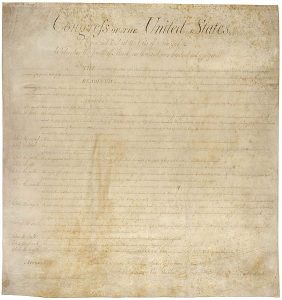
With the next election scheduled roughly nearly three months hence, I thought this a good time to (re-)visit the first ten amendments to our national Constitution. As each deserves its own introspective—both in what it says and why it says it—this will be a series of articles leading into that election; this first installment is intended to address the general meaning and purpose of this collective of explications/clarifications/resolutions of and to the main body of the Constitution itself.
The preamble to this Bill begins with the following (emphasis mine):
The Conventions of a number of the States, having at the time of their adopting the Constitution, expressed a desire, in order to prevent misconstruction or abuse of its powers, that further declaratory and restrictive clauses should be added
And the amendments read:
- Congress shall make no law respecting an establishment of religion or prohibiting the free exercise thereof, or abridging the freedom of speech or of the press, or the right of the people peaceably to assemble and to petition the government for a redress of grievances.
- A well-regulated Militia being necessary to the security of a free State, the right of the people to keep and bear Arms shall not be infringed.
- No soldier shall, in time of peace, be quartered in any house without the consent of the owner, nor in time of war but in a manner to be prescribed by law.
- The right of the people to be secure in their persons, houses, papers, and effects against unreasonable searches and seizures shall not be violated, and no warrants shall issue but upon probable cause, supported by oath or affirmation, and particularly describing the place to be searched and the persons or things to be seized.
- No person shall be held to answer for a capital or otherwise infamous crime unless on a presentment or indictment of a grand jury, except in cases arising in the land or naval forces, or in the militia, when in actual service in time of war or public danger; nor shall any person be subject for the same offense to be twice put in jeopardy of life or limb; nor shall be compelled in any criminal case to be a witness against himself, nor be deprived of life, liberty, or property without due process of law; nor shall private property be taken for public use without just compensation.
- In all criminal prosecutions, the accused shall enjoy the right to a speedy and public trial by an impartial jury of the state and district wherein the crime shall have been committed, which district shall have been previously ascertained by law, and to be informed of the nature and cause of the accusation; to be confronted with the witnesses against him; to have compulsory process for obtaining witnesses in his favor; and to have the assistance of counsel for his defense.
- In suits at common law, where the value in controversy shall exceed twenty dollars, the right of trial by jury shall be preserved, and no fact tried by a jury shall be otherwise reexamined in any court of the United States than according to the rules of the common law.
- Excessive bail shall not be required, nor excessive fines imposed, nor cruel and unusual punishments inflicted.
- The enumeration in the Constitution of certain rights shall not be construed to deny or disparage others retained by the people.
- The powers not delegated to the United States by the Constitution, nor prohibited by it to the states, are reserved to the states respectively, or to the people.
While I agree with virtually nothing else which has ever been uttered publicly by President Barack Obama, I do agree with this statement of his: “Generally, the Constitution is a charter of negative liberties, says what the states can’t do to you. Says what the federal government can’t do to you. But it doesn’t say what the state or federal government must do on your behalf.” Truer words were never spoken, as the so-called Bill of Rights could just as easily have been named the List of Things the Government of the United States Is Prohibited from Doing. With one subtle exception, every one of these amendments is rife with the words no, not, and nor, with Congress and/or other branches of government being the subject (explicit or implied) of each grammatical declaration. There is no language (except in the passive objective sense) stating that the national government is granting or bestowing rights to the citizenry or the individually sovereign States.
And whether President Obama realized it or not, he did acknowledge that our Constitution in no way stipulates any proactivity on the part of government to forestall, rescue, repair, remunerate, etc., the condition of any individual or State in his or its free pursuit of happiness. This was by design; as well-versed students of human history, and as firsthand sufferers of the whims of an unrestrained monarch, our founders knew that unlimited power in the hands of any Man or group of Men would ultimately result in tyranny, as we are all fallen and flawed. They recognized that it was government—and not the private citizen—that needed to be formally constrained with a national Constitution; they further felt the need to explicate those constraints on government authority and power via the Bill of Rights.
If you enjoyed this article, then please REPOST or SHARE with others; encourage them to follow AFNN
Truth Social: @AFNN_USA
Facebook: https://m.facebook.com/afnnusa
Telegram: https://t.me/joinchat/2_-GAzcXmIRjODNh
Twitter: https://twitter.com/AfnnUsa
GETTR: https://gettr.com/user/AFNN_USA
CloutHub: AFNN_USA