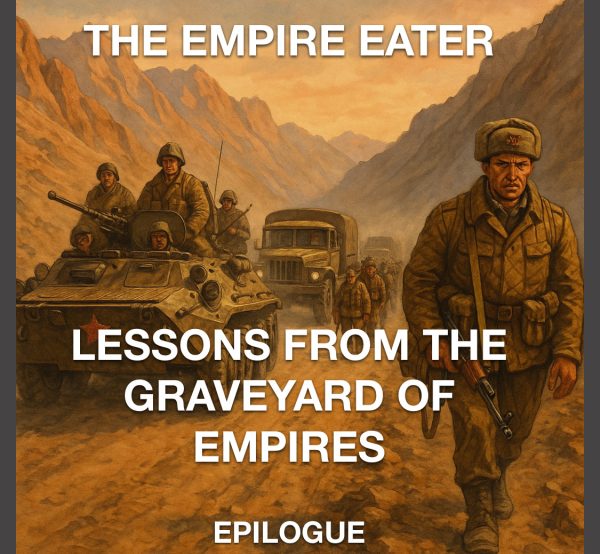
Epilogue: The Bear That Choked on the Mountains
They called Afghanistan “The Graveyard of Empires,” and by the time the Soviets showed up, it already had a headstone collection. The Persians, the Greeks, the Mongols, and the British were all buried there in one form or another. Still, the Soviets thought they could be different. They always do.
It was December 1979. Moscow was nervous. The Afghan government — a communist ally installed after the so-called Saur Revolution — was falling apart faster than a Lada in winter. The countryside had erupted in rebellion. Islamic fighters were rallying, the U.S. was whispering, and the Kremlin’s patience snapped. So they invaded.
Not for oil, not for minerals — for control. Afghanistan bordered the Soviet Union’s soft southern underbelly, where millions of Soviet Muslims lived. The Kremlin couldn’t afford a fundamentalist wildfire spreading north. So under the banner of “brotherly socialist assistance,” they marched across the border, confident it would be a quick stabilization mission.
It wasn’t.
The Soviets found themselves in the same mountain maze that had swallowed the British a century earlier. Villages that smiled by day turned into ambush zones by night. Soviet convoys got picked apart by guerrilla fighters who seemed to materialize out of the rocks. And thanks to the CIA’s Operation Cyclone, those guerrillas — the mujahideen — suddenly had Stinger missiles that could knock Soviet helicopters right out of the sky.
Ten years, a million Afghan deaths, and fifteen thousand Soviet coffins later, the Red Army limped out. It wasn’t defeat in the traditional sense — it was exhaustion, demoralization, and disillusion. The once-mighty USSR had choked on the same dust that had clogged the rifles of the British before them.
And within two years of their retreat, the Soviet Union itself collapsed.
The Bear, like the Empire before it, had been eaten alive by the mountains.
The Pattern
Three superpowers. Three centuries. Three defeats.
• The British Empire tried to bring civilization and found a war it couldn’t win.
• The Soviet Empire tried to bring socialism and found a resistance it couldn’t crush.
• The American Empire tried to bring democracy and found a country that didn’t want it.
Afghanistan doesn’t play by foreign rules. It isn’t conquered — it’s endured. Empires go in to change it and leave changed themselves.
The Lesson
The lesson of Afghanistan isn’t about strategy, religion, or politics. It’s about pride.
Every great power that enters those mountains thinks it’s the exception — the one smart enough, rich enough, or righteous enough to “fix” Afghanistan. And every one of them ends up staring into the same jagged mirror, realizing too late that Afghanistan isn’t the problem — arrogance is.
If the British Empire was the first to trip, and the Soviet Empire the second, America was the third. Let’s hope we’ve finally learned the lesson the mountains have been teaching for two thousand years:
“You can march into Afghanistan with an army, but you’ll leave with humility — if you leave at all.”
This is Part 4 of a 4 part series. Links below become active as each segment is published and on the dates indicated:
October 28: Part I — The Redcoats and the Graveyard Gate (1839–1842)
October 29: Part II — The Empire That Wouldn’t Quit (1878–1880, 1919)
October 30: Part III — The Empire That Thought It Was Different (2001–2021)
October 31: Epilogue: The Bear That Choked on the Mountains
If you enjoyed this article, then please REPOST or SHARE with others; encourage them to follow AFNN. If you’d like to become a citizen contributor for AFNN, contact us at managingeditor@afnn.us Help keep us ad-free by donating here.
Substack: American Free News Network Substack
Truth Social: @AFNN_USA
Facebook: https://m.facebook.com/afnnusa
Telegram: https://t.me/joinchat/2_-GAzcXmIRjODNh
Twitter: https://twitter.com/AfnnUsa
GETTR: https://gettr.com/user/AFNN_USA
CloutHub: @AFNN_USA