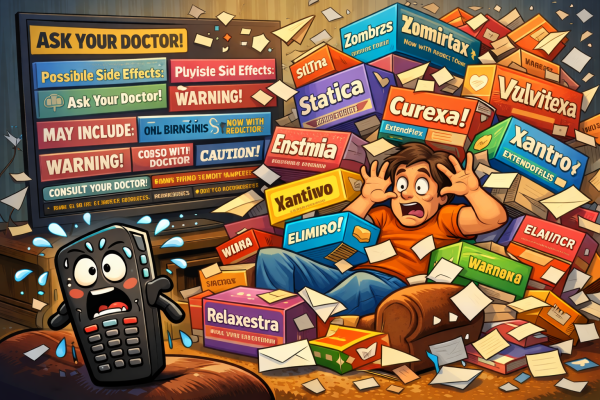
I turn on Fox News for the same reason a man checks the weather before he goes outside: I want to know what’s coming, and I’d prefer not to be blindsided by it. Is the world on fire? Are we at war? Did Congress accidentally pass something useful? Did somebody somewhere do something so insane it requires a full segment and a therapist?
But instead of news, analysis, or even just a respectable amount of yelling… I get hit with the commercial equivalent of a flashbang.
In five minutes, I’m forced to watch four pharmaceutical ads.
Four.
That’s not a “commercial break.” That’s a managed care ambush.
And nothing sets the tone for a nice peaceful breakfast like being told—over soft piano music and footage of smiling people walking through a field—that your new miracle medication may cause a rash “on your anus and genitals.”
Nothing says “good morning, America” like hearing the phrase anus and genitals while you’re chewing eggs.
And this is where the game is up—because once you notice it, you can’t unsee it. Fox News isn’t just a news channel anymore. It’s a wildlife preserve where pharmaceutical companies roam freely, grazing in lush fields of captive audiences, dropping brand names like confetti, and buying so much airtime that the actual news becomes the side dish.
Fox News is basically the perfect habitat for pharma advertising. The conditions are ideal. The economics line up so perfectly it’s almost beautiful in a “watching a vulture circle a wounded animal” kind of way.
The audience skews older. Older audiences are more likely to have chronic conditions. Chronic conditions are where the money lives. And cable news viewers are still watching live—like God intended—so they can’t skip the ads with a swipe and a smug little grin. They have to sit there, take the hit, and wonder if they suddenly have psoriasis, blood clots, depression, or “moderate-to-severe something” that can only be treated with a drug that costs more than a used pickup.
That’s the business model.
You’re not watching the news.
You’re watching a product pipeline.
Now let’s define the thing we’re all swimming in, because it’s important: DTC advertising. That stands for Direct-To-Consumer advertising. It means prescription drug companies advertise straight to the public—by name—so you can march into your doctor’s office like an angry customer at a drive-thru and demand the Mountain Dew Baja Blast of immunosuppressants you saw on TV.
“Hi doc. I don’t know what’s wrong with me. But I do know I want Zombirtax.”
And the doctor has to decide whether today is the day they practice medicine… or the day they negotiate with a pharmaceutical commercial that has a better soundtrack and higher production value than most Hollywood movies.
Here’s the part that should make you choke on your toast: almost every other country prohibits this. Most of the planet looks at prescription drug commercials the way you’d look at a raccoon driving a forklift. It’s not a debate. It’s not “controversial.” It’s just obviously a bad idea. The United States and New Zealand are basically the only two countries where this whole “ask your doctor about BrandName™” circus runs openly on television.
Which is hilarious. Not “ha-ha” hilarious. More like “we’re the only ones doing this and it’s probably not because we’re smarter” hilarious.
So why does the rest of the world ban it?
Because they understand something we pretend not to: when you advertise prescription drugs like consumer goods, you turn healthcare into a marketing war. You increase demand for expensive treatments. You normalize dependency. You inflame costs. You create an environment where medicine is shaped by emotions, branding, fear, and desire—rather than clinical judgment.
It becomes “I saw it on TV,” medicine.
And America is the global champion of “I saw it on TV.”
Now, to be fair, Fox isn’t the only one running these ads. But Fox feels like the epicenter because the audience is so perfect. If you’re a pharmaceutical company, where do you want your commercials landing? On teenagers? On twenty-somethings? On people living off energy drinks and spite?
No. You want people who have insurance, prescriptions, and a doctor’s appointment already scheduled. You want the demographic where the words “joint pain,” “blood sugar,” and “cholesterol” aren’t abstract concepts—they’re Tuesday.
So the pharma ads flood cable news. Not one or two. A wall. A barrage. The same drug names again and again until your brain starts to accept it as normal. And that’s where the psychological magic happens.
Because these ads don’t just sell medication. They sell legitimacy.
They turn Big Pharma into the friendly neighborhood helper.
They wrap it in sunshine, golden retrievers, and couples holding hands on a beach while the narrator calmly mentions that the medication might cause “rare but serious infection, organ failure, or death.”
And then, like the cherry on top of this absurd sundae, they finish every commercial with the greatest corporate mind trick ever invented:
“Ask your doctor.”
Translation: Go pressure your doctor into giving you what we’re selling.
That’s not healthcare education. That’s a marketing maneuver using the authority of medicine as a delivery mechanism. Doctors become the final checkpoint in the sales funnel. Some hold the line. Some don’t. Either way, the drug company wins because now the product is in the conversation. It’s planted.
Now let’s talk about the “unwritten agreement” nobody wants to say out loud.
Does Fox News have an official contract with Big Pharma saying they won’t criticize them?
Probably not in some cartoon villain way.
But do they have a financial ecosystem where it becomes inconvenient, unprofitable, and culturally discouraged to go too hard against the industry buying half the commercial breaks?
Absolutely.
It’s not censorship with a gavel. It’s censorship with a spreadsheet.
When a network is swimming in pharma ad money, the natural outcome is that “hard-hitting” coverage starts to have guardrails. You can criticize bureaucrats. You can rage at politicians. You can fight culture wars until the studio walls shake. But you’ll rarely see sustained, ruthless, prime-time investigation into the pharmaceutical machine itself—the pricing games, the lobbying power, the revolving door, the marketing ethics, the way DTC advertising reshapes public perception and inflates demand.
Not because nobody knows.
Because everybody knows.
And the game is up.
So yes—turn on Fox News and get your headlines. Stay informed. Watch the world spin.
But just understand what you’re actually watching: a news program sponsored by a medical-industrial advertising engine that can’t stop telling you your “anus and genitals” might revolt unless you consult your physician immediately.
It’s not news anymore.
It’s a commercial ecosystem with a few updates from reality in between.
And if you’re still wondering why other countries banned it while we kept it?
Well… maybe the rest of the world still thinks medicine should be about healing.
And we decided it should also be about quarterly earnings, market share, and whether you’re ready to “ask your doctor” about the latest $1,600-a-month miracle injection.
Bon appétit. My eggs don’t taste very good…
If you enjoyed this article, then please REPOST or SHARE with others; encourage them to follow AFNN. If you’d like to become a citizen contributor for AFNN, contact us at managingeditor@afnn.us Help keep us ad-free by donating here.
Substack: American Free News Network Substack
Truth Social: @AFNN_USA
Facebook: https://m.facebook.com/afnnusa
Telegram: https://t.me/joinchat/2_-GAzcXmIRjODNh
Twitter: https://twitter.com/AfnnUsa
GETTR: https://gettr.com/user/AFNN_USA
CloutHub: @AFNN_USA