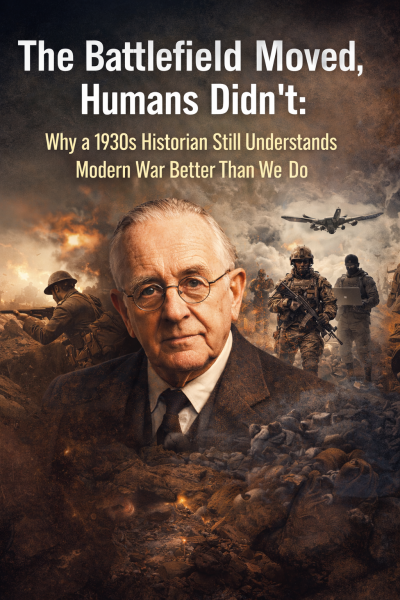
Nearly a hundred years ago, Sir Herbert Butterfield sat down and committed the unforgivable sin of telling historians, strategists, and polite academics something they still hate hearing today: war is not a clean system. It is not a spreadsheet problem. It is not solved by better charts, prettier maps, or a PowerPoint deck with the right color palette. War—every war—boils down to frightened human beings trying to reconcile self-preservation, honor, faith, and meaning while other frightened human beings try to kill them.
This was an inconvenient truth in the 1930s. It is downright heretical in the age of fifth-generation warfare.
Butterfield wrote before drones, social media, cyber operations, influence campaigns, and armies of anonymous experts explaining conflict through think-tank jargon. Yet he understood something that entire modern bureaucracies still manage to miss: the further war drifts from formal battlefields, the more decisive the human soul becomes—and the worse technocrats perform.
Modern warfare has convinced itself that it has evolved past fear. We call it “information dominance” now. Or “narrative shaping.” Or “whole-of-government approaches.” Butterfield would have recognized the same old human panic, just dressed up in acronyms and grant funding. Fear did not disappear; it went airborne. It moved into phones, screens, news cycles, and institutional cowardice.
Fifth-generation warfare doesn’t seek to destroy your army. That’s inefficient. It seeks to exhaust your meaning. It attacks trust, legitimacy, identity, and belief until people voluntarily surrender their courage and call it progress. Butterfield saw this coming before the first influencer monetized outrage or the first general briefed “strategic patience” as a victory condition.
The modern obsession with metrics is exactly what Butterfield warned against. We measure clicks, sentiment analysis, territory “controlled,” and engagement statistics as if these things explain why societies fracture or hold. They don’t. They never did. A population doesn’t collapse because it lost the narrative battle on Twitter. It collapses because it no longer believes sacrifice is honorable, truth exists, or endurance matters.
Butterfield’s critics—then and now—prefer a safer story: history bends toward enlightenment, modernity fixes ancient problems, and technology redeems human weakness. Butterfield ruined that party by insisting humans don’t evolve out of fear. They merely find new ways to justify it.
In fifth-generation warfare, fear isn’t episodic. There is no “combat zone” where you brace yourself and then return home. Fear is ambient. It hums constantly. It comes through headlines, HR policies, economic pressure, reputational threats, and moral confusion. Butterfield understood that courage is not infinite. It must be anchored to belief. When belief dissolves, self-preservation takes over—and no amount of firepower can reverse that.
This is why modern states win battles and lose wars while insisting they are doing everything “right.” They dominate tactically while hemorrhaging morally. Butterfield would not be impressed by precision-guided munitions paired with leaders who cannot articulate why survival should require courage in the first place.
He also anticipated the most corrosive weapon of fifth-generation warfare: the myth of inevitability. Today’s conflicts are packaged as historical destiny. Resistance is labeled backward. Compliance is labeled moral. Butterfield warned that this Whiggish nonsense doesn’t clarify history—it weaponizes it. People do not fight for inevitability. They fight for meaning. Tell them history has already decided, and you shouldn’t be surprised when they stop standing in front of bullets—or stop believing the system deserves loyalty at all.
Modern strategists love to talk about “resilience.” Butterfield knew resilience is not built by workshops or slogans. It is built by moral coherence. When soldiers, citizens, and institutions are asked to endure fear without honor, sacrifice without meaning, or obedience without legitimacy, resilience collapses quietly. Then everyone pretends it was a surprise.
Butterfield’s real crime was refusing to flatter modern confidence. He insisted that war would always be a study of fear and courage, usually of faith, and sometimes of vision. Today we would prefer to replace faith with branding, vision with messaging, and courage with compliance training. And then we act stunned when societies fracture under pressure.
Fifth-generation warfare has not disproven Butterfield. It has vindicated him mercilessly. The battlefield has moved, but the human animal has not. Fear still governs action. Honor still restrains panic. Faith still determines endurance. Vision still separates collapse from survival.
Butterfield didn’t predict drones or cyber operations. He didn’t need to. He understood the one system that has never been upgraded: the human soul under threat. And nearly a century later, while we congratulate ourselves on how sophisticated warfare has become, we are still relearning the lesson he already wrote down in plain English.
War was never about the maps. It was always about whether people believe life is worth risking for something greater than themselves. Fifth-generation warfare just made that truth impossible to ignore.
If you enjoyed this article, then please REPOST or SHARE with others; encourage them to follow AFNN. If you’d like to become a citizen contributor for AFNN, contact us at managingeditor@afnn.us Help keep us ad-free by donating here.
Substack: American Free News Network Substack
Truth Social: @AFNN_USA
Facebook: https://m.facebook.com/afnnusa
Telegram: https://t.me/joinchat/2_-GAzcXmIRjODNh
Twitter: https://twitter.com/AfnnUsa
GETTR: https://gettr.com/user/AFNN_USA
CloutHub: @AFNN_USA