There’s a comforting lie we tell ourselves when we watch bombs fall on places like Iran.
“That’s over there.”
It isn’t.
What’s unfolding between the United States, Israel, and Iran isn’t just another Middle East conflict—it’s a real-time demonstration of fifth-generation warfare, and whether people want to admit it or not, we’re already inside the blast radius.
Not from missiles.
From consequences.
Because in this kind of war, armies don’t need to invade your country anymore. They don’t need to land on your beaches or roll tanks through your cities. That’s outdated. Expensive. Politically messy.
Now they just need to touch a few key pressure points and let the system unravel itself.
Start with a chokepoint. In this case, the Strait of Hormuz—the narrow artery that quietly carries a massive portion of the world’s energy and, more importantly, something far less discussed: fertilizer inputs. Nitrogen, ammonia, urea, sulfur—none of it sexy, all of it essential. You don’t notice fertilizer until it’s gone. Then you notice it everywhere.
Disrupt that flow—whether through direct action, threat, insurance spikes, or simple uncertainty—and you don’t just affect oil prices. You start bending the global food system. Slowly at first. Then all at once.
Farmers delay purchases. Costs spike. Application rates drop. Yields follow. And months later, when harvests come in lighter than expected, the effects show up where people actually feel them—at the grocery store, at the dinner table, and eventually, in the streets.
Nobody bombs a wheat field anymore.
They don’t have to.
This is the shift most people haven’t caught up to. War isn’t just physical anymore—it’s systemic. It operates in layers. The missile strike is just the opening move. The real damage happens downstream, where supply chains tighten, economies strain, and populations start asking uncomfortable questions.
And that’s where the real battlefield emerges: perception.
Because once fertilizer shortages start nudging food prices higher, especially in already fragile regions, the narrative fight begins. And Iran doesn’t need to win a single conventional engagement to exploit it.
All they have to do is say, “We were attacked. Our infrastructure was damaged. We can’t export what the world depends on.”
And just like that, the framing flips.
The United States goes from stabilizer to disruptor. From defender to cause. It doesn’t matter if that framing is incomplete or even unfair. In fifth-generation warfare, perception isn’t a sideshow—it’s the objective.
And here’s the part that should concern anyone paying attention: that narrative doesn’t just land overseas.
It lands here.
Because while the external war escalates, the internal one fractures.
You can already see the fault lines forming. Conservatives splitting between interventionists and restraint advocates. America First versus alliance-first. Strategic necessity versus economic reality. And now layer in rising input costs, food price pressure, and agricultural concerns, and suddenly this isn’t just foreign policy anymore—it’s personal.
When farmers start talking about fertilizer costs becoming unsustainable, that’s not an abstract policy debate. That’s the beginning of a domestic pressure point. And pressure points, in this kind of warfare, are targets.
This is where fifth-generation warfare gets uncomfortable.
The enemy doesn’t need to defeat you.
They just need to make you argue with yourself.
Because once the narrative fractures internally—once the population stops agreeing on what the war is, why it matters, or whether it should be fought at all—the strategic center of gravity shifts inward. The battlefield moves from Tehran to Twitter, from Hormuz to your own political ecosystem.
And that’s a fight you can lose without firing a shot.
Iran understands this. It’s built into how they operate. They can’t outmatch the United States in conventional terms. But they don’t need to. They just need to survive, disrupt, and let the second- and third-order effects do the work.
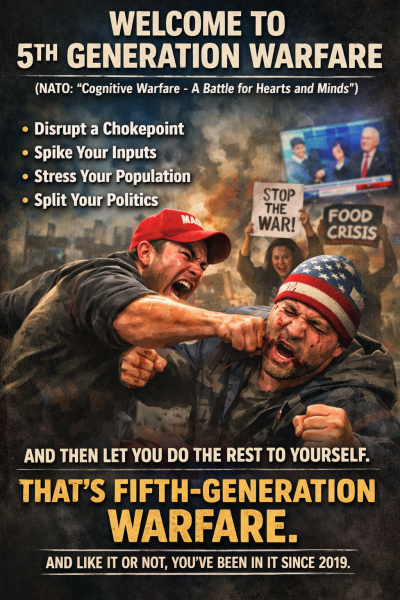
Disrupt a chokepoint.
Spike the inputs.
Stress the population.
Split the politics.
After that, gravity takes over.
Meanwhile, the United States, for all its unmatched military capability, is uniquely vulnerable in this environment—not because it’s weak, but because it’s open. Because its political system amplifies disagreement. Because its media ecosystem fragments reality. Because its population is already primed to divide first and analyze later.
That’s not a moral judgment. It’s a strategic condition.
And in fifth-generation warfare, conditions matter more than capabilities.
What makes this moment different isn’t just the technology. Yes, there’s AI-assisted targeting, cyber exploitation, real-time information warfare. But those are tools. The real shift is conceptual.
Victory is no longer defined by terrain seized or enemies killed.
It’s defined by who controls the narrative, who maintains internal cohesion, and who avoids being blamed when the system starts to strain.
Because once you lose legitimacy—once enough people believe you’re the cause of instability—you can win every battle on paper and still lose the war in reality.
That’s the trap.
And it’s already set.
So no, you’re not just watching a war in Iran.
You’re watching a system being stressed, a narrative being shaped, and a population—yours—being pulled into the fight whether it realizes it or not.
Like it or not, you’ve been in this war for years now.
You just didn’t notice when it started.
If you enjoyed this article, then please REPOST or SHARE with others; encourage them to follow AFNN. If you’d like to become a citizen contributor for AFNN, contact us at managingeditor@afnn.us Help keep us ad-free by donating here.
Substack: American Free News Network Substack
Truth Social: @AFNN_USA
Facebook: https://m.facebook.com/afnnusa
Telegram: https://t.me/joinchat/2_-GAzcXmIRjODNh
Twitter: https://twitter.com/AfnnUsa
GETTR: https://gettr.com/user/AFNN_USA
CloutHub: @AFNN_USA