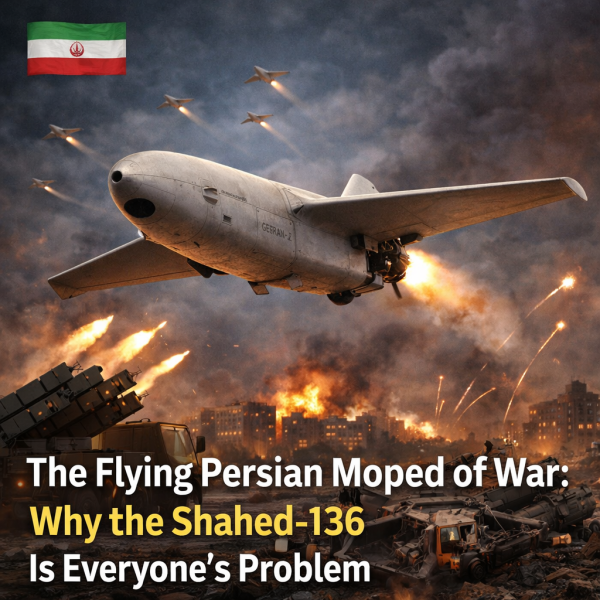
The Shahed-136 is not a masterpiece of engineering. It’s not stealthy, not fast, not elegant, and certainly not impressive in the way a fifth-generation fighter is. It sounds like a weed whacker with anger issues. It flies like a lawn dart with a GPS addiction. And yet—this ugly little flying triangle has exposed a brutal truth about modern warfare:
You don’t need to be advanced to be effective. You just need to be cheap, numerous, and good enough.
Let’s start with the name, because even that tells you something. “Shahed” translates roughly to “witness” in Persian—religious overtones baked into the branding. The “136”? Nobody outside the Iranian system can definitively tell you. It’s likely just a model number in a broader family, not some coded message. But in a way, that ambiguity fits. The system isn’t about symbolism. It’s about scale.
And scale is where this thing becomes dangerous.
The Shahed-136 is a loitering munition, which is a polite way of saying it’s a one-way trip. It launches off a rack—often from the back of a truck—with a small booster, transitions to a piston engine, and then flies a pre-programmed route using GPS and inertial navigation. No pilot sitting somewhere with a joystick. No real-time heroics. Just coordinates, fuel, and inevitability.
It is, functionally, a budget cruise missile.
The numbers tell the story. Roughly 3.5 meters long. About a 2.5-meter wingspan. Warhead somewhere in the 20–50 kg range, depending on the variant. Range? Conservatively over 1,000 kilometers, potentially pushing closer to 2,000 depending on configuration. Cost? That’s where things get offensive—estimates typically land somewhere between $20,000 and $50,000 per unit.
That’s not a typo.
Now stack that against the systems designed to stop it. Patriot missiles. NASAMS interceptors. High-end radar networks. You’re talking anywhere from hundreds of thousands to several million dollars per shot to take down something that costs less than a used pickup truck.
That’s not warfare. That’s financial trolling.
And the Shahed doesn’t come alone. It comes in packs. Waves. Swarms. Enough to force defenders into bad decisions. Do you shoot everything? You go broke. Do you hold fire? Something gets through. That’s the trap.
This is not about precision. This is about pressure.
The drone itself is laughably unsophisticated by Western standards. It’s slow. It’s noisy. Once you detect it, it’s vulnerable. Electronic warfare can degrade its navigation. Guns can shoot it down. Even improvised defenses can work. This is not some unstoppable wunderwaffe.
But that’s not the point.
The point is that it doesn’t need to be good—it just needs to be annoying at scale.
And scale is where modern Western thinking has gotten lazy. For twenty years, the U.S. and its allies optimized for exquisite systems—perfect sensors, perfect shooters, perfect networks. We built Ferraris for a fight that increasingly looks like a demolition derby.
Enter the Shahed-136: the world’s most effective reminder that war is still, at its core, about cost imposition and attrition.
Iran understood something early: if you can’t win the air superiority game, don’t play it. Change the game. Build something cheap enough to mass-produce, simple enough to export, and effective enough to force your enemy to overspend reacting to it.
And they did.
The counter is not mysterious, but it is uncomfortable. You don’t beat the Shahed with more expensive toys. You beat it with layers. You hit the supply chain. You destroy launch sites. You jam navigation signals. And when it gets through, you kill it with the cheapest thing available—guns, short-range missiles, even interceptor drones. You flip the cost equation back.
Because right now, the Shahed-136 wins not by being deadly—though it is—but by being economically abusive.
It’s the military equivalent of forcing your opponent to spend $1,000 every time you spend $10.
And here’s the part nobody likes to admit: this model is scalable. Exportable. Copyable. The barrier to entry is dropping. What Iran built is not just a weapon—it’s a template.
That’s the real threat.
Not the drone itself, but the idea behind it.
The Shahed-136 is not the future of warfare because it’s advanced.
It’s the future because it’s affordable.
And in war, affordability wins more often than elegance.
If you enjoyed this article, then please REPOST or SHARE with others; encourage them to follow AFNN. If you’d like to become a citizen contributor for AFNN, contact us at managingeditor@afnn.us Help keep us ad-free by donating here.
Substack: American Free News Network Substack
Truth Social: @AFNN_USA
Facebook: https://m.facebook.com/afnnusa
Telegram: https://t.me/joinchat/2_-GAzcXmIRjODNh
Twitter: https://twitter.com/AfnnUsa
GETTR: https://gettr.com/user/AFNN_USA
CloutHub: @AFNN_USA