Büdingen, Germany, late ’90s. The barracks were “historic,” which was Army-speak for old, fragile, and nobody wants to pay to fix it. The plumbing was past its expiration date—backups, leaks, that constant low-grade stench that never quite left your clothes. And that’s where we put our enlisted soldiers.
The pitch from leadership bordered on parody: “You’re living in a historic building—Adolf Hitler once gave a speech here. See the photo!”
That didn’t land. Not even close.
Turns out soldiers don’t care about historical trivia when the shower barely works and the hallway smells like a busted sewer line. “Historic” doesn’t compete with “habitable.” You can’t build morale on a plaque when the pipes are actively betraying you. And you definitely can’t convince a 19-year-old specialist that this is what a professional Army should look like.
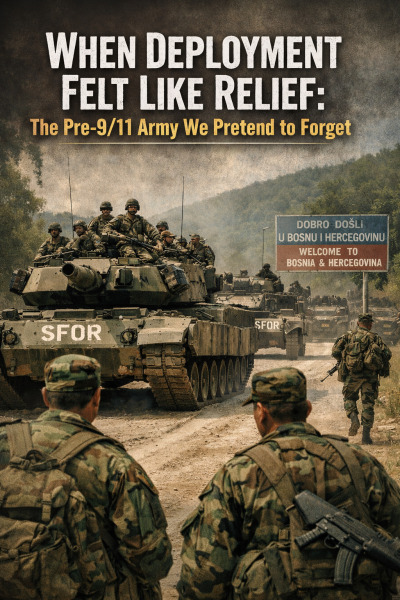
Here’s the part that should make people uncomfortable: many of those same soldiers would rather deploy to Bosnia than stay in those barracks.
Let that sink in.
Bosnia wasn’t a vacation. It was post-conflict stabilization—uncertain, austere, and operationally real. But at least the hardship made sense. When you’re downrange, discomfort has a purpose. You expect rough conditions. You accept them because the mission demands it.
Back in Germany? That wasn’t hardship. That was neglect.
And soldiers know the difference.
This wasn’t just a Büdingen problem—it was a snapshot of the pre-2001 Army. After the Cold War, budgets tightened while commitments didn’t. Under Bill Clinton, the force shrank, but the task list didn’t. Bosnia. Kosovo. Rotations stacked on rotations. The operational tempo stayed high while the infrastructure aged in place.
What did that look like in real life?
Barracks that should’ve been condemned but weren’t.
Motor pools held together with ingenuity and spare parts scavenged from other broken vehicles.
Training schedules dictated as much by fuel allocations as by readiness requirements.
A constant, quiet understanding that if something broke, it might stay broken for a while.
And yet—we survived. More than that, we executed. Units deployed, missions got done, and the Army maintained credibility on the world stage.
Why?
Because the system leaned heavily on the one thing it still had in abundance: soldiers who would make it work anyway.
NCOs became magicians. Leaders triaged priorities. Soldiers adapted. If a vehicle wasn’t running, you fixed it. If the barracks were a mess, you lived around it. If the plan didn’t survive first contact with reality, you adjusted and drove on. There was a grit to that Army that’s hard to replicate.
But let’s not romanticize it.
That grit was compensating for systemic underinvestment.
The Bosnia example makes the point better than any budget chart ever could. When your soldiers would rather deploy to a post-war environment than remain in garrison housing, something is fundamentally broken. That’s not toughness—that’s a vote of no confidence in how the institution is taking care of its own.
Then 9/11 happened, and the equation changed overnight.
The September 11 attacks didn’t just launch two decades of war—they forced a reckoning. Suddenly, readiness wasn’t theoretical. Equipment that didn’t work wasn’t an inconvenience—it was a liability that could get people killed. Barracks, maintenance, modernization—these weren’t “nice to have” anymore. They were directly tied to combat effectiveness and retention.
Money followed.
The Army that emerged in the 2000s and matured into what we see in 2026 is fundamentally different. Better equipment. Better housing. Better sustainment. Not perfect—but a far cry from the “make do” force of the late ’90s.
And maybe that’s exactly the point.
The pre-2001 Army proved something important: American soldiers can endure almost anything and still accomplish the mission. But that doesn’t mean they should have to. Endurance is not a substitute for leadership. Improvisation is not a long-term strategy.
Büdingen and Bosnia sit on opposite ends of the same lesson.
In Bosnia, hardship had meaning.
In Germany, hardship had excuses.
Soldiers will tolerate the first all day long. The second erodes trust.
So yes, today’s Army is different. Better funded. Better equipped. More attentive to quality of life. And that’s not softness—it’s a recognition, earned the hard way, that how you treat soldiers in garrison shows up later on the battlefield.
Because when the institution neglects the basics, soldiers notice.
And when soldiers start preferring deployment over coming home, you don’t have a toughness problem.
You have a leadership problem.
If you enjoyed this article, then please REPOST or SHARE with others; encourage them to follow AFNN. If you’d like to become a citizen contributor for AFNN, contact us at managingeditor@afnn.us Help keep us ad-free by donating here.
Substack: American Free News Network Substack
Truth Social: @AFNN_USA
Facebook: https://m.facebook.com/afnnusa
Telegram: https://t.me/joinchat/2_-GAzcXmIRjODNh
Twitter: https://twitter.com/AfnnUsa
GETTR: https://gettr.com/user/AFNN_USA
CloutHub: @AFNN_USA