The FOBbit: How the Army Turns Warriors Into PowerPoint-Slinging Indoor Cats
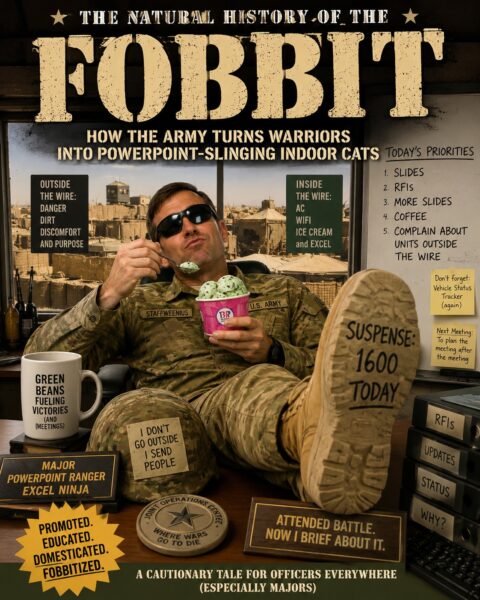
The Army has a remarkable ability to take a perfectly functional warrior, promote him a few times, hand him three computer monitors, and turn him into a PowerPoint-slinging indoor cat. Thus begins the evolution of the FOBbit: that mysterious creature who once went outside the wire but now survives on RFIs, synchronization meetings, Green Beans coffee, and Baskin-Robbins. The real horror comes when you finally look down at your ice cream, look at your clean uniform, hit “Send” on another 1600 suspense, and realize the terrible truth: Oh, $h!tt! I’m the FOBbit.
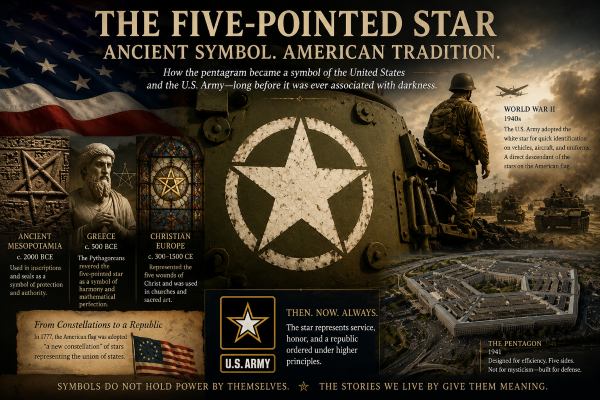
Why the U.S. Army Adopted an Ancient Symbol for a Logo

The five-pointed star was a symbol of harmony, divine order, and protection for thousands of years before Hollywood and occult writers gave it a darker reputation. The Greeks saw mathematical perfection in its lines, Christians saw the wounds of Christ, and the American founders saw a “new constellation” representing a republic of united states. The geometry never changed. The story did. And when the U.S. Army painted a white star on tanks and aircraft, it was not invoking ancient magic—it was carrying forward one of humanity’s oldest and most enduring symbols of order, purpose, and identity.

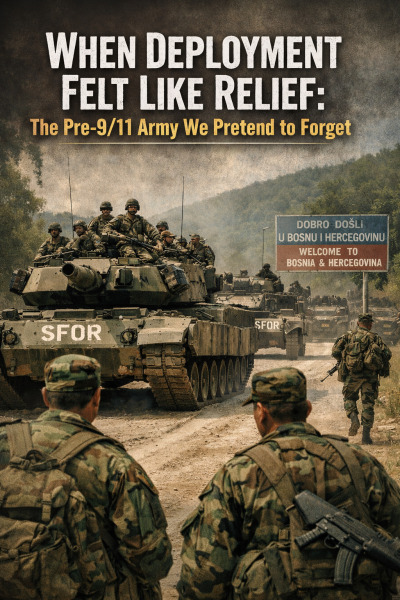
When Deployment Felt Like Relief: The Pre-9/11 Army We Pretend to Forget

Büdingen, Germany, late ’90s. The barracks were “historic,” which was Army-speak for old, fragile, and nobody wants to pay to fix it. The plumbing was past its expiration date—backups, leaks, that constant low-grade stench that never quite left your clothes. And that’s where we put our enlisted soldiers. The pitch from leadership bordered on parody: “You’re living in a historic building—Adolf Hitler once gave a speech here. See the photo!” That didn’t land. Not even close.