Somewhere in the Pentagon filing cabinets sits a 2017 document that reads less like doctrine and more like a warning label we ignored. The Joint Concept for Access and Maneuver in the Global Commons (JAM-GC) laid it out plainly: the United States wins wars because we can show up anywhere on earth, kick in the door, and maneuver freely across air, sea, space, and cyber. That’s our superpower. Not just firepower—access.
And the bad guys figured that out.
JAM-GC wasn’t written for Iran. It was written for a Pacific slugfest with China—long distances, island chains, anti-ship missiles, the whole “Pacific chessboard” narrative. The assumption baked into every briefing slide was that we’d be fighting our way across water, seizing terrain, opening lanes, and restoring freedom of movement like some modern-day island-hopping campaign.
Here’s the problem: the Strait of Hormuz is not the Pacific.
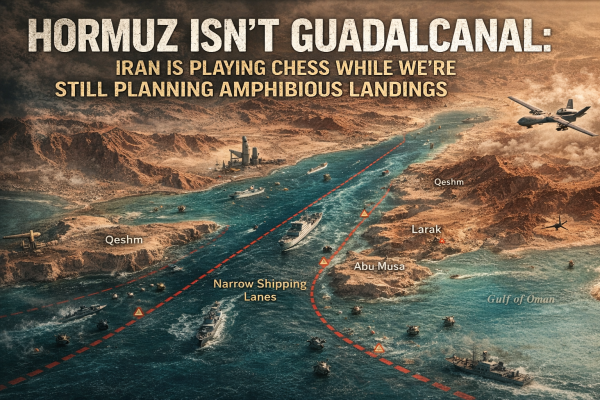
It’s a 21-mile-wide choke point with shipping lanes squeezed even tighter, bordered by a country that has spent the last two decades studying exactly how to make that space lethal. This isn’t Guadalcanal. There is no stepping-stone campaign here. There is no clean flank. There is no “we’ll just take that island and move on.” This is a knife fight in a hallway—with the hallway wired for explosives.
And Iran? They’ve been paying attention.
They didn’t try to build a navy to rival ours. That would be stupid. Instead, they built exactly what JAM-GC warned about: a layered anti-access/area-denial (A2/AD) system designed to make getting into the fight more painful than staying out of it. Coastal missile batteries. Naval mines. Fast attack craft swarms. Drones feeding targeting data. Dispersed launchers tucked into terrain and islands like Qeshm and Abu Musa. You don’t defeat that with a PowerPoint and a carrier strike group. You grind through it—slowly, expensively, and under constant risk.
And that’s the point.
Iran isn’t trying to beat the U.S. military in a fair fight. They’re trying to break the American way of war. JAM-GC says we must ensure access and freedom of maneuver. Iran says, “No, you don’t.” They’re not contesting us symmetrically—they’re turning the entry itself into the battle.
Every tanker becomes a liability. Every escort mission becomes a multi-domain problem. Mine-clearing turns into a high-risk, time-consuming slog. Ships operate under missile threat from land they can’t easily neutralize without escalation. Drones extend Iran’s eyes. Swarm boats compress decision-making timelines. It’s death by a thousand complications.
And here’s where it gets worse—because this isn’t just maritime denial.
Iran has extended A2/AD inland. You don’t just “get ashore” and start maneuvering like it’s 1944. You land into a pre-wired kill zone tied to interior lines, mobile fires, and distributed forces. Logistics becomes the real target. Sustainment becomes the vulnerability. Every mile inland stretches exposure back to that same narrow strait you barely secured in the first place.
This is not an island campaign. This is a system.
JAM-GC understood that future wars would begin in contested environments, not after access was achieved. Iran took that idea and operationalized it. They’ve turned geography into a weapon and layered it with just enough capability to make any U.S. response messy, slow, and politically radioactive.
And that’s the strategic punchline nobody wants to say out loud: Iran doesn’t have to win.
They just have to make it hurt long enough.
The Strait of Hormuz carries a massive portion of the world’s oil. You don’t need to close it forever. You close it for a month, maybe two. Prices spike. Markets panic. Allies start asking hard questions. Domestic pressure builds. Suddenly, the conversation in Washington isn’t about victory—it’s about cost.
That’s A2/AD done right.
While we were building doctrine for a high-end Pacific fight, Iran built a real-world application of that doctrine in one of the most strategically important chokepoints on the planet. Not bigger. Not better. Just smarter for the fight they intend to have.
So no—this isn’t a quick strike. It’s not a “slam dunk.” And it sure isn’t island hopping.
It’s a contested entry into a kill box designed specifically to neutralize our greatest advantage.
And if we don’t respect that, Hormuz won’t just be a battlefield.
It’ll be a bill we will regret paying, for still nebulous strategic objectives.
Concept originally developed by Michael E. Hutchens, William D. Dries, Jason C. Perdew, Vincent D. Bryant, and Kerry E. Moores in the Joint Concept for Access and Maneuver in the Global Commons (JAM-GC), 2017.
If you enjoyed this article, then please REPOST or SHARE with others; encourage them to follow AFNN. If you’d like to become a citizen contributor for AFNN, contact us at managingeditor@afnn.us Help keep us ad-free by donating here.
Substack: American Free News Network Substack
Truth Social: @AFNN_USA
Facebook: https://m.facebook.com/afnnusa
Telegram: https://t.me/joinchat/2_-GAzcXmIRjODNh
Twitter: https://twitter.com/AfnnUsa
GETTR: https://gettr.com/user/AFNN_USA
CloutHub: @AFNN_USA
Crediting the leadership of Iran with possessing some 5th level military genius is a bit silly. And who thinks Trump is planning an amphibious landing? This article smacks of Democrat alarmism and “quagmire-mongering”.