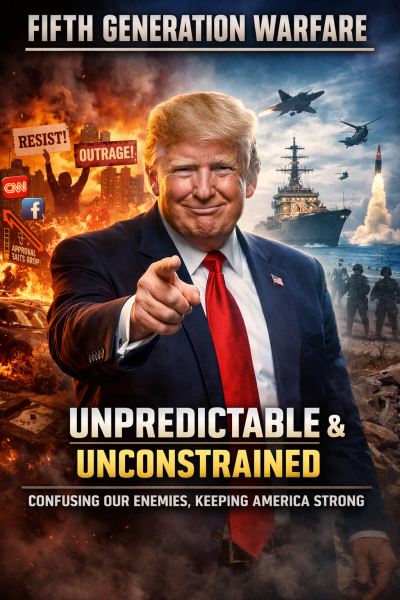
There’s a comforting myth Americans like to tell themselves: that chaos at the top equals incompetence. It helps people sleep at night. It gives pundits something tidy to package between commercial breaks. But what if what looks like irrational behavior isn’t a bug—it’s the feature? What if the perceived unpredictability coming out of Washington is less “off the rails” and more “off the script,” and very much on purpose?
We’ve seen this movie before, and the lesson was written in blood during the Vietnam War. The United States didn’t lose because it ran out of bombs, bullets, or body armor. It lost because it ran out of public will. The battlefield shifted from the jungle to the living room, and once the American people stopped believing, the strategy collapsed under its own weight. Since then, every adversary worth their salt—from insurgent groups to near-peer competitors—has studied that vulnerability like it’s the Rosetta Stone of defeating the United States: fracture the narrative, erode domestic support, and time will do the rest.
So now fast-forward to the modern era, where war isn’t just fought with tanks and missiles but with memes, media cycles, and manipulated outrage. Call it fifth-generation warfare, cognitive warfare, or just good old-fashioned psychological operations on steroids—the battlefield is perception. And in that fight, America’s greatest strength—an engaged, vocal, free-thinking public—can also be its greatest liability.
Enter the theory: what if the chaos is intentional?
When a leader like Donald Trump says something that makes half the country clutch their pearls and the other half cheer like it’s the Super Bowl, the immediate reaction is to label it reckless. Undisciplined. Unpresidential. And maybe it is. But there’s another possibility—one that makes people uncomfortable because it implies design rather than dysfunction.
What if pushing the boundaries of “acceptable” rhetoric is a way to harden the system against manipulation?
Think about it from an adversary’s perspective. For decades, the playbook has been simple: provoke outrage, amplify division, and let America tear itself apart. Use media, social platforms, and information operations to create the perception that leadership is constrained by public backlash. If the American people won’t tolerate a fight, the leadership won’t sustain one. That’s the assumption.
But what happens if that assumption no longer holds?
If a president demonstrates—repeatedly—that public outrage does not automatically translate into policy reversal, it introduces a new variable into the equation. The signal being sent is blunt: “You don’t get a veto through our media cycle. We’ll act if we think it’s necessary, whether Twitter likes it or not.” That’s not traditional statesmanship. It’s something closer to strategic unpredictability weaponized for deterrence.
In classic deterrence theory, predictability is supposed to stabilize the system. Everyone knows the rules, everyone knows the red lines, and nobody crosses them because the consequences are clear. But in a world of cognitive warfare, predictability can be exploited. If your adversary knows exactly how your public will react—and knows that reaction will constrain your options—then they can shape your decision space before you even make a move.
So one way to counter that is to break the model.
Act outside the expected norms. Say the thing you’re “not supposed” to say. Signal that domestic outrage is no longer a reliable pressure point. It’s messy. It’s uncomfortable. It looks like dysfunction. But it may also complicate an adversary’s calculus in ways that a polished press conference never could.
Of course, there’s a cost—and it’s not a small one.
Statesmanship exists for a reason. It builds trust with allies, reassures partners, and maintains a baseline of credibility in an otherwise volatile world. When you trade that for raw unpredictability, you don’t just confuse your adversaries—you risk confusing your friends. Alliances depend on a certain level of consistency, and when that erodes, so does confidence. The same behavior that signals strength to an opponent can look like instability to a partner.
And then there’s the domestic front. You can try to harden the system against manipulation, but you can also end up accelerating the very division you’re trying to neutralize. There’s a fine line between inoculating against information warfare and pouring gasoline on it. In a country already running hot, pushing rhetoric to the edge of rationality can either desensitize the population—or fracture it further.
That’s the razor’s edge this theory lives on.
So is it strategy or is it chaos? The honest answer is probably some of both. No administration operates with perfect coherence, and no leader is playing 4D chess every minute of the day. But dismissing everything as irrational misses the possibility that at least part of the behavior is adaptive—a response to a battlespace where perception is the weapon and narrative is the terrain.
What we may be witnessing isn’t the abandonment of strategy, but its evolution into a domain most Americans are still uncomfortable acknowledging: a war for the mind, where credibility, outrage, and unpredictability are all tools in the kit.
The uncomfortable truth? In that kind of fight, looking a little crazy might not be a liability.
It might be the point.
If you enjoyed this article, then please REPOST or SHARE with others; encourage them to follow AFNN. If you’d like to become a citizen contributor for AFNN, contact us at managingeditor@afnn.us Help keep us ad-free by donating here.
Substack: AmericanFreeNewsNetworkSubstack
TruthSocial:@AFNN_USA
Facebook: https://m.facebook.com/afnnusa
Telegram: https://t.me/joinchat/2_-GAzcXmIRjODNh
Twitter: https://twitter.com/AfnnUsa
GETTR: https://gettr.com/user/AFNN_USA
CloutHub: @AFNN_USA