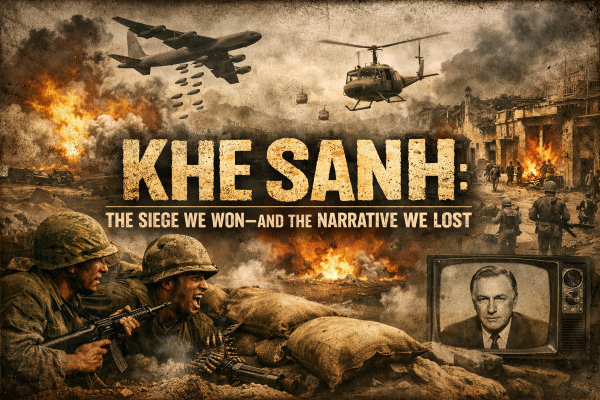
There’s a reason Khe Sanh still gets brought up in war colleges, smoky VFW halls, and late-night strategy debates. It wasn’t just a battle. It was a live-fire experiment in something we didn’t have a name for yet—what we now call fifth-generation warfare. Not bullets versus bullets. Not even armies versus armies. It was narrative versus reality.
And narrative won.
Let’s set the stage. Early 1968. A remote outpost near Laos—Khe Sanh Combat Base—held by U.S. Marines. About 6,000 Americans dug in. Surrounding them: tens of thousands from the People’s Army of Vietnam, tightening the noose. Artillery starts walking in. Resupply becomes a high-stakes air game. Every incoming round carries a message: You are surrounded.
Sound familiar? It should. It’s the same psychological framing used today—encircle, isolate, amplify fear.
The U.S. response was pure industrial-age warfighting. Operation Niagara—a firepower flex that would make a Roman god blush. B-52s dropping tonnage like it was going out of style. Sensors in the jungle. Constant airstrikes. Marines holding trenches under bombardment. If war were just math—inputs and outputs—this was dominance.
And tactically? We won. The base held. The siege broke after 77 days. The enemy took catastrophic losses.
Game over, right?
Not even close.
Because while Khe Sanh was grinding on, something else detonated across Vietnam: the Tet Offensive. Coordinated attacks in cities, including Saigon. Militarily, Tet was a disaster for North Vietnam. Strategically? It was a masterstroke.
Here’s where fifth-generation warfare enters the chat.
The American public didn’t see body counts. They saw chaos. They saw fighting in the U.S. embassy compound. They heard officials say “we’re winning,” and then watched cities burn on the evening news. Credibility cracked.
Khe Sanh, meanwhile, was framed as America’s potential Battle of Dien Bien Phu—a looming disaster, a colonial echo, a narrative trap. Whether Hanoi intended it as a diversion or a decisive battle is still debated. Doesn’t matter. The effect was the same.
They seized the story.
And once you control the story, you don’t have to win every fight. You just have to make your opponent’s victories feel pointless.
Which brings us to the most damning move of all: we held Khe Sanh… and then we abandoned it months later.
Let that sink in. Seventy-seven days of siege. Massive airpower. Blood, logistics, political capital—and then we blew it up and walked away.
You can explain that decision a dozen different ways. Shifting strategy. Reduced need for the outpost. Better positioning elsewhere. All of that may be true.
But here’s the only thing that mattered in a fifth-generation fight:
Perception.
To the American public, it looked like this: We fought hard for something we didn’t need.
To the enemy, it looked like this: We can make them bleed for ground they won’t keep.
To the world, it looked like this: The U.S. doesn’t know what it’s doing.
And just like that, a tactical victory became a strategic liability.
Enter William Westmoreland. He wasn’t fired—but he might as well have been. Reassigned to Army Chief of Staff after Tet. A promotion on paper. A quiet exit in practice. Washington didn’t want to admit failure, so it changed the face without changing the headline.
Classic move. Happens in corporations. Happens in politics. Happens in wars.
Because in fifth-generation warfare, admitting failure is more dangerous than failure itself.
Khe Sanh exposed a brutal truth: you can dominate the battlefield and still lose the war if you lose the narrative.
That lesson didn’t stay in Vietnam. It evolved.
Fast forward to today—information moves at light speed. Social media, AI amplification, algorithmic targeting. Back then, it took Walter Cronkite a broadcast to shift public sentiment. Now it takes a viral clip and a bot network.
Different tools. Same fight.
Encircle the perception. Attack credibility. Create cognitive dissonance. Make the enemy question their own success.
Khe Sanh wasn’t just a siege of Marines. It was a siege of American confidence.
And once that confidence cracked, everything else followed.
Here’s the takeaway, no sugar coating: Firepower wins battles. Narrative wins wars.
We proved we could hold Khe Sanh. Hanoi proved they could make it not matter.
That’s fifth-generation warfare—1968 edition.
If you enjoyed this article, then please REPOST or SHARE with others; encourage them to follow AFNN. If you’d like to become a citizen contributor for AFNN, contact us at managingeditor@afnn.us Help keep us ad-free by donating here.
Substack: AmericanFreeNewsNetworkSubstack
TruthSocial:@AFNN_USA
Facebook: https://m.facebook.com/afnnusa
Telegram: https://t.me/joinchat/2_-GAzcXmIRjODNh
Twitter: https://twitter.com/AfnnUsa
GETTR: https://gettr.com/user/AFNN_USA
CloutHub: @AFNN_USA