2:16 p.m.—We step off the plane in Adolfo Suárez Madrid-Barajas Airport, and it is pure chaos. People crowd this ginormous public space like ants swarming a fallen Tootsie Pop. This place is like Black Friday at Walmart, only with less exposed thong underwear.
As a rule, the Spanish dress more sharply and beautifully than we Americanos. Guys, girls, old men, old women, they all have excellent fashion. Even Spanish cops dress nicer than your average American investment banker.
I was standing in line and one of the female officers was inspecting my passport when I noticed she was wearing what appeared to be Gucci footwear.
“Are those Gucci?” I asked.
She looked at me flatly but said nothing.
“Cops are allowed to wear Gucci in uniform?” I said. “Outstanding.”
Still no response. She just cleared her throat and stared at me.
“Don’t worry,” I said. “Your secret is safe with me.”
She returned my passport calmly. “Have you ever seen the inside of a Spanish prison, sir?”
“No,” I replied. “But I’ll bet the inmates dress amazing.”
3:08 p.m.—We are now in an airport café trying to make sense of our train tickets, which are written using some kind of double-speak logic system.
We are asking everyone we meet for assistance, showing innocent bystanders our phone screens which display our digital tickets. Sadly, nobody seems to know how to interpret our passes.
So we go to customer service where a gentleman scrutinizes our tickets, then shakes his head ominously. “Today is a holiday, señor,” he says.
“Is that good?” my wife replies.
He shrugs. “Holidays good for some. Not for others.”
After his existentialist riddle, Grasshopper hands us our tickets back and beckons the next customer.
And already I’m getting that wonderfully helpless feeling you get when you travel internationally. It’s a lower body sensation that manifests physically, and can only be described as “puckering.”
4:32 p.m.—We find our train. But this isn’t easy inasmuch as the number on the train keeps changing from a one to a two. The digital screen on the train flashes “one” for a few seconds, then flashes “two.”
“I don’t know if this is the right train,” I say to a railway employee. “It keeps flashing both numbers.”
He looks at my ticket and helpfully says, “Okie dokey.”
I am confused by this.
“Which train is this?” I ask. “One or two?”
“Okie dokey,” he points out.
My wife whispers, “I think those are the only English words he knows.”
So I rephrase my question using clear, articulate middle-schooler Spanish, as taught by Mrs. Allen. The man is thrilled that I speak Spanish. His face lights up. He answers with such rapid Español that he is not, technically, using any consonants. I have no idea what he just said. For all I know he might have been reciting the 1978 Spanish Constitution.
“Comprende?” he asks.
“Okie dokey,” I reply.
6:28 p.m.—We are watching the landscape pass at eye level from a train window. The Galician mountains are soft, fuzzy, green, Muppet-style mountains. Almost too perfect to be real.
These mountains sort of feel like home. Last year we spent a month trekking across Spain’s mountains, wearing their mud and grit as a daily uniform as we walked our first Camino. Once you bond with mountains, you can never un-bond.
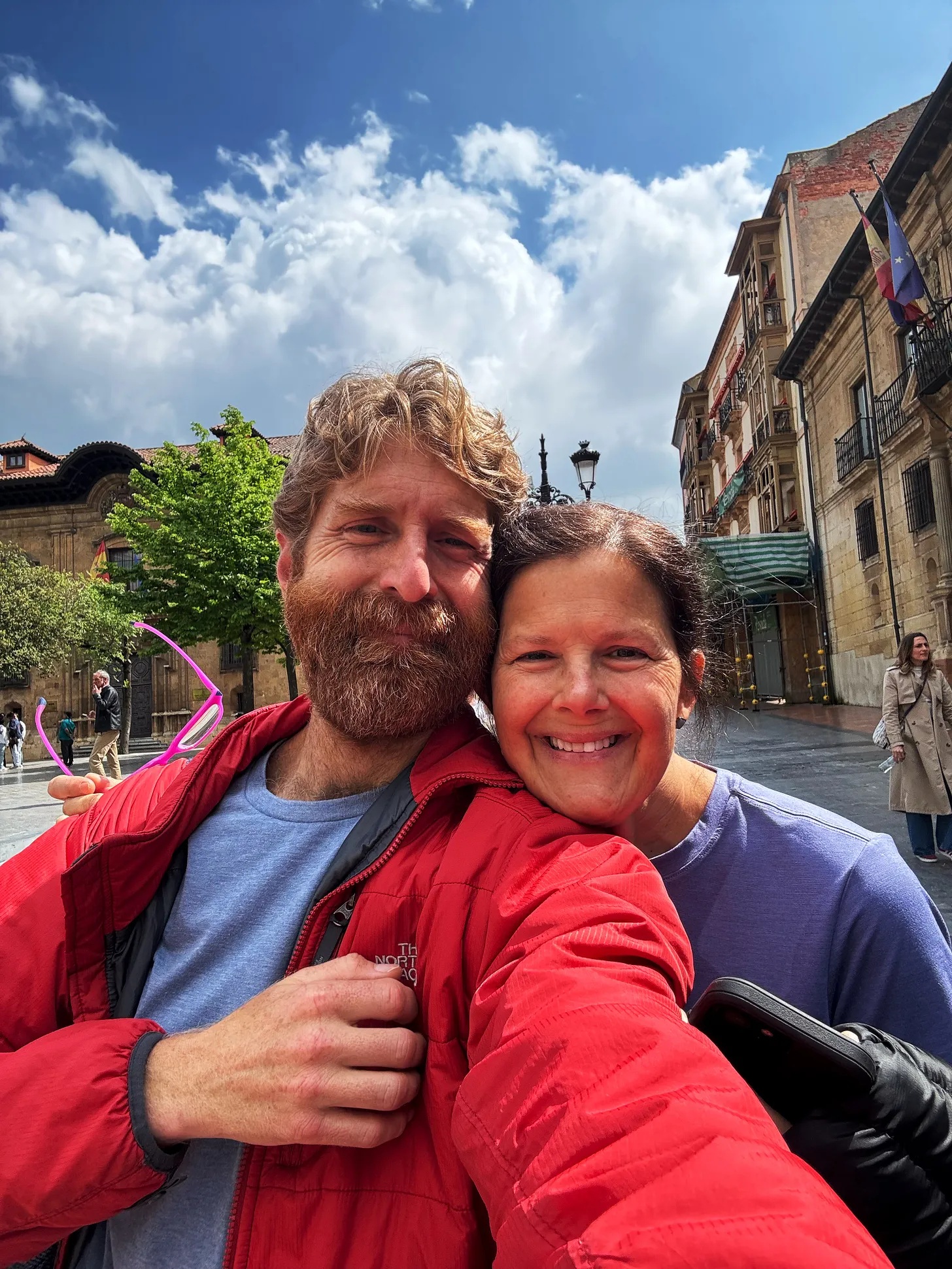
8:11 p.m.—We arrive in Oviedo. This is where the Camino Primitivo route will begin. History’s oldest Camino route. Perhaps the oldest pilgrimage in the world, second only to the pilgrimages to Jerusalem, or Pigeon Forge.
Nearly 1,500 years ago, antiquity’s first pilgrim to Santiago started his walk right here. This pilgrim, like all thereafter, walked for one reason alone: the search for union with God. And I find myself wondering how these Spanish pilgrims faced hunger, illness, the elements, and the very real threat of no WiFi. Many of them died in their quest. And worse, many of them would die without ever finding a personal relationship with Gucci.
8:36 p.m.—The streets of Oviedo are so alive. I am traveling with a fiddle attached to my backpack. My fiddle seems to endear me to the locals. They are constantly asking what kind of instrument is in my case and do I want another beer?
“You mean it is a violín?” they ask.
“No,” I say. “A fiddle.”
“What’s the difference between a violín and a fiddle?”
“Nobody cares if you spill beer on a fiddle.”
They treat music so reverently here. I have been a musician all my life, music is how I have earned a living since age 14. Music is not revered in the US. Why is it so seemingly cherished in Spain? I ask an old man at the bar about this.
“In España,” he says, exhaling a cloud of smoke, “music, writing, and art are considered the most noble and holy of callings. Is it not this way in the US?”
Not really, I explain. In the US, when someone finds out you’re a musician, they just say “Good for you,” and then pay you for the pizza.
9:02 p.m.—Oviedo is amazing. The Spanish are warmhearted, but they don’t advertise it. At first they seem aloof, until you talk to them. Then they open up like pink Home Run roses.
Tonight, throngs of children are playing in the park. Groups of old women cross the street arm-in-arm. The outdoor cafés are doing huge business.
The streets are swarming with teens. The adolescents are unsupervised. I see no helicopter parents. No leashes. And these teens act differently than American teens. They are outwardly joyful and affectionate, not at all self-conscious. I see no phones among their numbers—although I’m certain they exist.
Moreover, the teens look each other in the eyes when they speak. They seem to have no issues conversing with random adults. For example, I ask a local kid in a café for directions. He is 13, unsupervised, well-spoken, amiable, and has no problem making eye contact with his waitress. In short, he is not awkward.
9:19 p.m.—We are still in search of our inn. But our GPS and cell service is not working. So, we are standing at a crosswalk, amidst a large crowd, wearing heavy backpacks, unsure of which way to walk. Lost as all get-out.
There is an older woman beside me who turns and casually says, “Where y’all from?”
At first, I’m not sure I hear this stranger correctly. Her words take a second to sink in.
“Ma’am,” I reply, “did you just say ‘y’all?’”
Her accent is unmistakably Cajun. “Well, they’s two a’you, ain’t they?”
Her name is Dolly, from Louisiana. She lives here. She just moved here a few months ago.
“I’m from Lafayette originally,” she says. “One day, back in 2014, I decided to hike the Camino. I left for Spain the day after I retired.
“It changed me. The people I met. The love I felt. So I hiked more Caminos, and I was never the same. And, well, now I live here.”
Dolly walks alongside us, showing us around the city, helping us find our inn. We feel incredibly indebted to her. She is our angel. I don’t know why Dolly was at that particular crosswalk, at that particular time, but we are probably keeping her from doing something important.
“Something important?” she says with a laugh. “No, I was out walking tonight because something just told me I needed to take a walk.”
There are no accidents.
Okie dokey?
Questions: SeanDietrich@gmail.com
Visit the Sean of the South Website
Find out where you can see Sean live.
Originally published on Sean’s website. Republished here with permission.
If you enjoyed this article, then please REPOST or SHARE with others; encourage them to follow AFNN. If you’d like to become a citizen contributor for AFNN, contact us at managingeditor@afnn.us Help keep us ad-free by donating here.
Substack: American Free News Network Substack
Truth Social: @AFNN_USA
Facebook: https://m.facebook.com/afnnusa
Telegram: https://t.me/joinchat/2_-GAzcXmIRjODNh
Twitter: https://twitter.com/AfnnUsa
GETTR: https://gettr.com/user/AFNN_USA
CloutHub: @AFNN_USA