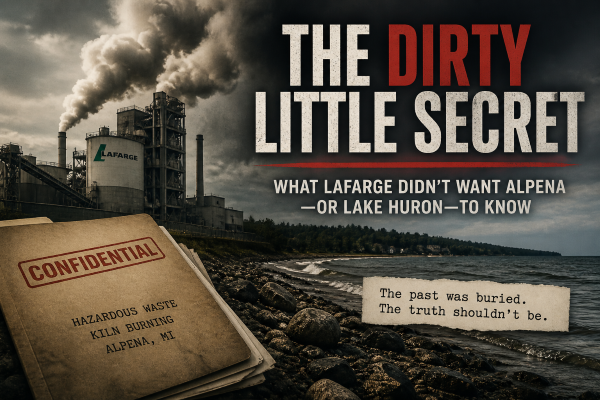
There’s a special kind of optimism required to live in a place where the air smells vaguely industrial, the water conversation starts with acronyms like PFAS, and the biggest employer once decided the best way to save on fuel was to burn other people’s chemical garbage. Welcome to Alpena, Michigan—where “innovation” in the 1990s came with a smokestack and a waiver.
Back then, the cement plant—run by Lafarge Corporation and its subsidiary Systech Environmental—pitched a brilliant idea: instead of burning traditional fuels, why not torch hazardous waste in the kiln? Tires, solvents, industrial byproducts—if it could burn, it could earn. Companies paid to get rid of their waste, Lafarge saved on fuel, and everyone shook hands like they’d just invented fire.
The pitch was wrapped in the kind of language only a regulatory lawyer could love: “resource recovery,” “alternative fuels,” “energy efficiency.” What it meant in plain English was this: Alpena became a destination for waste that nobody else wanted, cooked at 2,500 degrees and released into the same air the locals were breathing.
Now, to be fair—and let’s be painfully fair—cement kilns are hot enough to destroy a lot of nasty stuff. That’s the industry’s core argument, and it’s not entirely fiction. But here’s where things get less comforting: destroying something chemically doesn’t mean it disappears into moral purity. Combustion transforms. It doesn’t absolve. You still get emissions. You still get residues. And depending on what you’re burning, you may get trace amounts of compounds that don’t exactly belong in a healthy ecosystem.
Back in the 1990s, people noticed. Local groups raised concerns about emissions, heavy metals, and long-term exposure risks. They weren’t wearing tinfoil hats—they were asking basic questions: What’s coming out of that stack? Where is it going? And why does it seem like we’re the ones hosting everyone else’s toxic leftovers?
Fast forward to today, and here’s where things get uncomfortable.
Northeast Michigan—including Alpena County—has been noted in various public health datasets as having higher-than-average cancer rates compared to state averages. That’s not a conspiracy theory. It’s data. But before anyone grabs a pitchfork or a lawyer, let’s state the obvious like adults: correlation does not equal causation.
Cancer rates are influenced by a long list of variables—age demographics, smoking rates, occupational exposure, genetics, access to healthcare, and environmental factors. Alpena checks several of those boxes. It’s an older population. It has a blue-collar industrial history. It has environmental exposures beyond just one facility—everything from legacy industrial runoff to modern contaminants like PFAS.
So no, you cannot point a finger at a smokestack from 1992 and declare, “That’s the smoking gun.” That’s not how science works.
But here’s the part that keeps this from being neatly dismissed: patterns matter. When a community with known industrial exposure histories shows elevated health concerns, the correct response isn’t denial—it’s investigation. Not panic. Not PR spin. Just honest, uncomfortable inquiry.
Because if everything was perfectly safe, you wouldn’t need to keep explaining it.
And this is where Alpena’s story gets stuck in neutral. Instead of a full-throated, transparent reckoning with its industrial past and present, what you get is a kind of collective shrug. The plant still operates. The region still markets itself as pristine Great Lakes shoreline. And the uncomfortable questions get filed somewhere between “economic necessity” and “please don’t scare off tourism.”
It’s a delicate balancing act. On one hand, the cement plant has been a major employer—arguably a backbone of the local economy. On the other, nobody signs up to be part of a long-term environmental case study.
That tension—jobs versus health, industry versus environment—isn’t unique to Alpena. It’s the American story in miniature. But Alpena has a twist: it’s small enough that the effects, real or perceived, feel personal. When cancer rates are higher than average, it’s not an abstract statistic. It’s your neighbor. Your coworker. Your family.
So where does that leave things?
Somewhere between skepticism and responsibility.
No, there is no definitive proof that burning hazardous waste in Alpena’s cement kiln caused elevated cancer rates. But the combination of historical industrial practices, environmental concerns, and public health data absolutely raises questions worth answering—not dismissing.
And here’s the uncomfortable truth: communities that don’t ask hard questions tend to become footnotes in someone else’s report later.
Alpena doesn’t need outrage. It doesn’t need denial. It needs clarity. Transparent environmental monitoring. Honest health studies. And the willingness to follow the data wherever it leads—even if it makes people uncomfortable.
Because “trust us, it’s safe” ages about as well as a 1990s waste-burning permit.
And if nothing’s wrong? Great. Prove it.
If something is? Then maybe it’s time Alpena stops being the place where problems go to disappear in a kiln—and starts being the place that finally asks what’s been left behind.
If you enjoyed this article, then please REPOST or SHARE with others; encourage them to follow AFNN. If you’d like to become a citizen contributor for AFNN, contact us at managingeditor@afnn.us Help keep us ad-free by donating here.
Substack: American Free News Network Substack
Truth Social: @AFNN_USA
Facebook: https://m.facebook.com/afnnusa
Telegram: https://t.me/joinchat/2_-GAzcXmIRjODNh
Twitter: https://twitter.com/AfnnUsa
GETTR: https://gettr.com/user/AFNN_USA
CloutHub: @AFNN_USA