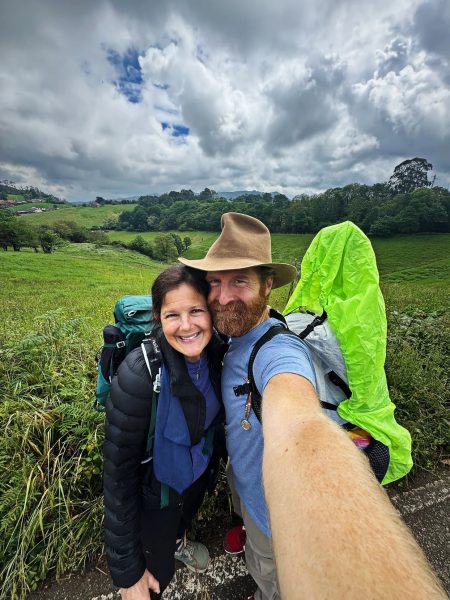
Our first day walking the Camino. We leave our inn at Oviedo a little after daybreak.
There are no people on the streets. No cars. Only one stray dog, dutifully cleaning his privates, and one old man hosing down a section of street in front of his shop while smoking a cigar the size of a grown man’s upper thigh.
We wind through the city, heavy-laden with the packs upon our backs, making our way past the Catedral de San Salvador. I’ve forgotten how heavy a backpack can be. It’s been a year since my last Camino. There are some things you forget.
We say a quick prayer outside the cathedral. And just like that, our feet are officially on the Camino Primitivo.
It isn’t long before we are in pure mountains. The hillsides swoop upward, through dense forests, past white-foamed streams, along picturesque mountain pastures composed solely of sheep manure.
Monstrous cumulus clouds overtake our mountains, and the air grows spicy with the smell of fresh mint and the scent of coming rain. Distant claps of thunder sound, and a quilt of mist falls from the iron sky.
The earth is muddy and soupy. The smell of foliage becomes so strong it waters your eyes.

We pass our first pilgrim of the day. A small older woman with red pixie-cut hair, a smile on her face, and a German accent. She pauses every mile to remove a leather-bound book from her backpack and recite scripture quietly to herself. Then she prays the Anima Christi in Latin.
The incline grows steeper with each step until our noses are touching the soil as we trek ever upward.
After a full day of walking, we arrive at our albergue in the hamlet of Palatína. Although to call this a village would be gracious. Palatína is merely a wide spot on the trail.
Pablo and Oscar are there to receive us. There are only a few other pilgrims at our albergue, sitting under a tent to escape the downpour, resting weary and soaked feet, guzzling pints of surgically cold beer.
Oscar is deaf. He speaks no Inglés but communicates with gestures in a way that can only be referred to as artwork. I am amazed how people of all languages understand his communication, and yet he uses no words.
“You are an excellent communicator,” I tell Oscar, making sure to use enunciative movements with my mouth.
Oscar reads lips. “Gracias,” he replies.
I shake his hand and then fingerspell my name via the manual alphabet.
He smiles.
“Pleasure to meet you, Sean,” he says in a clear voice.
Pablo also works here. He is a big man, loud and happy, with the comedic sensibility of Chris Farley, and the personality of Zorba the Greek. He is quick with a joke and full of one-liners.
Pablo asks whether he might borrow my hat while he does his work.
“Sí,” I say, handing him my hat.

He wears my hat and serves customers, tipping his brim after each transaction. Each of his customers is European, with the standard-issue Euro aloofness and withdrawn disposition. But asocial behavior does not last in the wake of Pablo’s joy. All standoffish attitudes vanish in Pablo’s presence like flatulence in a Category-Four tropical storm.
At supper, pilgrims all gather in the dining room. We are sleepy and starving. Conversation around the table is pinched. The Swedes are reserved, the Germans are detached, the Czechs are stoic, the French are—well, French.
That is, up until Pablo arrives. He manages to draw everyone out of their respective shells. He brings our dinner, our wine, and he is singing.
Meantime, Tatiana, our cook, is making sure everyone around the table is satisfied. She tells us the story of how she started this place seven years ago. She came from a farming family. Her mother taught her to cook, and this was all she ever wanted to do. To run an inn, and to serve pilgrims, to bring travelers joy.
“My mama teach’a me to cook with love. This is only ingredient that matter, she say.
“It is not the quality of recipe that matter. It is not the spice. It is not the meat or the vegetables. It is the love.
“If you have the love, and you put this into whatever you do, everyone will feel and taste the joy of life, and your energía will affect them. Love can change even the blandest dish into perfección.”
Pablo is leaning backward in a chair, my hat still on his head. In a loud voice he says, “And so it is with life, no?”
And so it is with life.

Questions: SeanDietrich@gmail.com
Visit the Sean of the South Website
Find out where you can see Sean live.
Originally published on Sean’s website. Republished here with permission.
If you enjoyed this article, then please REPOST or SHARE with others; encourage them to follow AFNN. If you’d like to become a citizen contributor for AFNN, contact us at managingeditor@afnn.us Help keep us ad-free by donating here.
Substack: American Free News Network Substack
Truth Social: @AFNN_USA
Facebook: https://m.facebook.com/afnnusa
Telegram: https://t.me/joinchat/2_-GAzcXmIRjODNh
Twitter: https://twitter.com/AfnnUsa
GETTR: https://gettr.com/user/AFNN_USA
CloutHub: @AFNN_USA