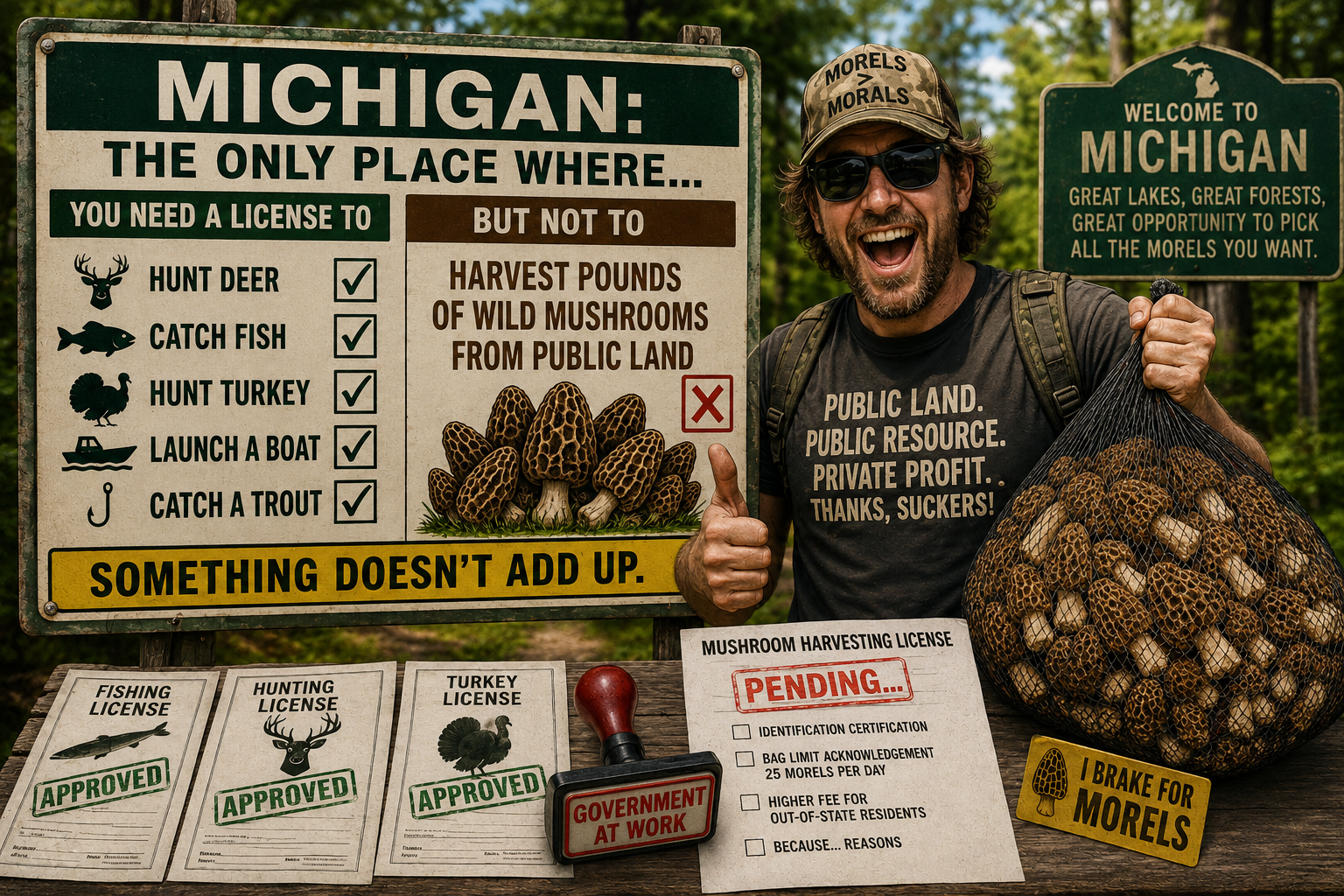
Every spring in Michigan, the forests erupt into a full-scale fungal gold rush. Pickup trucks jam two-tracks. Facebook groups trade morel coordinates like cartel smugglers swapping contraband routes. Grown adults crawl through the woods in camouflage carrying mesh bags full of mushrooms worth more per pound than some cuts of steak. And through all of it, the State of Michigan collects exactly zero dollars from one of the largest seasonal harvest activities on public land.
That’s insane.
Michigan already requires licenses for deer hunting, fishing, trapping, waterfowl, and enough other outdoor activities to make a printer cry ink cartridges. The justification is always the same: conservation. Public resources require funding. Habitat management costs money. Enforcement costs money. Public access costs money.
Fine. Fair enough.
Then explain why mushroom hunters get a free pass while extracting a valuable natural resource from public land by the pound.
If you harvest from the public resource, you should help support the public resource. That principle somehow becomes controversial only when people wearing cargo shorts and carrying morels get involved.
So here’s the logical solution: Michigan should establish a mushroom harvesting license system.
Not because mushrooms are evil. Not because Grandma picking six morels for dinner is a threat to civilization. But because consistency matters. Hunters and anglers have carried conservation funding on their backs for decades while another exploding outdoor activity contributes almost nothing directly to the system maintaining the land they use.
Start with a simple resident mushroom permit. Ten or fifteen bucks annually. Cheap enough that nobody honest could claim financial oppression with a straight face.
Non-residents? Different story.
Out-of-state harvesters should absolutely pay more.
Michigan already does this with hunting and fishing licenses because residents already support state resources through taxes. Meanwhile every spring, non-residents flood into northern Michigan chasing morels like it’s woodland cryptocurrency season. If someone wants to drive up from another state and fill coolers with mushrooms harvested from Michigan public lands, they can help pay for the forests, roads, DNR staffing, and land maintenance they’re using.
Call it a non-resident mushroom stamp. Fifty bucks. Maybe more.
And yes — before the internet starts hyperventilating — there should also be a daily bag limit.
Twenty-five morels per day per licensed harvester.
Why? Because the current “take however much you can carry” system is idiotic. Social media already transformed mushroom hunting from a quiet hobby into organized extraction. Entire groups sweep productive areas clean before average families even arrive. Some people harvest commercially while contributing absolutely nothing back into conservation funding.
That’s not tradition anymore. That’s resource exploitation wearing flannel.
A reasonable daily limit would preserve recreational access, reduce commercial abuse, and help maintain long-term sustainability. Hunters already accept bag limits. Anglers already accept creel limits. Apparently mushrooms are the only magical category where unlimited public harvesting is supposed to continue forever because feelings.
Then comes the funniest part of all: mandatory mushroom identification certification.
And honestly, this may be the most defensible part of the entire idea.
Michigan requires hunter safety courses because mistakes with firearms can kill people. Well, news flash: mistakes with mushrooms can kill people too. The forests contain toxic species capable of causing liver failure, organ damage, hallucinations, and death. Yet right now the official statewide safety standard is basically, “Good luck, buddy.”
That’s absurd.
A basic online certification course covering morel identification, toxic lookalikes, sustainable harvesting practices, and public land ethics would take maybe an hour to complete. Most people could pass it while sitting on the toilet scrolling conspiracy memes. The course could prevent poisonings, reduce ecological damage, and educate new foragers who learned everything they know from a guy on TikTok named “FungiBro420.”
Because let’s be honest: some people absolutely should not be free-styling mushroom identification based on vibes and optimism.
And before somebody screams “tyranny,” relax.
This entire argument is exposing the inconsistency of the modern regulatory state. Michigan already regulates virtually every other form of public resource harvesting. The only reason mushrooms remain untouched is because mushroom hunting slipped through the cracks before government bureaucracy fully evolved into its final Pokémon form.
If morels were discovered tomorrow instead of inherited as an old tradition, there is zero chance they would remain unregulated. The state would immediately create seasonal permits, harvest quotas, educational requirements, enforcement officers, mandatory online reporting, and probably a “Fungal Equity Advisory Council” by lunchtime.
The joke is that everybody knows this sounds believable.
And the deeper joke is that many of the same people furious about the idea already accept dozens of nearly identical systems elsewhere without question.
Michigan hunters fund conservation. Michigan anglers fund conservation. Mushroom hunters use the same public lands, roads, forests, parking areas, and enforcement infrastructure while paying essentially nothing specifically toward maintaining them.
So if we’re going to pretend conservation licensing is morally necessary for deer, fish, and waterfowl, then the logic should apply consistently.
Otherwise we’re just admitting what everybody already suspects: government regulations are often less about principle and more about which groups became politically organized first.
Meanwhile Todd from Ohio is still hauling forty pounds of free morels out of a Michigan state forest in cargo shorts while the guy fishing bluegill nearby had to buy three different licenses and a trout stamp just to exist legally near water.
If you enjoyed this article, then please REPOST or SHARE with others; encourage them to follow AFNN. If you’d like to become a citizen contributor for AFNN, contact us at managingeditor@afnn.us Help keep us ad-free by donating here.
Substack: American Free News Network Substack
Truth Social: @AFNN_USA
Facebook: https://m.facebook.com/afnnusa
Telegram: https://t.me/joinchat/2_-GAzcXmIRjODNh
Twitter: https://twitter.com/AfnnUsa
GETTR: https://gettr.com/user/AFNN_USA
CloutHub: @AFNN_USA