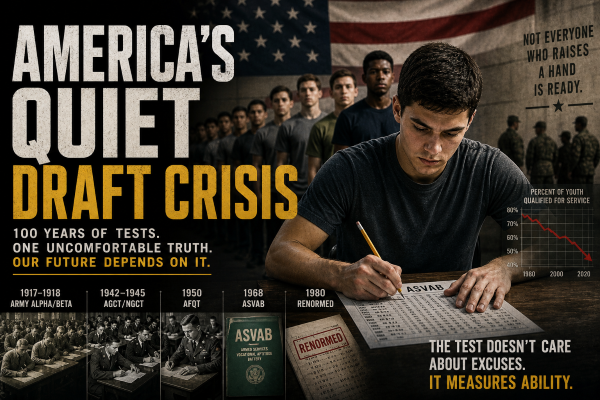
The United States has been running a rolling national aptitude audit since 1917. Not a think-tank paper, not a Twitter poll—a hard, cold intake valve where reality shows up in boots and a social security number. Call it the Army Alpha, the AGCT, the AFQT, or today’s ASVAB. The label changes. The message doesn’t.
For a century, the Department of Defense (now DoW) has asked a brutally simple question: can you read, can you reason, can you do basic math, can you learn a job without turning equipment into modern art? This isn’t about genius. It’s about baseline competence—the kind that keeps helicopters in the sky and generators from becoming bonfires.
And every few decades, that question returns an answer Washington would prefer not to read out loud.
Start in 1917. The Army Alpha/Beta tests weren’t born out of academic curiosity—they were emergency triage. Millions of recruits, many illiterate, many barely schooled, some unable to understand English. The Army learned the first hard lesson: a diploma doesn’t mean you can actually do anything. It just means someone signed a piece of paper.
Fast forward to World War II. Same story, just with better clipboards. The military sorted millions using standardized tests because it had to. You don’t build a modern force on vibes and good intentions.
Then comes the modern era. The ASVAB rolls out in 1968, standardized across all services by 1976. This is where things get interesting—and by “interesting,” I mean embarrassing.
Between 1976 and 1980, the ASVAB was “misnormed.” Translation: the measuring stick was bent. Scores were inflated. The services thought they were bringing in a certain level of aptitude. They weren’t. The Pentagon had essentially been grading on a curve it didn’t understand. When they fixed it in 1980, scores dropped—not because the nation suddenly got dumber overnight, but because the illusion evaporated.
That’s not a conspiracy. That’s a calibration failure. But it revealed something more uncomfortable: the system outside the military—the schools, the pipelines, the institutions feeding recruits—was not producing what the military thought it was.
And here’s where the modern storyline turns from awkward to ugly.
Today, the recruiting crisis isn’t just about numbers. It’s about quality. The pool of young Americans who are academically, physically, and behaviorally qualified for service is shrinking. Not slightly. Materially. The Pentagon has said for years that a majority of youth are disqualified for multiple reasons—low aptitude, poor fitness, medical issues, drugs, criminal records. It’s not one problem. It’s a buffet of dysfunction.
Meanwhile, the education system is cranking out more credentials than ever. Diplomas everywhere. Degrees stacked like sandbags. And yet the military—arguably the least sentimental employer in America—still leans on aptitude testing like it’s 1917. Because it has to. Because it knows the quiet truth: credentials are negotiable; competence is not.
Look at the broader data. National assessments show declining reading and math proficiency. College readiness benchmarks are being missed by the majority. Employers across sectors complain about basic skills gaps. The military isn’t the outlier—it’s just the only institution blunt enough to measure the problem at scale and admit it without dressing it up in consultant jargon.
This is where the comfortable narrative collapses.
No, the ASVAB does not prove “kids today are dumb.” That’s lazy and wrong. America has always had a wide range of ability. But what the last century of testing does show is that the system is increasingly bad at producing enough people at the middle—the reliable, trainable, disciplined majority that complex organizations depend on.
We’re not running out of brilliance. We’re running out of baseline.
And baseline is what wins wars, runs infrastructure, keeps supply chains moving, and prevents small problems from becoming national disasters. You don’t need a genius to maintain a radar system. You need someone who can read the manual, understand the numbers, and show up on time without falling apart. Those American’s are disappearing.
The Pentagon’s century-long dataset is essentially a mirror held up to American education. And the reflection isn’t flattering. Although we have tried more spending, more administrators, more theories—and yet the output, measured in raw capability, is still drifting in the wrong direction.
So here’s the uncomfortable conclusion.
If the military—the one place where failure has immediate, expensive, sometimes fatal consequences—still relies on a century-old idea called “test them and see what they can actually do,” maybe the rest of the country should take the hint.
Because right now, we’re graduating confidence, not competence. We’re awarding credentials for attendance. And we’re acting shocked when the one institution that can’t afford delusion keeps failing people who were told their whole lives they were ready.
The ASVAB isn’t broken. It’s doing exactly what it was designed to do. It’s telling the truth, American Human Capital is trending in the wrong direction.
If you enjoyed this article, then please REPOST or SHARE with others; encourage them to follow AFNN. If you’d like to become a citizen contributor for AFNN, contact us at managingeditor@afnn.us Help keep us ad-free by donating here.
Substack: American Free News Network Substack
Truth Social: @AFNN_USA
Facebook: https://m.facebook.com/afnnusa
Telegram: https://t.me/joinchat/2_-GAzcXmIRjODNh
Twitter: https://twitter.com/AfnnUsa
GETTR: https://gettr.com/user/AFNN_USA
CloutHub: @AFNN_USA