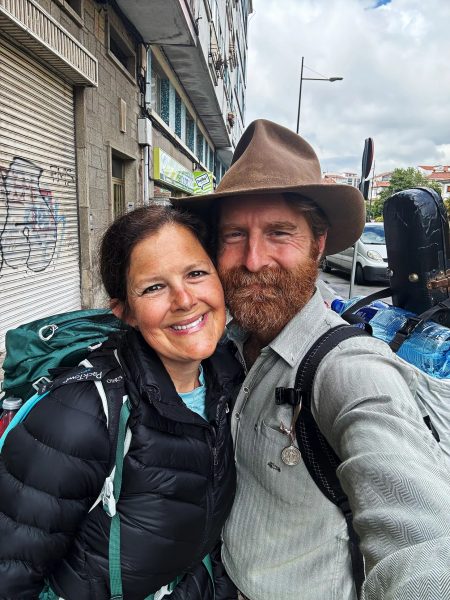
Lugo, Spain, is a mini metropolis compared to the remoteness of the Camino Primitivo. For days we have been hiking in isolated mountains and faraway countrysides. It’s startling to see a city suddenly emerge from the landscape.
We are looking at tall apartment buildings which stand over Lugo, and listening to the noise of traffic. The city is a vibrant oasis, teeming with life, an abundance of history, and iPhone retailers.
The cobblestones lead us into town, winding us past ragged stone walls, dating back to ancient Roman days. This is the only city in the world with such pristinely preserved Roman walls still surrounding the city. When you look at these walls, when you touch them, you get the distinct feeling that your species, your entire race, your culture, everything you know, is only slightly older than Keith Richards.

In other words, we humans are young. Painfully young. It was not that long ago, for example, that we as a race were solving our most pressing socio-economic issues with big sticks. Consequently, not much has changed among our species, except that our big sticks are now powered by AI software.
The walls of Lugo would’ve been built in 263 A.D. to defend this town against invasion. And they look almost the same as they did back in Roman times, except now there are more underwear ads.
Each June, the town of Lugo puts on a huge festival called Arde Lucus, wherein people dress up in Roman and Celtic costumes. The festival features gladiator-fight reenactments, ancient music, lots of dancing, lots of beer, and the ancient human tradition of waiting in line for porta-johns. Some 500,000 people attend the festival, just to remind themselves of Spain’s Roman heritage.

But today, all we pilgrims know of Lugo is that this city means we are nearing the end of our Camino. It won’t be long until our route joins the Camino Francés, and we arrive in Santiago.
This afternoon, Lugo is overrun with pilgrims. We can see them in the streets, carrying heavy packs, racing over crosswalks, heading to the tiendas and mercados to find supper.
Inside the supermarkets, they wander the aisles in tandem, browsing shelves of canned food, scrutinizing the weight of each item they will carry.
This is because you can only carry so much on your back. So you must be choosy. The Camino, just like life, is not about how much you can carry, but about how much you can leave behind.

We approach the market. When we enter the supermarket, we see an old man outside the automatic sliding doors.
The man is standing in the rain, barefoot. His beard is long, and there are tattoos on his soiled skin. There is a ratty backpack beside him, and he is shaking a small paper cup. He isn’t really saying anything to customers who enter the store. He’s just standing there, looking hungry.
This man, we realize, is not a pilgrim. He is homeless.
As local residents walk into the store, they mostly avoid eye contact with the beggar; many wholly ignore him and walk past as if he isn’t there.
Interestingly, each pilgrim behaves toward the man with a slightly different demeanor. Each peregrino, with heavy pack upon his or her back, with tired gait, and muddy boots, pauses before the homeless man when approaching the store. Almost every pilgrim places money into the man’s cup.
Almost every pilgrim pauses to give the man a smile and a God-bless-you in his or her own language. I overhear the man receive God-bless-yous in German, Portuguese, Italian, Russian, French, and Inglés. And his cup is almost runnething over.
And I’m wondering why my fellow pilgrims seem to be the only ones noticing this man.
In the store, I run into a few of my fellow pilgrims in the bakery aisle. They are college students from Canada. We were albergue roommates a few nights earlier. I ask why they personally donated money to this man. What made them do it?
“Because, look at us,” says one of the younger pilgrims. “Out here we’re no different than he is.”
“Yeah,” says another. “And if there’s one thing the Camino taught me, it’s that we never were .”

Questions: SeanDietrich@gmail.com
Visit the Sean of the South Website
Find out where you can see Sean live.
Originally published on Sean’s website. Republished here with permission.
If you enjoyed this article, then please REPOST or SHARE with others; encourage them to follow AFNN. If you’d like to become a citizen contributor for AFNN, contact us at managingeditor@afnn.us Help keep us ad-free by donating here.
Substack: American Free News Network Substack
Truth Social: @AFNN_USA
Facebook: https://m.facebook.com/afnnusa
Telegram: https://t.me/joinchat/2_-GAzcXmIRjODNh
Twitter: https://twitter.com/AfnnUsa
GETTR: https://gettr.com/user/AFNN_USA
CloutHub: @AFNN_USA