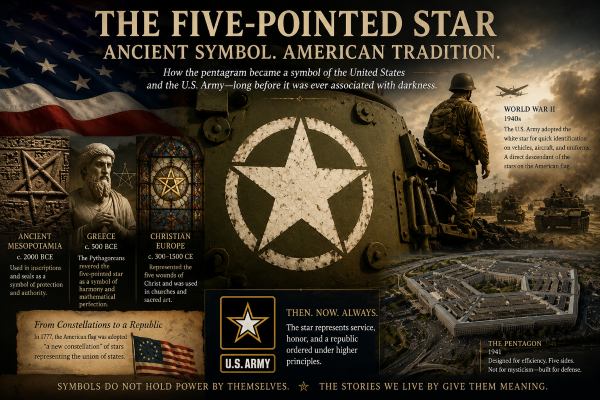
The five-pointed star is one of the oldest symbols in human civilization.
Long before it was painted on Sherman tanks, sewn onto generals’ collars, or emblazoned on the side of the Pentagon gift shop coffee mug, the pentagram was a mathematical and philosophical emblem used by cultures stretching back more than 4,000 years.
The ancient Mesopotamians used it in cuneiform inscriptions. The Pythagoreans in Greece revered it as a symbol of proportion and harmony. Medieval Christians used it to represent the five wounds of Christ. In other words, for most of recorded history, the pentagram was considered orderly, protective, and even sacred.
The symbol’s geometry is remarkable. Draw a five-pointed star and hidden within it is the golden ratio, the same mathematical proportion found in nautilus shells, flower petals, hurricanes, and Renaissance art. To the ancients, this was not evidence of occultism. It was evidence that the universe was structured according to intelligible design.
This is one reason symbols endure. They compress complex truths into a form that can be recognized instantly.
The United States inherited this symbolic vocabulary from European heraldry and classical tradition. By the 18th century, stars were already widely used to signify sovereignty, aspiration, and celestial order.
When the Continental Congress adopted the American flag in 1777, it specified “a new constellation” of stars representing the union of states. While no particular number of points was mandated, five-pointed stars became standard because they were visually balanced and easier to draw and sew than more complicated forms.
The American founders were steeped in Enlightenment thought, classical philosophy, and biblical imagery. To them, stars symbolized guidance, permanence, and a republic ordered under higher principles. George Washington did not look at the flag and whisper, “Excellent, a satanic diagram.” He saw a constellation—a nation of states joined in a common cause.
The military naturally adopted the same symbolism.
During the 19th century, stars became associated with rank, honors, and command authority. By the Civil War, stars were standard insignia for general officers. One star for a brigadier general, four for a full general. The star represented responsibility, not sorcery.
In World War II, the Army began painting large white stars on vehicles and aircraft for rapid identification. The mark was simple, unmistakably American, and easy to stencil in a muddy field with a paint brush and limited patience.
The Army star came from the national flag.
Nothing more exotic than that.
The Pentagon’s five-sided design adds another layer to the modern mythology. But the building was not shaped to mirror a pentagram or invoke ancient energies. The original site selected in 1941 constrained architects to a five-sided footprint. When the location changed, the efficient design was retained because it worked.
Sometimes engineers beat mystics to the punch.
The pentagram’s darker reputation is relatively recent. In the 19th century, occult writers such as Éliphas Lévi began associating the inverted pentagram with esoteric ideas. In the 20th century, modern satanic organizations adopted the inverted version with the goat-headed Sigil of Baphomet.
That popularized a new meaning.
But symbols are historical containers. They accumulate stories over time. One age sees harmony. Another sees protection. Another sees rebellion.
The shape remains unchanged.
The interpretation evolves.
This is the same phenomenon seen with the six-pointed star. For centuries it was associated with the legendary Seal of Solomon before becoming the Star of David and a symbol of Jewish identity. The geometry did not change. The story did.
The five-pointed star followed a similar journey.
To the Greeks, it represented mathematical beauty.
To Christians, the wounds of Christ.
To the American republic, the union of states and the authority of lawful command.
To modern occultists, something entirely different.
The lesson is straightforward.
Symbols have no independent moral force. Their meaning comes from the narratives and communities that adopt them.
The star on an American soldier’s uniform does not symbolize satanism.
It symbolizes service to a constitutional republic.
Five points.
One nation.
And a reminder that history is always more interesting than superstition.
If you enjoyed this article, then please REPOST or SHARE with others; encourage them to follow AFNN. If you’d like to become a citizen contributor for AFNN, contact us at managingeditor@afnn.us Help keep us ad-free by donating here.
Substack: American Free News Network Substack
Truth Social: @AFNN_USA
Facebook: https://m.facebook.com/afnnusa
Telegram: https://t.me/joinchat/2_-GAzcXmIRjODNh
Twitter: https://twitter.com/AfnnUsa
GETTR: https://gettr.com/user/AFNN_USA
CloutHub: @AFNN_USA