Every generation imagines itself immune to collapse.
The Romans thought Rome was eternal. The British thought the sun would never set on their empire. The bankers of 1928 thought prosperity had become permanent. In every age, people convince themselves that the machine is too large, too sophisticated, too interconnected to fail.
Then history clears its throat.
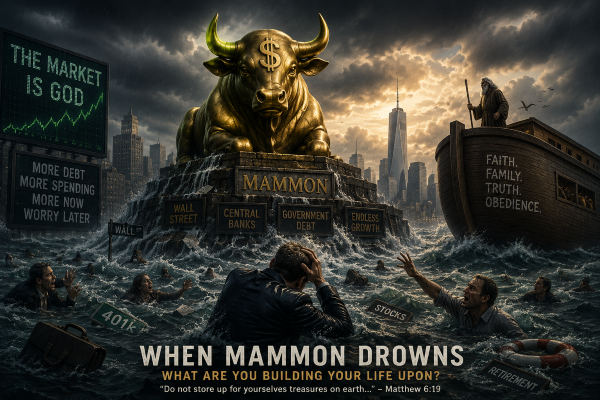
Most Christians are familiar with the account of Noah. The common image is animals boarding an ark while people laugh at a crazy old man building a boat in the middle of nowhere. What often gets overlooked is what the flood actually represented.
The flood was not merely a natural disaster.
It was the sudden destruction of a world that people believed would continue forever.
People were eating, drinking, marrying, buying, selling, planning, building, and investing. Life appeared normal right up until the moment it wasn’t. Their confidence was not in God. Their confidence was in the continuation of the system they knew.
Sound familiar?
Today, most people don’t trust God for their future. They trust direct deposits, retirement accounts, stock portfolios, home equity, government benefits, central banks, and the global financial system. The average person knows more about interest rates than Scripture and spends more time checking account balances than examining their own soul.
The modern world does not worship a golden calf.
It worships an economic system.
The priests wear business suits. The temples are banks and stock exchanges. The sacrifices are measured in overtime hours, family time, stress, debt, anxiety, and relationships placed on the altar of productivity.
We call it being responsible.
Sometimes it is.
Sometimes it is simply worship with better marketing.
Now imagine what would happen if the idol failed.
Imagine a severe currency crisis. A banking panic. A debt collapse. A market crash that doesn’t recover next quarter. A prolonged disruption to the assumptions upon which modern life is built.
The immediate damage would be financial, but the deeper damage would be spiritual.
Millions of people would discover that the thing they trusted was unable to save them.
The retirement account would not provide peace.
The stock portfolio would not provide security.
The government would not provide certainty.
The experts on television would not provide answers.
The invisible hand would suddenly look remarkably powerless.
And that is where the comparison to Noah becomes interesting.
The flood revealed what was real and what was illusion.
A global economic crisis would do much the same.
The modern world has built a civilization upon confidence. Not gold. Not tangible assets. Not even production. Confidence. Most of the wealth people believe they possess exists as digital entries, promises, debt instruments, valuations, and expectations. It functions because everyone agrees it functions.
Until they don’t.
History repeatedly demonstrates that systems can change much faster than people believe possible. Entire currencies have become worthless. Empires have vanished. Banking systems have frozen. Trade networks have collapsed. The people living through those events were just as convinced of their permanence as we are today.
That does not mean collapse is inevitable. It means permanence is an illusion.
The biblical lesson is not that Christians should fear economic disaster. It is that they should not worship economic stability.
There is a difference.
A prudent man saves.
A wise man prepares.
A Christian provides for his family.
But none of those things require bowing before Mammon.
The real danger is not losing money. The real danger is discovering that money was the foundation of your hope all along.
If a traumatic economic event ever arrives, the loudest voices on television will blame politicians, bankers, billionaires, foreign governments, corporations, speculators, regulators, or whoever happens to be politically convenient at the moment.
Some of those accusations may even be true.
But the deeper lesson may be much simpler.
A false god failed.
And false gods always fail eventually.
The flood in Noah’s day exposed the fragility of a civilization that believed tomorrow was guaranteed. A major economic reckoning would expose the fragility of a civilization that believes prosperity is guaranteed.
The question is not whether markets rise or fall. They always have.
The question is whether your faith rises and falls with them.
Because when the waters come, whatever you built your life upon is what will remain above the surface.
If you enjoyed this article, then please REPOST or SHARE with others; encourage them to follow AFNN. If you’d like to become a citizen contributor for AFNN, contact us at managingeditor@afnn.us Help keep us ad-free by donating here.
Substack: American Free News Network Substack
Truth Social: @AFNN_USA
Facebook: https://m.facebook.com/afnnusa
Telegram: https://t.me/joinchat/2_-GAzcXmIRjODNh
Twitter: https://twitter.com/AfnnUsa
GETTR: https://gettr.com/user/AFNN_USA
CloutHub: @AFNN_USA