Every civilization has a flood story.
The Bible has Noah. The Greeks had Deucalion. The Mesopotamians had Utnapishtim. Native American tribes from coast to coast tell stories of great floods, fires, and a world remade.
Modern people hear these stories and assume our ancestors were primitive storytellers explaining thunderstorms around a campfire.
Perhaps.
Or perhaps they were remembering something.
The Younger Dryas Impact Hypothesis remains one of the most controversial ideas in science. The theory proposes that around 12,800 years ago fragments of a comet struck Earth or exploded in the atmosphere, triggering abrupt climate change, widespread ecological disruption, and the beginning of a thousand-year cold period known as the Younger Dryas.
Many scientists reject the theory. Others argue the evidence continues to grow. The debate is far from settled.
Yet regardless of where one stands on the impact theory, there is an uncomfortable question that refuses to go away.
What if humanity’s memory stretches back to a catastrophe far greater than we imagine?
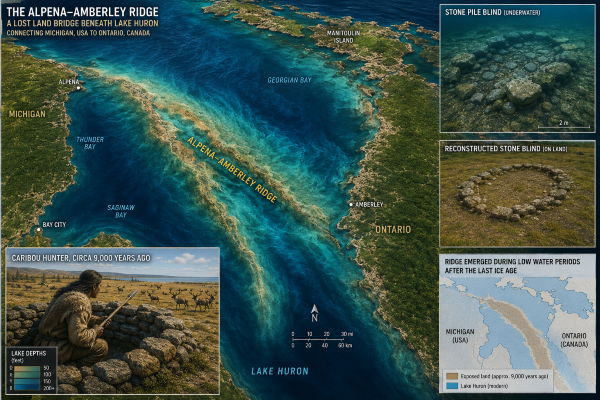
Enter the Alpena–Amberley Ridge.
Beneath the waters of Lake Huron lies an ancient landscape. Today divers and sonar systems explore what was once dry land connecting large portions of prehistoric North America. There, researchers discovered stone hunting structures believed to be approximately 9,000 years old.
Think about that for a moment.
Hunters were building organized hunting systems on land that now sits beneath a Great Lake.
The implications are profound.
Entire landscapes disappeared.
Entire ecosystems vanished.
Entire chapters of human history now lie underwater.
This is where the story becomes fascinating.
Critics and supporters alike often argue over the interpretation of the Amberley Ridge structures. Were they designed for caribou? Were they used for other game? Were researchers too quick to settle on a single explanation?
Those are legitimate questions.
But an even larger question sits quietly beneath the debate.
How much of our ancient past is missing?
If one of the most significant prehistoric hunting sites in North America remained hidden under Lake Huron for thousands of years, what else is waiting beneath the Great Lakes, continental shelves, and drowned coastlines around the world?
The standard story tells us that glaciers advanced and retreated over immense spans of time, carving the Great Lakes and reshaping the landscape.
That explanation may ultimately be correct.
Yet even within mainstream geology, the end of the Ice Age was anything but gentle.
Massive floods occurred.
Ancient lakes drained catastrophically.
Shorelines moved.
Entire regions transformed.
The Earth was not changing at the speed of a lawn growing. In many places it was changing at the speed of an immediate disaster.
That reality creates an intriguing overlap with the Younger Dryas Impact Hypothesis.
Suppose for a moment that a global catastrophe occurred near the end of the Ice Age.
Not necessarily world-ending.
Not necessarily civilization-ending.
But severe enough to disrupt climate, alter ecosystems, and reshape landscapes.
What would humanity look like a few thousand years later?
Probably a lot like the people of Amberley Ridge.
Not superhumans.
Not Atlanteans.
Not a lost race wielding laser crystals.
Just survivors.
Hunters.
Families.
People rebuilding their lives in a dramatically altered world.
History provides countless examples.
After wars, plagues, volcanic eruptions, and natural disasters, humanity does not disappear. It adapts.
Knowledge is lost.
Knowledge is preserved.
Cultures collapse.
New cultures emerge.
The story continues.
Seen through that lens, the hunters of Amberley Ridge may represent something larger than a hunting site. They may represent a chapter in humanity’s long recovery from one of the most dramatic environmental transitions in our planet’s recent history.
Does this prove the Younger Dryas Impact Hypothesis?
No.
The site contains no smoking gun proving a comet impact.
No artifact bears the inscription, “Dear future archaeologist, the sky just exploded.”
Science demands more than speculation.
Yet good science also demands curiosity.
The existence of Amberley Ridge reminds us that our understanding of the distant past remains incomplete.
The deeper we look beneath the waters of the Great Lakes, the more we discover that ancient North America was not the world we once imagined.
Perhaps the greatest lesson is humility.
For generations we believed the bottom of Lake Huron was empty.
It wasn’t.
We believed the story was complete.
It wasn’t.
And somewhere beneath the waves, buried beneath sediment and forgotten shorelines, there may still be pieces of a story humanity has not yet remembered.
A story of catastrophe.
A story of survival.
And perhaps a story of how our ancestors rebuilt a world after the great climate reset 9,000+ years ago.
If you enjoyed this article, then please REPOST or SHARE with others; encourage them to follow AFNN. If you’d like to become a citizen contributor for AFNN, contact us at managingeditor@afnn.us Help keep us ad-free by donating here.
Substack: American Free News Network Substack
Truth Social: @AFNN_USA
Facebook: https://m.facebook.com/afnnusa
Telegram: https://t.me/joinchat/2_-GAzcXmIRjODNh
Twitter: https://twitter.com/AfnnUsa
GETTR: https://gettr.com/user/AFNN_USA
CloutHub: @AFNN_USA