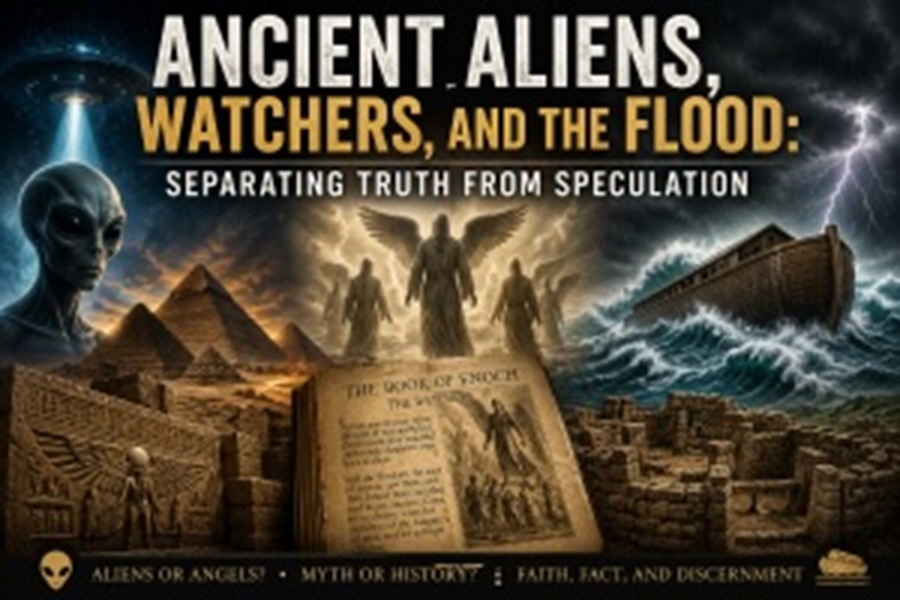
Every generation has its mystery. Ours seems to be asking the same question in a hundred different ways: Who built the ancient world?
Was it ancient aliens? The Watchers from the Book of Enoch? Atlantians? A forgotten Ice Age civilization? Or were our ancestors simply far more capable than we give them credit for?
The internet is overflowing with theories. Graham Hancock points to a lost civilization swallowed by the rising seas after the last Ice Age. Matthew LaCroix suggests ancient “gods” were real beings who passed advanced knowledge to humanity. Ancient Aliens insists extraterrestrials were the architects behind a slave civilization itself. Meanwhile, biblical scholar Michael Heiser reminds us that the ancient Israelites already had a category for powerful non-human beings—they simply weren’t called aliens.
The truth is probably less sensational than television and more fascinating than fiction.
The Ancient Alien theory became famous by asking a reasonable question with an extraordinary answer. Ancient people moved stones weighing hundreds of tons. They aligned monuments with incredible precision. Surely, the argument goes, primitive humans couldn’t have accomplished these feats alone.
The problem is that archaeology doesn’t require extraterrestrials. Every year, researchers uncover more evidence showing that ancient civilizations possessed engineering skills, mathematics, organization, and patience that modern people often underestimate. Difficult does not mean impossible.
Matthew LaCroix takes a different path. Rather than pointing to spaceships, he argues for an advanced civilization that existed before recorded history, perhaps before the biblical Flood itself. In his view, many of the world’s gods were not imaginary but remembered leaders or extraordinary beings whose accomplishments became myth over thousands of years. Similar flood stories, sacred geometry, pyramid building, and recurring symbols are interpreted as fragments of a forgotten global civilization.
It is an intriguing theory—but it faces an enormous challenge.
Civilizations leave garbage.
Archaeologists don’t build careers excavating pyramids. They build careers excavating trash pits, broken pottery, discarded tools, workshops, mines, cemeteries, kitchens, and sewage systems. Rome, Egypt, Babylon, and the Maya left millions of ordinary artifacts. If an advanced civilization spanned the globe before the Ice Age, where are its factories? Where are its broken chisels? Where are its villages, children’s toys, metalworking slag, and agricultural tools?
That question remains largely unanswered.
Then there is the biblical account.
Genesis presents a world that was technologically capable but spiritually corrupt. Before the Flood, humanity built cities, forged metal, raised livestock, composed music, and practiced agriculture. Scripture never describes cavemen dragging clubs through the wilderness. Instead, it portrays a flourishing civilization destroyed by divine judgment.
The Book of Enoch—while not considered Scripture by most Christian traditions—adds another layer. It describes heavenly beings known as the Watchers descending to Earth, taking wives, producing the Nephilim, and teaching humanity forbidden knowledge: metallurgy, weapon making, occult practices, astrology, and enchantments.
This is where Michael Heiser offered perhaps the most compelling framework.
Heiser argued that the Bible never denies that the pagan nations encountered real supernatural beings. Instead, it identifies those “gods” as created spiritual beings—members of God’s divine council—some of whom rebelled against Him. In this view, the ancient world wasn’t inventing supernatural experiences out of thin air. It was often interpreting genuine encounters through a pagan lens.
That creates an interesting contrast with LaCroix.
Where LaCroix sees ancient teachers preserving forgotten wisdom, Heiser sees rebellious spiritual beings introducing knowledge outside God’s design. The same stories are viewed through completely different worldviews.
Even the flood traditions fit both models.
Nearly every ancient civilization preserves a flood account. Ancient Alien proponents sometimes see evidence of extraterrestrial intervention. Lost civilization advocates see memories of Atlantis. Archaeologists often attribute them to regional catastrophes and shared cultural traditions. Christians see confirmation that Genesis preserves the memory of a real historical judgment remembered by Noah’s descendants as they spread across the earth.
None of these possibilities can simply be asserted—they must be supported by evidence.
Perhaps the most honest position is one of disciplined curiosity.
Sites like Göbekli Tepe continue to surprise archaeologists. Underwater discoveries may reveal coastal settlements drowned by rising seas after the last Ice Age. Ancient engineering continues to humble modern assumptions. There are genuine mysteries still waiting to be solved.
But mystery is not a license to fill every gap with speculation.
As Christians, we should neither fear archaeology nor chase every sensational theory that appears on YouTube. Scripture has always acknowledged an unseen world populated by spiritual beings. It has always taught that humanity before the Flood was sophisticated. It has always warned that not every supernatural claim originates with God.
That perspective allows believers to investigate history without surrendering discernment.
Perhaps the greatest lesson is this: truth does not need embellishment.
The pyramids are astonishing enough without aliens.
Genesis is profound enough without Atlantis.
The Watchers are unsettling enough without turning every ancient myth into a documentary.
History is filled with unanswered questions. The wise investigator welcomes new evidence while refusing to confuse possibility with proof. Curiosity is a virtue. Credulity is not.
In an age captivated by hidden knowledge and forgotten civilizations, perhaps the oldest biblical advice remains the best: “Test everything; hold fast what is good.”
If you enjoyed this article, then please REPOST or SHARE with others; encourage them to follow AFNN. If you’d like to become a citizen contributor for AFNN, contact us at managingeditor@afnn.us Help keep us ad-free by donating here.
Substack: American Free News Network Substack
Truth Social: @AFNN_USA
Facebook: https://m.facebook.com/afnnusa
Telegram: https://t.me/joinchat/2_-GAzcXmIRjODNh
Twitter: https://twitter.com/AfnnUsa
GETTR: https://gettr.com/user/AFNN_USA
CloutHub: @AFNN_USA