There are two ways to preserve history.
You can teach it.
Or you can erase it.
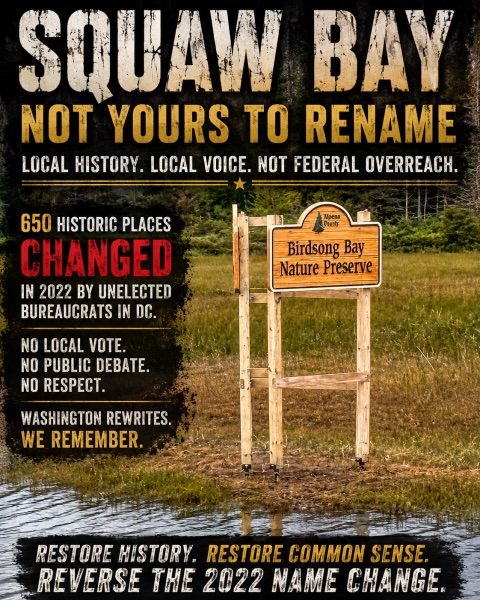
In 2022, Washington chose the eraser.
During the height of the DEI movement—when institutions were scrambling to rename, remove, apologize, and “correct” everything from mascots to monuments—the federal government quietly crossed another line. Under the direction of Interior Secretary Deb Haaland, the U.S. Board on Geographic Names officially changed nearly **650** geographic names across America containing the word “squaw.” The administration described the effort as advancing equity, inclusion, and removing what it considered a derogatory term from federal use.
Among those names was “Squaw Bay” in Alpena County.
Here’s the question nobody in Washington seemed interested in asking:
Who gave them the moral authority to rewrite local history?
Notice what didn’t happen.
Congress never debated Squaw Bay.
Michigan voters never voted.
Alpena County residents never voted.
No township referendum.
No county ballot proposal.
No statewide initiative.
Instead, appointed federal officials made a nationwide decision that reached into 650 communities they had likely never visited.
Whether you believe the word should remain or not isn’t the larger issue.
The larger issue is who decides.
Our constitutional system was built on the principle that government closest to the people is usually the government that best understands the people. Local communities govern local schools. Counties maintain county roads. Townships make zoning decisions.
Yet somehow Washington believes it should rename local landmarks that generations of residents have known by the same name.
That’s not local self-government.
That’s centralized cultural management.
Supporters argue that the federal government only changed the official federal name used on maps and documents. Legally, that’s true. The federal government has authority over its own geographic naming system. But legality and wisdom are not always the same thing.
History isn’t supposed to be comfortable.
If every generation edits maps to reflect today’s political values, eventually those maps stop telling us about the past and begin telling us only about whoever happened to be in power.
Today’s officials dislike one word.
Tomorrow’s officials may dislike another.
Where does that process end?
One of the great ironies of the modern era is that America fiercely defends controversial artistic expression. A crucifix submerged in urine may be praised by some as protected expression. Offensive art is defended because freedom includes the right to offend.
Yet a historical place name that existed for generations is treated as something the federal government must officially erase.
Apparently offensive art deserves protection.
Offensive history deserves correction.
That inconsistency should bother everyone, regardless of where they stand on the word itself.
A more balanced approach would have been simple.
Keep the historic name.
Add educational signs explaining its origins, its disputed meanings, and why many Native Americans object to it today.
Teach history instead of editing it.
That’s how mature societies handle difficult subjects.
Instead, America increasingly chooses symbolic victories over historical understanding.
The DEI atmosphere of 2021 and 2022 rewarded institutions for making highly visible cultural statements. Renaming hundreds of geographic features became another way for Washington to demonstrate its commitment to inclusion. Whether those decisions reflected the wishes of the affected communities often became secondary.
Reasonable people can disagree about the word “squaw.” There are genuine differences among historians, linguists, tribal members, and local residents over its origins, evolution, and modern usage.
But there should be far less disagreement about this:
Communities deserve a meaningful voice before Washington rewrites their maps.
If Alpena County wants Birdsong Bay, let Alpena County say so.
If Alpena County wants to preserve Squaw Bay as a historical place name while teaching its complicated history, that should also be the community’s choice.
Federal agencies exist to serve the people—not to become national editors of local history.
History should be preserved, explained, debated, and remembered.
Not revised because the politics of one particular decade demanded it.
Perhaps it’s time for Congress to revisit how official geographic names are changed. Any renaming of long-established local landmarks should require meaningful participation from the communities that have lived with those names for generations. That’s not a rejection of history or respect. It’s a reaffirmation of self-government.
Washington can keep its maps.
Alpena County should keep its voice.
If you enjoyed this article, then please REPOST or SHARE with others; encourage them to follow AFNN. If you’d like to become a citizen contributor for AFNN, contact us at managingeditor@afnn.us Help keep us ad-free by donating here.
Substack: American Free News Network Substack
Truth Social: @AFNN_USA
Facebook: https://m.facebook.com/afnnusa
Telegram: https://t.me/joinchat/2_-GAzcXmIRjODNh
Twitter: https://twitter.com/AfnnUsa
GETTR: https://gettr.com/user/AFNN_USA
CloutHub: @AFNN_USA