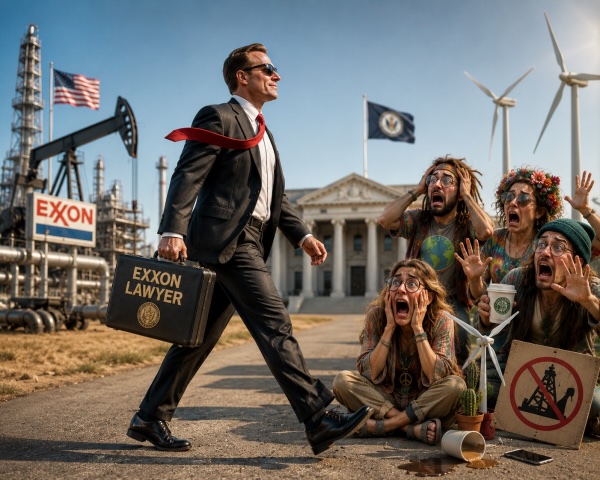
The announcement that a veteran ExxonMobil attorney is headed to the Justice Department was enough to send the usual crowd into DEFCON 1. The headlines practically wrote themselves: “Big Oil infiltrates government!” The outrage machines fired up faster than a gas turbine.
Or… maybe—just maybe—the country is finally acknowledging a simple reality.
America is entering the biggest energy expansion in generations.
Artificial intelligence doesn’t run on hashtags. Data centers don’t operate on good intentions. Semiconductor plants don’t manufacture computer chips with positive affirmations and interpretive dance. Reshoring American manufacturing, rebuilding defense production, powering AI, and competing with China all require one thing above everything else:
Energy.
Lots of it.
Reliable. Affordable. Available twenty-four hours a day.
Which makes the appointment of someone who actually understands energy law look a lot less sinister and a lot more practical.
Imagine hiring a former airline pilot to regulate aviation. Shocking. Or a surgeon to oversee hospitals. The horror.
Yet when someone who spent years navigating one of the world’s largest energy companies joins the Justice Department, suddenly it’s treated like the final chapter of democracy.
The reality is that America needs pipelines. Transmission lines. Natural gas. Nuclear power. Hydroelectric dams. Oil production. Mining. Refineries. LNG export terminals. And yes, wind and solar where they make economic and engineering sense.
But here’s the part that sends the Birkenstock-and-mocha-latte crowd into emotional cardiac arrest: wind and solar alone cannot presently provide around-the-clock power for an industrial superpower without additional generation, storage, or backup resources. Physics remains stubbornly unimpressed by political slogans.
Meanwhile, nuclear energy—one of the most energy-dense low-carbon power sources available—still frightens people who seem to think every reactor is one bad day away from becoming a Hollywood disaster movie.
Then comes the climate discussion.
The Earth has experienced natural climate variability throughout its history, and modern climate science also concludes that human activities may contribute a little to recent warming. Reasonable people continue to debate the scale of future impacts, the costs and benefits of different policies, and how to balance environmental protection with economic growth and energy security.
Those debates deserve evidence—not panic, guilt, or declarations that civilization itself must shrink.
Here’s the uncomfortable truth.
Countries with abundant, dependable, affordable energy generally enjoy higher living standards, cleaner water, better healthcare, longer life expectancy, stronger industries, and greater economic opportunity than countries struggling with energy scarcity. Energy doesn’t solve every problem, but history suggests it’s one of the foundations of prosperity.
So if America wants to win the AI race, rebuild manufacturing, strengthen national security, and remain the world’s leading economy, then hiring people who actually understand the energy sector isn’t corruption.
It’s common sense.
The future won’t be built by people screaming at pipelines while charging their phones with electricity generated somewhere else.
It will be built by engineers. Builders. Scientists. Electricians. Welders. Miners. Refinery workers. Utility crews. Nuclear operators. Manufacturers.
And yes…
Lawyers who actually know how America’s energy system works.
If you enjoyed this article, then please REPOST or SHARE with others; encourage them to follow AFNN. If you’d like to become a citizen contributor for AFNN, contact us at managingeditor@afnn.us Help keep us ad-free by donating here.
Substack: American Free News Network Substack
Truth Social: @AFNN_USA
Facebook: https://m.facebook.com/afnnusa
Telegram: https://t.me/joinchat/2_-GAzcXmIRjODNh
Twitter: https://twitter.com/AfnnUsa
GETTR: https://gettr.com/user/AFNN_USA
CloutHub: @AFNN_USA