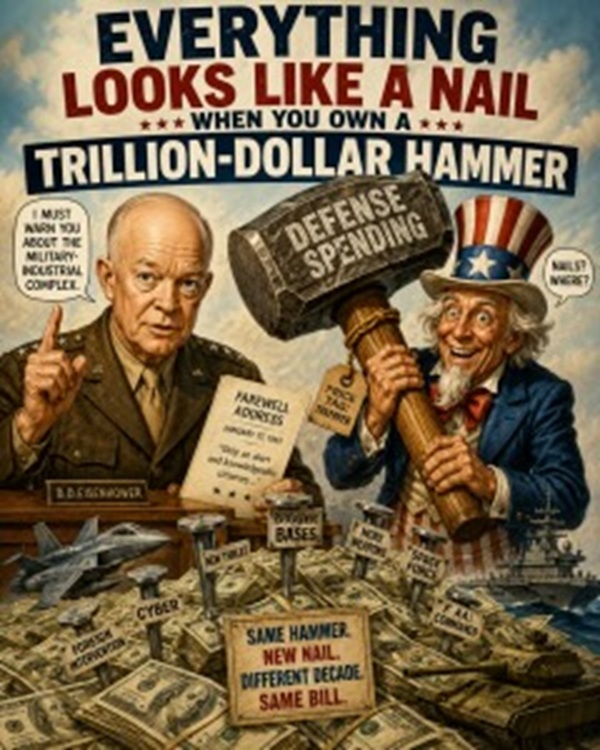
“In the councils of government, we must guard against the acquisition of unwarranted influence… by the military-industrial complex.”
— President Dwight D. Eisenhower, January 17, 1961
Imagine you’ve just spent a lifetime defeating Adolf Hitler, commanding the largest military force in history, and serving eight years as President of the United States. As you prepare to leave office, you don’t warn Americans about communists hiding under the bed. You don’t warn about nuclear weapons. You don’t even warn about the Soviets.
You warn about… us.
Specifically, what could happen when a permanent military, a permanent defense industry, and a permanent government bureaucracy become so intertwined that nobody remembers where one ends and the next begins.
That wasn’t some anti-war protester with a guitar. That was Dwight D. Eisenhower—a five-star general who knew exactly why America needed a strong military. Which is why people should have listened when he added the part almost nobody quotes anymore.
“Only an alert and knowledgeable citizenry…”
There’s the catch.
Are we?
Or have we traded being alert for being entertained?
Ask the average American who Taylor Swift is dating, and you’ll probably get an answer before you’ve finished the question. Ask them why the Department of Defense has never received a clean financial audit, and you’ll get the same look your dog gives you when you ask him to explain quantum physics.
That little fact alone ought to make taxpayers spill their coffee.
Since Congress required comprehensive audits, the Pentagon has repeatedly failed to earn a clean audit opinion. That doesn’t mean someone backed a dump truck up to Fort Knox and drove away with trillions of dollars. It means the largest organization on Earth still struggles to fully account for everything it owns in a way that independent auditors can verify. If your local hardware store kept its books that way, it’d be out of business before deer season.
Speaking of hardware…
Psychologist Abraham Maslow once observed, “If the only tool you have is a hammer, everything looks like a nail.”
America doesn’t just own a hammer.
We own the biggest hammer ever built.
So every international problem starts looking suspiciously like a construction project.
Cold War? Hammer.
Vietnam? Bigger hammer.
The War on Terror? Twenty years of hammering.
Cyber threats? Build Cyber Command.
Space competition? Build the Space Force.
Artificial intelligence? Better fund another command, another office, another initiative.
To be clear, those threats are real. China is real. Russia is real. Terrorism is real. Cyber warfare is real.
But institutions naturally solve problems with the tools they already have. That’s human nature. Give a carpenter enough time, and he’ll start noticing things that need wood. Give a bureaucracy enough time, and it’ll start noticing reasons to expand.
Eisenhower understood that better than most because he’d watched it happen.
The famous “$600 toilet seat” story from the 1980s has become part of American folklore. The exact number wasn’t always accurate, but the outrage wasn’t invented. Congressional investigations uncovered astonishing prices for ordinary spare parts, revealing a procurement system where hammers, pliers, coffee makers, and replacement components somehow acquired luxury-car price tags after winding their way through contracts and subcontractors. Taxpayers laughed because the numbers sounded absurd. They stopped laughing when they realized many of them were real.
Then there’s the F-35.
It’s an extraordinary aircraft. It can do things pilots fifty years ago couldn’t have imagined.
It is also projected to cost taxpayers more over its lifetime than any weapons program in history. We’re not talking about billions anymore. We’re talking about figures measured in the trillions over decades.
Here’s the part most Americans never hear.
Pieces of major weapons systems are often manufactured in dozens of states. That’s smart economics, but it’s also brilliant politics. If an airplane supports jobs in forty states, suddenly forty-state delegations have a reason to protect it. Cancel the program and you aren’t just cutting spending—you’ve become the politician who eliminated jobs back home.
The machine learns how to defend itself.
That’s not a conspiracy.
It’s incentives.
Congress wants jobs. Contractors want contracts. Communities want payrolls. The Pentagon wants readiness. None of those goals are inherently evil. Together, though, they create a system where every program has champions and almost none have funerals.
Meanwhile, the national debt climbs past levels that would have sounded like science fiction when Eisenhower left office.
And here’s the irony.
The same citizens who can identify every celebrity breakup of the year often couldn’t tell you the government’s largest spending categories or explain why America still maintains hundreds of military sites around the world.
That’s not an insult.
It’s an observation.
We’ve become remarkably informed about things that don’t matter and remarkably uninformed about things that do.
Eisenhower never argued America should become weak. He never suggested dismantling the military. Quite the opposite. He believed strength deterred war.
His warning was subtler—and, perhaps, more unsettling.
Power accumulates.
Institutions protect themselves.
Budgets rarely shrink voluntarily.
And free people eventually stop asking questions because someone else surely has it under control.
His solution wasn’t another law.
It wasn’t another agency.
It wasn’t another committee.
It was an alert and knowledgeable citizenry.
That’s us.
Or at least it’s supposed to be.
So here’s the uncomfortable question.
If Eisenhower came back today and looked at America—at our trillion-dollar defense enterprise, our endless procurement debates, our chronic audit failures, our habit of treating every global crisis as another nail for an ever-larger hammer—would he conclude that his warning had been heeded?
Or would he quietly repeat the last sentence of his farewell address and wonder what happened to the alert and knowledgeable citizenry he believed was liberty’s last line of defense?
If you enjoyed this article, then please REPOST or SHARE with others; encourage them to follow AFNN. If you’d like to become a citizen contributor for AFNN, contact us at managingeditor@afnn.us Help keep us ad-free by donating here.
Substack: American Free News Network Substack
Truth Social: @AFNN_USA
Facebook: https://m.facebook.com/afnnusa
Telegram: https://t.me/joinchat/2_-GAzcXmIRjODNh
Twitter: https://twitter.com/AfnnUsa
GETTR: https://gettr.com/user/AFNN_USA
CloutHub: @AFNN_USA