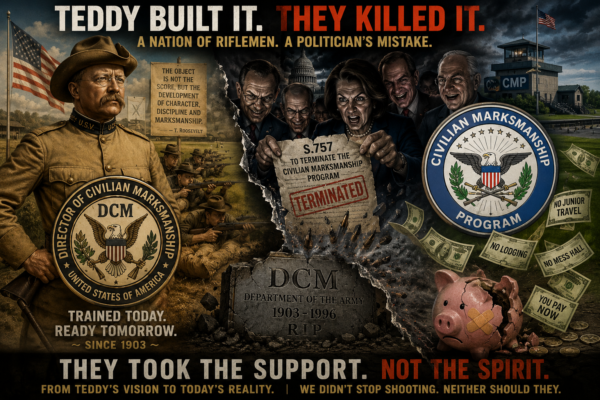
The Rise, Fall, and Resurrection of the Director of Civilian Marksmanship
There was once a strange and dangerous idea in Washington:
Americans should know how to shoot.
Not just soldiers.
Ordinary Americans.
Farm kids. Factory workers. College students. Teenagers. Future soldiers who hadn’t enlisted yet and citizens who never would.
And instead of being terrified by this prospect, the federal government actually encouraged it.
Welcome to the America of Theodore Roosevelt.
Following the Spanish-American War, America’s military leadership had learned an uncomfortable lesson: owning millions of rifles and having millions of citizens were not the same thing as having millions of riflemen. Just because you own the tool, doesn’t mean you know how to use it well.
President Theodore Roosevelt understood the distinction. Roosevelt was many things, but terrified of armed, competent American citizens was certainly not one of them.
In 1903, the federal government established the National Board for the Promotion of Rifle Practice, beginning the system that eventually became associated with the Director of Civilian Marksmanship (DCM).
The philosophy was beautifully simple:
A nation that might someday need citizen-soldiers should probably teach its citizens how to shoot before the war starts.
Apparently this was considered common sense before Washington discovered focus groups and Super PACs.
For most of the twentieth century, civilian marksmanship wasn’t treated merely as recreation. It had a national-defense purpose.
Military rifles became available to qualified civilians. Rifle clubs flourished. The National Matches grew. Military marksmanship instruction became available to ordinary Americans.
And juniors were brought into the system.
For generations, one of the greatest honors a young competitive shooter could earn was selection to his state’s two-person Whistler Boy team.
There were Whistler Boy competitions for both smallbore and highpower.
And here’s the part that sounds almost fictional today:
The federal government helped send those juniors to Camp Perry.
Travel.
Lodging.
Subsistence.
Mess-hall meals.
You represented your state, packed your state flag with your shooting gear and headed to the National Matches.
Why?
Because the United States government believed developing young American riflemen was actually in the interest national security.
Read that sentence again.
Then compare it with Washington ninety years later.
By the 1990s, America had apparently become much smarter than Theodore Roosevelt.
The Soviet Union had collapsed.
The Cold War was over.
History had ended.
Surely America would never again fight a major war.
And certainly there was no conceivable national-defense value in having young Americans understand rifles, wind, ballistics, discipline, safety and marksmanship.
Then came 1995.
Democratic Senators Frank Lautenberg, Dianne Feinstein, Paul Simon and Carl Levin introduced S.757.
Its purpose wasn’t subtle.
The bill was titled: “A bill to terminate the Civilian Marksmanship Program…”
Terminate.
Not streamline.
Not reform.
Not modernize.
Terminate.
A federal marksmanship program with roots reaching back to Theodore Roosevelt had somehow survived two World Wars, Korea, Vietnam, the Cold War and approximately nine billion rounds fired at Camp Perry.
Then Washington discovered the real threat to America:
Sixteen-year-olds shooting projectiles at paper targets.
Thank God Congress finally got involved.
Think about the philosophical reversal.
Roosevelt’s generation looked at an armed and skilled citizenry and saw a national asset.
The 1990s Washington political class increasingly looked at the same thing and saw a government program that shouldn’t exist.
Roosevelt’s America asked:
How do we create more riflemen?
Washington’s answer ninety years later was:
Why are we paying for riflemen at all?
That wasn’t merely a budget decision.
It represented a profound change in how parts of the American political establishment viewed civilian firearms ownership and marksmanship.
The rifle had migrated culturally from being a tool of citizenship, military preparedness and national defense into something politicians increasingly treated as a problem requiring regulation.
The DCM was an obvious target.
Fortunately, They Failed
Here is the part that ruins the simplest political narrative.
The DCM wasn’t simply abolished and buried.
The Republican-controlled 104th Congress refused to let civilian marksmanship disappear.
Instead, Congress essentially told the program:
You’re being thrown out of the Army. Figure out how to survive.
The FY1996 National Defense Authorization Act transferred the Civilian Marksmanship Program from the Department of the Army to a new private nonprofit corporation.
President Bill Clinton signed it.
By September 30, 1996, the old Army-run program was finished.
The modern Civilian Marksmanship Program (CMP) emerged from the wreckage.
And then something happened that Washington probably wasn’t expecting.
It worked.
The CMP survived.
Then it grew.
Today the organization operates world-class ranges and competitions, supports junior shooting programs, conducts the National Matches, runs marksmanship clinics, sanctions thousands of competitions and continues introducing Americans to competitive shooting.
The politicians trying to terminate civilian marksmanship didn’t eliminate it.
They helped force it out of Washington.
That may have been the greatest favor they ever did for it.
There is nevertheless an enormous difference between today’s CMP and the old DCM.
The old system carried a message from the United States government:
We want young Americans to become riflemen.
Being selected for your state’s Whistler Boy team meant something extraordinary.
Two juniors.
Your state.
Camp Perry.
The government helped get you there because America considered developing young marksmen important enough to support.
Today we will spend astonishing sums developing teenage athletes.
Baseball academies.
Hockey tournaments.
Soccer camps.
Travel teams crossing six states so 13-year-olds can chase a ball around a field while their parents refinance the house.
Nobody bats an eye.
But imagine proposing a federal program today that identifies two outstanding junior rifle shooters from every state and helps send them to Camp Perry.
The screaming could probably be heard from the moon.
Theodore Roosevelt didn’t believe an armed citizenry was something government should fear.
He believed Americans possessing competence, discipline and martial skills made the Republic stronger.
That’s the part of the DCM story worth remembering.
It wasn’t fundamentally about free ammunition.
It wasn’t about cheap government rifles.
It wasn’t even about getting a couple of teenagers a free trip to Ohio and feeding them Army chow—which, admittedly, places some strain on the definition of “free food.”
It was about a national philosophy. Citizenship carried responsibilities.
Physical fitness mattered.
Preparedness mattered.
Military competence mattered.
And marksmanship mattered.
America didn’t wait until young men arrived at basic training to introduce them to rifles. It deliberately cultivated marksmanship throughout civilian society.
That philosophy helped produce generations of American riflemen.
Then, ninety years later, politicians introduced legislation to terminate the program.
They failed.
The DCM disappeared, but civilian marksmanship escaped Washington and survived as the CMP.
Maybe there’s a lesson there.
Theodore Roosevelt believed government should help Americans become riflemen.
The politicians of the 1990s tried to make the government stop.
And the riflemen?
We kept shooting anyway.
If you enjoyed this article, then please REPOST or SHARE with others; encourage them to follow AFNN. If you’d like to become a citizen contributor for AFNN, contact us at managingeditor@afnn.us Help keep us ad-free by donating here.
Substack: American Free News Network Substack
Truth Social: @AFNN_USA
Facebook: https://m.facebook.com/afnnusa
Telegram: https://t.me/joinchat/2_-GAzcXmIRjODNh
Twitter: https://twitter.com/AfnnUsa
GETTR: https://gettr.com/user/AFNN_USA
CloutHub: @AFNN_USA