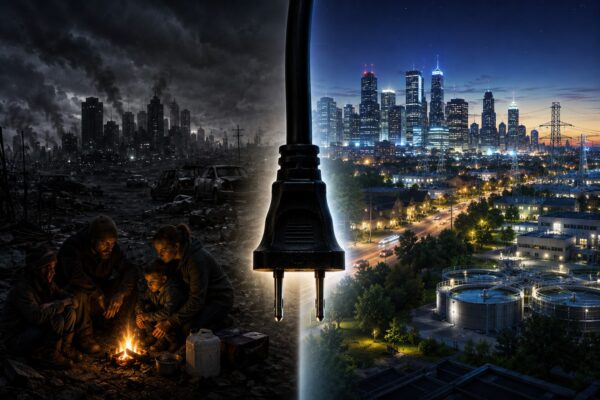
For most of human history, electricity was an unimaginable luxury.
Then it became a convenience.
Then it became an expectation.
Then somewhere between the refrigerator, insulin pump, municipal water plant, cell tower, traffic light, credit-card reader, gas pump, sewer lift station, Amazon delivery truck and Wi-Fi router, electricity quietly became essential to keeping large concentrations of human beings alive.
Congratulations, civilization.
We have built the most technologically sophisticated society in human history around one gigantic extension cord.
And somebody just noticed the cord can be cut.
That is the uncomfortable truth behind America’s growing concern about electrical-grid security. Our greatest vulnerability may not be an enemy army storming across a beach. It may be losing the invisible infrastructure that makes modern life possible.
Three months without electricity wouldn’t simply mean three months without Netflix.
It would mean discovering how extraordinarily dependent modern civilization has become upon machines most people never see.
Nobody can responsibly tell you exactly how many Americans would die during a three-month regional blackout. Geography, season, population density, outside assistance, fuel availability and the size of the affected area would radically change the answer.
But actual blackouts provide an unpleasant preview.
Researchers studying the 2003 New York City blackout estimated approximately 90 excess deaths during an outage lasting roughly a day. More recent research found that additional outage hours are associated with increased mortality, with particularly severe effects when electricity failures coincide with high temperatures.
Now stretch the problem from hours into months.
The first thing disappearing isn’t necessarily food.
It’s water.
The average city dweller doesn’t obtain water from a stream with a bucket. Water is pumped, treated, pressurized, stored and distributed through enormous engineered systems that require electricity somewhere along the chain.
Your faucet is basically an electrical appliance located several miles away.
When water stops flowing, Americans will quickly discover something our ancestors understood perfectly: obtaining enough clean water every single day is hard work.
Finding water isn’t enough.
You have to make it safe.
CDC warns that electrical outages can compromise water-purification systems. Untreated water can spread gastrointestinal disease, and chemical contamination can’t simply be boiled away.
Then comes the subject nobody wants to discuss at dinner.
Poop.
Eight million people in a metropolitan area produce an impressive amount of it every day.
Modern sanitation is arguably one of humanity’s greatest achievements, and almost nobody appreciates it because its greatest accomplishment is making us forget it exists.
Sewage requires pumping, treatment and disposal. Toilets require water. Garbage requires collection. Hospitals require sterilization. Food preparation requires handwashing.
Lose those systems long enough and the problem isn’t merely thirst.
It’s disease.
Then refrigeration disappears. CDC says refrigerated perishables generally become unsafe after about four hours without power, while a closed, full freezer buys roughly 48 hours.
Your $4,000 stainless-steel refrigerator has now become a very attractive insulated cabinet full of future diarrhea.
Next comes medicine.
Pharmacies depend upon computerized inventories, refrigeration and continuous deliveries. Hospitals have generators, but generators require fuel. Fuel requires refining, transportation and pumping. Gas stations require electricity.
See the problem?
Everything depends upon something else that depends upon electricity.
And this is where the urban-versus-rural skills gap becomes fascinating.
Ask an average city resident to find potable water, safely dispose of human waste without a functioning sewer, start and maintain a cooking fire, preserve meat without refrigeration, sharpen an axe, split firewood, grow calorie-producing crops, navigate without GPS, repair a small engine, identify edible plants, clean a fish, dress game, can vegetables or provide meaningful first aid.
Some certainly can.
Millions cannot.
That’s not because urban Americans are stupid. Quite the opposite. Modern society rewards specialization. Someone may be brilliant at finance, software engineering or medicine while possessing absolutely no idea how to make lake water safely drinkable.
Civilization allows us to outsource survival.
The grocery store is our food-storage system.
The municipal utility is our well.
The sewer authority is our sanitation system.
The hospital is our medical safety net.
Google is our accumulated practical knowledge.
Electricity connects nearly all of it.
And that brings us to perhaps the greatest threat during a three-month blackout.
It isn’t starvation.
It isn’t darkness.
It may not even be violence.
It’s systems failure cascading into public-health failure.
Water fails. Sanitation deteriorates. Food spoils. Medicine becomes difficult to obtain. Heat or cold begins killing vulnerable people. Communications become unreliable. Fuel distribution falters. Hospitals become overwhelmed.
And then frightened people begin making bad decisions.
This is why grid security should be considered national defense.
Harden the transformers. Protect industrial-control systems. Manufacture critical electrical equipment in America. Stockpile replacement components. Build microgrids. Maintain emergency water capabilities. Exercise communities for prolonged outages rather than another comfortable three-hour tabletop exercise ending before lunch.
But perhaps we should also rebuild something that doesn’t require congressional appropriations:
Competence.
Teach children first aid. Teach them how to purify water. Grow food. Preserve food. Read a paper map. Build a fire. Use hand tools. Repair things. Understand sanitation. Know their neighbors.
Because America’s Achilles’ heel isn’t simply that the electrical grid might someday fail.
It’s that we’ve created generations of people who cannot imagine life without it.
Electricity was once a luxury.
Today it keeps civilization alive.
And if fifth-generation warfare is about attacking an opponent’s systems rather than his armies, our enemies don’t necessarily have to defeat 1.3 million American service members.
They just have to find and cut the extension cord.
_________________________________
If you enjoyed this article, then please REPOST or SHARE with others; encourage them to follow AFNN. If you’d like to become a citizen contributor for AFNN, contact us at managingeditor@afnn.us Help keep us ad-free by donating here.
_________________________________
Substack: American Free News Network Substack
Truth Social: @AFNN_USA
Facebook: https://m.facebook.com/afnnusa
Telegram: https://t.me/joinchat/2_-GAzcXmIRjODNh
Twitter: https://twitter.com/AfnnUsa
GETTR: https://gettr.com/user/AFNN_USA
CloutHub: @AFNN_USA