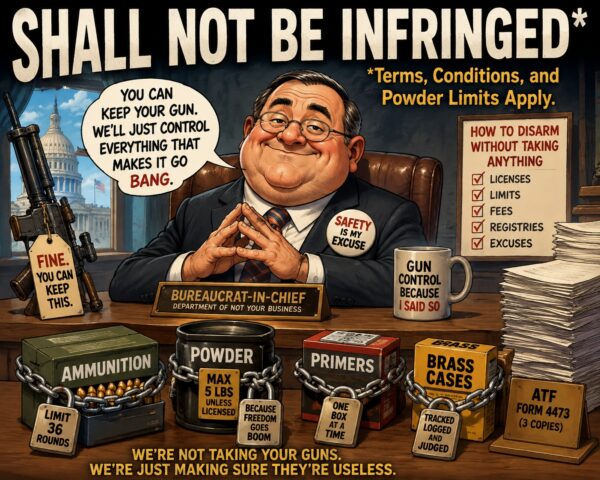
“Shall not be infringed.”
Apparently, somewhere between 1791 and the modern administrative state, those four words acquired an asterisk approximately the size of Maryland.
The Second Amendment says the right of the people to keep and bear arms shall not be infringed. It does not say ammunition. It doesn’t say primers. It doesn’t say cartridge cases. And it certainly doesn’t mention the eight-pound jug of smokeless powder sitting under a handloader’s bench.
Ah-ha!
Government has discovered the cheat code.
You may keep the rifle, citizen. We would never infringe upon your constitutional rights.
We’ll just regulate everything required to make the damn thing go bang.
Maryland provides a wonderful example of this bureaucratic logic. Under current Maryland law, an unlicensed individual generally cannot possess or store more than five pounds of smokeless powder for use in firearms. Five pounds. The personal-use exemption likewise tops out at five pounds and requires the powder to remain in its original shipping containers. Go beyond that and you’re into the state’s licensing regime.
For people unfamiliar with handloading, five pounds might sound like Pablo Escobar quantities of gunpowder.
For competitive rifle shooters, five pounds is called Tuesday.
An eight-pound jug of rifle powder is a completely ordinary commercial package. Yet bring one home in Maryland without the required license and congratulations: the container itself holds three pounds more than the state’s unlicensed limit.
This raises a constitutional question considerably bigger than Maryland.
Where does the Second Amendment end?
Can government protect your right to own a rifle while progressively controlling everything necessary to operate it?
Imagine applying that reasoning elsewhere.
Congress shall make no law abridging freedom of the press.
Wonderful. You may own the printing press.
Paper requires a license.
Ink is limited to five ounces.
Printers must record every sale.
But don’t worry. Nobody infringed the press.
That sounds ridiculous because it is ridiculous.
A constitutional right necessarily protects some ability to exercise that right. And courts have recognized exactly that principle concerning ammunition.
In Jackson v. City and County of San Francisco, the Ninth Circuit confronted ammunition restrictions and stated the obvious:
“Without bullets, the right to bear arms would be meaningless.”
The court reasoned that the right to possess firearms implies a corresponding right to obtain the ammunition necessary to use them. It further concluded that ammunition restrictions fall within the historical scope of the Second Amendment.
That’s important.
The argument isn’t that every ammunition regulation is automatically unconstitutional. It isn’t even that every powder-storage regulation is unconstitutional.
There is a legitimate historical counterargument.
Americans regulated gunpowder storage going all the way back to the founding era. Cities didn’t particularly enjoy warehouses full of black powder exploding and converting several blocks into low Earth orbit. Heller itself discussed historical gunpowder-storage laws, and subsequent courts have described many of them essentially as fire-safety regulations.
Fine.
That’s called context.
There is an enormous constitutional difference between saying, “Store a large quantity of powder safely because your house is attached to seventeen other houses,” and saying, “Government may control ammunition however it wishes because the Second Amendment only protects the metal object called a gun.”
The latter argument collapses under its own stupidity.
A firearm without ammunition isn’t an arm in any meaningful practical sense.
It’s an unusually expensive stick.
And ammunition doesn’t magically materialize from the ammunition fairy. For millions of American shooters, hunters and competitors, cartridges are assembled from components: bullet, case, primer and powder.
Take away one component and you haven’t technically confiscated the rifle.
You’ve merely rendered it useless.
How convenient.
That’s why Americans should pay attention whenever government attempts to separate the right from the things reasonably necessary to exercise it.
Today it’s five pounds of powder.
Tomorrow it might be ammunition taxes, purchase limits, background checks for components, primer restrictions or regulations making ammunition prohibitively expensive.
At some point, “You can keep your gun” becomes constitutional theater.
The Second Amendment does not create an unlimited right to store dangerous materials recklessly. Government has always possessed legitimate authority to address genuine public-safety hazards.
But neither should “public safety” become magical constitutional pixie dust that government sprinkles over any restriction it wants.
The question should always be burden, history and purpose.
Is this genuinely a safety regulation consistent with America’s historical tradition?
Or is it another attempt to regulate around a constitutional right that government cannot regulate directly?
Because there is one uncomfortable fact politicians can’t escape:
The right to keep and bear arms means considerably less if government can regulate away your ability to feed them.
Sure, citizen.
Keep your rifle.
Just don’t ask where all the ammunition went.
_________________________________
If you enjoyed this article, then please REPOST or SHARE with others; encourage them to follow AFNN. If you’d like to become a citizen contributor for AFNN, contact us at managingeditor@afnn.us Help keep us ad-free by donating here.
_________________________________
Substack: American Free News Network Substack
Truth Social: @AFNN_USA
Facebook: https://m.facebook.com/afnnusa
Telegram: https://t.me/joinchat/2_-GAzcXmIRjODNh
Twitter: https://twitter.com/AfnnUsa
GETTR: https://gettr.com/user/AFNN_USA
CloutHub: @AFNN_USA