One of the great things about getting older is discovering how much history you supposedly learned in school that nobody actually bothered to teach you.
Case in point: Fort Wilkins.
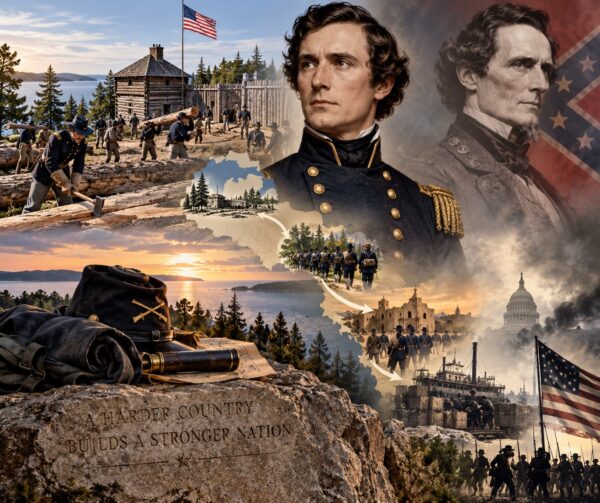
Sitting way up at Copper Harbor, Michigan—basically where America runs out of pavement and Lake Superior takes over—the United States Army built an honest-to-goodness frontier fort in 1844.
I had no idea. And I’m a fellow West Point graduate. My Finnish ancestors homesteaded here, I thought I knew some military history…
Apparently, somewhere between learning about Grant, Lee, Gettysburg, Little Bighorn and approximately 14,000 hours of calculus, nobody thought to mention that the Army once sent another West Pointer to the tip of the Keweenaw Peninsula to build a fort in the wilderness.
His name was Captain Robert Emmet Clary, West Point Class of 1828.
And his story is outstanding.
Michigan became a state in 1837, and before long Americans realized that the Keweenaw Peninsula contained an absolutely ridiculous amount of copper. Michigan originally never wanted the “wasteland of timber”, but got in compensation for giving Ohio the town of Toldeo.
After the 1842 Treaty of La Pointe and the opening of the region to American mining, prospectors began heading north.
Washington looked at this situation and apparently concluded:
Miners. Indians. Whiskey. Big Money. Wilderness.
We’d better send some infantry.
So in May 1844, roughly 150 soldiers traveled about 600 miles from Detroit aboard the sailing vessel John Jacob Astor (another important name to this locations history) and landed at Copper Harbor.
No interstate.
No helicopters.
No heated government vehicle.
No North Face special forces puffy warm jackets.
No satellite phone.
No DoorDash.
Welcome to the Keweenaw, Lieutenant. Here’s an axe.
The Army’s mission was to maintain order as miners poured into the region and to deter possible conflict with the local Ojibwe population.
But, the massive Indian war Washington apparently worried about never happened.
Which left the soldiers with another traditional Army mission: boredom and manual labor.
Clary’s soldiers began cutting trees, quarrying stone and rafting logs across Lake Fanny Hooe (funny name of a sister-in-law).
They built barracks, officers’ quarters, kitchens, a hospital, bakery, blacksmith shop, carpenter shop, guardhouse, powder magazine and storehouses.
In about five months, they completed 19 of the planned 22 buildings.
The whole project cost roughly $15,000.
Today $15,000 might get the federal government an environmental impact study discussing whether they’re allowed to replace the door on the guardhouse.
These guys built most of a fort.
And some of those buildings are still standing.
That’s the part that gets me.
We tend to imagine nineteenth-century soldiers as faded photographs of stern-looking men wearing uncomfortable wool uniforms.
But these were young guys.
They were chopping timber, hauling rocks, repairing equipment, standing guard and trying not to freeze to death beside Lake Superior.
They weren’t reenacting history. They were living Tuesday.
The Army barely had time to get comfortable before the strategic situation changed. As it always does…
The United States went to war with Mexico in 1846.
Suddenly Washington had a much more urgent use for infantry than guarding copper miners at the end of Lake Superior.
Fort Wilkins was essentially emptied.
The Army had spent two years building a frontier installation only to discover that the frontier had moved.
Anyone who spent a career in the Army should find this strangely comforting.
Some things never change.
There’s a popular version of the story saying Captain Clary marched directly from Copper Harbor all the way to Texas with his soldiers.
Great story.
Unfortunately, the historical record doesn’t quite support it.
Clary left Fort Wilkins before the Mexican War and subsequently served at Buffalo, Fort Leavenworth and New Orleans. He later served in Texas in 1857.
So I’m not going to improve history just because Hollywood would have written it better.
The truth is interesting and twisty enough.
Robert Clary graduated from West Point in 1828, 13th in his class. Another cadet graduated 23rd. His name was Jefferson Davis.
Yes. That Jefferson Davis.
Better yet, historical accounts report that when Clary married Esther Philipson in 1829, Jefferson Davis served as his best man.
Think about that.
Two young West Point officers start their careers together.
One stands beside the other at his wedding.
They serve in the same tiny antebellum Army, bouncing around frontier posts while the United States expands westward.
Then, three decades later, the country tears itself apart.
Jefferson Davis becomes president of the Confederacy.
Robert Clary stays with the United States Union. Now that is an awkward alumni reunion.
By the time the Civil War began, Clary wasn’t a young captain swinging an axe in Copper Harbor anymore.
He was an experienced Army quartermaster.
And if you think quartermasters aren’t important, try fighting a war without food.
Or ammunition.
Or horses.
Or wagons.
Or uniforms.
Or boots.
Clary served as chief quartermaster for major Union commands, including the Department of West Virginia and Army of Virginia, later served in the Department of the Northwest, worked in the Quartermaster General’s Office in Washington, and eventually took charge of the massive Union supply operation at Memphis.
Not quite Pickett’s Charge.
But Pickett’s Charge becomes considerably more difficult if nobody remembered to deliver breakfast.
For his Civil War service, Clary received brevet promotions to colonel and brigadier general in 1864 for faithful and meritorious service.
The kid who graduated from West Point in 1828 and helped establish a lonely fort beside Lake Superior had lived long enough to help sustain the enormous industrial armies of the Civil War.
He finally retired from the Army in 1869 after more than 40 years of service.
That’s what I find so fascinating about Fort Wilkins.
We know the Civil War.
Gettysburg. Antietam. Bull Run. Grant. Sherman. Lee. Stonewall Jackson.
But sometimes we treat everything before 1861 like the opening credits.
It wasn’t.
The generation before the Civil War was physically building the United States.
They surveyed wilderness.
They cut roads.
They built forts.
They established ports.
They opened mines.
They crossed mountains.
They fought wars.
And they negotiated, displaced and fought Native peoples as American settlement expanded—an uncomfortable but inseparable part of this story.
These were imperfect people operating in a hard and often brutal age.
But good grief, they were tough.
Stand at Fort Wilkins today and look at those buildings.
No excavator.
No cordless DeWalt.
No Home Depot run because somebody forgot the screws.
Just axes, saws, horses, boats, muscle and an Army first sergeant undoubtedly wondering why Private Snuffy had disappeared again.
And somehow they built the place.
Maybe that’s why Fort Wilkins struck me so strongly.
As a West Point graduate, I could look across almost two centuries and recognize something familiar.
Orders came down.
Some young officer looked at the map.
Copper Harbor?
Where the hell is Copper Harbor?
Then he packed his gear and went.
That’s how much of America was built—not by people who knew they were making history, but by ordinary people handed extraordinarily difficult jobs in extraordinarily difficult places.
Gettysburg tells us how close Americans came to destroying their country.
Fort Wilkins reminds us of something we don’t talk about nearly enough.
Before Americans could fight over their nation, somebody had to build it!
If you enjoyed this article, then please REPOST or SHARE with others; encourage them to follow AFNN. If you’d like to become a citizen contributor for AFNN, contact us at managingeditor@afnn.us Help keep us ad-free by donating here.
Substack: American Free News Network Substack
Truth Social: @AFNN_USA
Facebook: https://m.facebook.com/afnnusa
Telegram: https://t.me/joinchat/2_-GAzcXmIRjODNh
Twitter: https://twitter.com/AfnnUsa
GETTR: https://gettr.com/user/AFNN_USA
CloutHub: @AFNN_USA