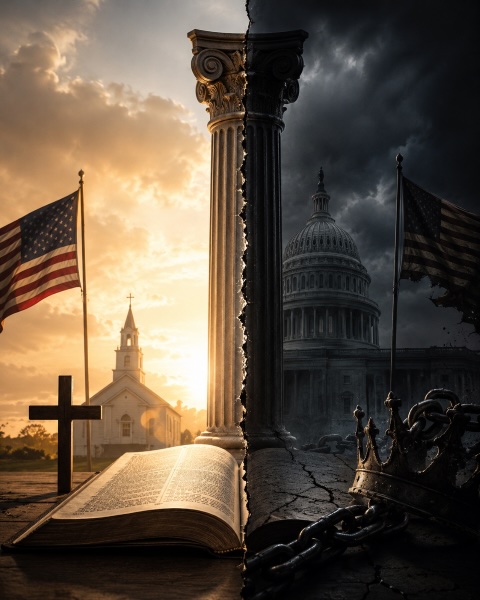
Romans 13 and Revelation 13 aren’t contradictory. They’re complementary.
Romans 13 tells us what government is supposed to be. Revelation 13 warns us what government becomes when it forgets God entirely and starts acting like it is God.
Paul describes the ideal: government as a servant of justice, rewarding good and restraining evil. John describes the collapse: government as a beast that rewards evil, punishes righteousness, and demands worship. One is Biblical design. The other is wordly decay.
History has already proven both true more times than we’d like to admit.
And yes, that includes today.
Let’s not pretend modern political parties are moral opposites locked in some noble ideological duel. They are often just two brands of the same broken system—each convinced the other is uniquely evil while quietly excusing their own corruption. Where is the good fruit? Seriously. Look for it. Take your time. I’ll wait.
What you mostly find instead is self-preservation, power games, and carefully packaged self-interest. Politicians love themselves first, their party second, and the public somewhere far down the list—usually right next to “campaign donors.”
And let’s be honest: very few of them demonstrate any meaningful personal relationship with Jesus Christ. Not the new “hipster” cultural Christianity. Not photo-op spirituality. A real, shaping, governing relationship with God. That absence shows. It shows in policy. It shows in character. It shows in the fruit—or absolute lack of it.
Kings once invoked Romans 13 to justify divine right. Slaveholders used it to defend slavery. Nazi-aligned churches used it to demand obedience. Apartheid supporters used it to silence resistance. The same passage meant to describe legitimate authority was repeatedly weaponized to sanctify injustice.
And the Bible never once endorses that abuse.
Hebrew midwives defied Pharaoh. Daniel disobeyed the king’s decree. Three men refused to bow to a state-sponsored idol. The apostles looked authorities in the eye and said, “We must obey God rather than men.”
That’s not rebellion for rebellion’s sake. That’s hierarchy. God first. Always.
Paul wrote Romans 13 under Nero—an emperor who would later execute Christians for sport. Including, eventually, Paul himself. So no, Romans 13 was never a blank check for tyranny. It was a call to order, not blind obedience.
Consider the irony. Paul wrote Romans 13 while Nero sat on the imperial throne. Within a few years, that same emperor would blame Christians for the Great Fire of Rome, crucify many of them, throw others to wild beasts for public entertainment, and—according to the Roman historian Tacitus—have some coated in pitch, tied to stakes, and burned alive as nighttime torches in his gardens.
If Romans 13 were a command for blind obedience to every government action, then Paul himself violated it when he continued preaching Christ, and the apostles were wrong when they declared, “We must obey God rather than men.” Romans 13 was never permission for tyranny. It was instruction for respecting legitimate authority while recognizing that every earthly ruler remains accountable to the King of Kings.
Government is a tool. A necessary one. A good one when it functions properly. It is meant to restrain evil, protect the innocent, and uphold justice. But it is not God. And it is not the church. And it is not your savior, no matter how many campaign slogans suggest otherwise.
Here’s the uncomfortable truth: we were not built to be a theocracy (this is definitely not an endorsement of Christian Nationalism) and forcing one would be just as corrupting as the systems we already have. That’s been tried before and failed.
But let’s not kid ourselves either—no system survives long without a moral foundation. And in the West, that foundation was explicitly biblical. Remove it, and you don’t get neutrality. You get moral drift. Living for pleasure. Then confusion. Then collapse.
As often said: “A government that rewards evil and punishes good will not long survive.”
Proverbs 29:12 adds the same warning in ancient form: “If a ruler listens to lies, all his officials will become wicked.”
Romans 13 tells us to respect authority. Revelation 13 tells us not to worship it.
That tension is intentional.
Christians are called to be good citizens, not blind subjects. We pray for leaders. We pay taxes. We participate. We engage. But we do not bow.
Because at the end of the day, no party, no politician, and no system gets the throne.
God is still in charge.
_________________________________
If you enjoyed this article, then please REPOST or SHARE with others; encourage them to follow AFNN. If you’d like to become a citizen contributor for AFNN, contact us at managingeditor@afnn.us Help keep us ad-free by donating here.
_________________________________
Substack: American Free News Network Substack
Truth Social: @AFNN_USA
Facebook: https://m.facebook.com/afnnusa
Telegram: https://t.me/joinchat/2_-GAzcXmIRjODNh
Twitter: https://twitter.com/AfnnUsa
GETTR: https://gettr.com/user/AFNN_USA
CloutHub: @AFNN_USA