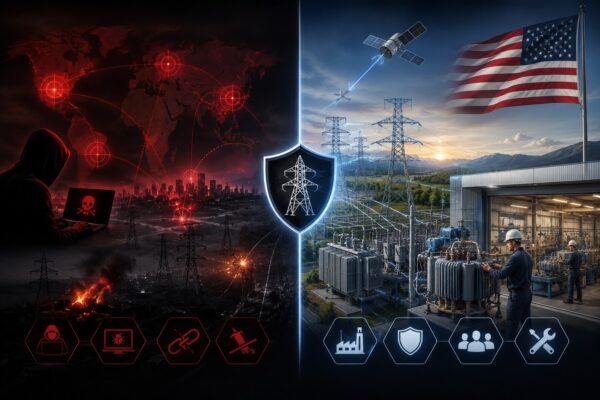
For most of American history, preparing for war meant building tanks, ships, airplanes, ammunition, and eventually missiles. You could drive past the factory and actually see national defense being manufactured.
The fifth-generation battlefield is different.
The next major war may begin while Walmart is still open, your phone still has five bars, and nobody has fired anything resembling a conventional shot.
That is why President Trump’s August 26 declaration of a national emergency concerning the American bulk-power system deserves more attention than another Washington story about electrical transformers.
This isn’t really about transformers.
It is about terrain.
In fifth-generation warfare, the battlefield isn’t merely some miserable patch of dirt overseas where young Americans get sent to solve problems created by older Americans. The battlefield is financial systems, telecommunications, public opinion, computer networks, supply chains, satellites, ports, energy infrastructure—and increasingly the electrical grid underneath almost all of them.
Turn off electricity long enough and modern civilization begins uninstalling itself.
The White House order recognizes that certain foreign-produced equipment could create opportunities for sabotage, unauthorized access, malicious remote action, or supply disruption. It specifically reaches beyond transformers and generators into industrial control systems, programmable logic controllers, protective relays, software, firmware, digital services, maintenance systems, and remote-access capabilities.
That’s not your grandfather’s power grid.
That’s a gigantic computerized machine.
And computers can be attacked.
The federal government has already warned that Chinese state-sponsored Volt Typhoon actors have sought persistent access inside American critical-infrastructure environments. A joint cybersecurity advisory says investigators observed indications that the actors maintained footholds in some victim networks for at least five years.
Five years!
Think about that from a military perspective. That isn’t somebody kicking down the front gate during the battle.
That’s somebody potentially wandering around the battlefield years beforehand, studying the roads, measuring the bridges, locating the ammunition dumps, and quietly making copies of the keys.
Welcome to 5GW.
Now add America’s manufacturing problem.
DOE says critical grid equipment—including transformers, circuit breakers, substation components, and power electronics—faces limited domestic manufacturing capacity and significant dependence on imported components and materials. Some critical equipment has lead times of two years or more. DOE says some transformer prices have increased four- to nine-fold in five years.
That’s inconvenient during peacetime.
During a major war, it could become catastrophic.
Imagine an adversary doesn’t need to destroy 500 substations. Perhaps it damages a carefully selected handful while simultaneously disrupting communications, attacking control networks, interfering with logistics, manipulating social media, disrupting financial systems, and choking the foreign supply chain supplying replacement equipment.
Now you’re fighting the enemy while simultaneously trying to manufacture the equipment necessary to turn your own country back on.
That’s why the executive order’s domestic-manufacturing component matters. It directs the government to prioritize U.S.-manufactured energy infrastructure in federal procurement. Earlier this year, the administration also invoked the Defense Production Act framework to expand domestic manufacturing and deployment capacity for large-scale energy infrastructure.
That’s a good start.
But we should go farther.
America needs to start thinking about the electrical grid the way the military thinks about battlefield logistics: redundancy, dispersion, stockpiles, alternate routes, rapid repair, interchangeable parts, trained personnel, and the ability to continue operating after somebody punches holes in the system.
DOE is already moving toward greater standardization of grid equipment, which could reduce manufacturing and replacement times. That idea deserves acceleration.
We should maintain strategic reserves of critical transformers and components. We should develop modular transformers capable of replacing multiple configurations. We should expand domestic production of electrical steel, conductors, switchgear, control electronics, and the specialized components hiding inside the equipment. Critical systems should have secure manual or degraded operating modes where technically feasible. Utilities should regularly exercise cyberattack and physical-destruction scenarios alongside federal, state, local, military, and emergency-management organizations.
And perhaps most importantly, we need the industrial capacity to replace equipment faster than an adversary can destroy or disrupt it.
That is deterrence too.
A resilient country is a lousy target.
For decades America enjoyed the luxury of separating the civilian economy from the battlefield. Globalization encouraged us to purchase critical components wherever they were cheapest, connect everything digitally because it was convenient, eliminate excess inventory because it was inefficient, and assume the global supply chain would always deliver another widget on Tuesday.
That model works beautifully right up until somebody decides Tuesday is canceled.
The future battlefield will not necessarily announce itself with bombers crossing the coastline.
It may arrive as a cyberattack, a mysteriously failed transformer, a disrupted satellite, a closed port, a banking outage, a telecommunications failure, a disinformation campaign, and a shortage of replacement components—all happening at approximately the same time.
The August 26 order recognizes one piece of that battlefield.
Now America needs to recognize the rest of it.
Because in fifth-generation warfare, protecting the homeland doesn’t begin when the shooting starts.
It begins while the lights are still on.
_________________________________
If you enjoyed this article, then please REPOST or SHARE with others; encourage them to follow AFNN. If you’d like to become a citizen contributor for AFNN, contact us at managingeditor@afnn.us Help keep us ad-free by donating here.
_________________________________
Substack: American Free News Network Substack
Truth Social: @AFNN_USA
Facebook: https://m.facebook.com/afnnusa
Telegram: https://t.me/joinchat/2_-GAzcXmIRjODNh
Twitter: https://twitter.com/AfnnUsa
GETTR: https://gettr.com/user/AFNN_USA
CloutHub: @AFNN_USA