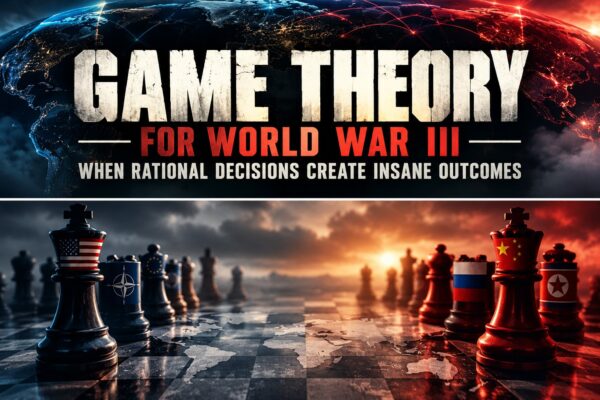
I spent 13-years of my Army career as an Operations Research/Systems Analysis guy—FA49, otherwise known as a math geek, or one of those strange officers who believed that somewhere, buried underneath enough spreadsheets, equations, probability distributions, and PowerPoint slides, human stupidity could eventually be quantified.
Turns out we were right.
There is an idea from game theory called the Prisoner’s Dilemma, and once you understand it, an uncomfortable amount of the geopolitical insanity of 2026 begins to make sense.
The concept traces back to mathematicians Merrill Flood and Melvin Dresher, who conducted an experiment at the RAND Corporation in 1950. RAND was intensely interested in game theory because this wasn’t merely academic mathematics. These ideas potentially applied to military strategy, deterrence, and eventually the terrifying question of how nuclear-armed nations behave when neither side can completely trust the other.
The basic game is wonderfully simple.
Two criminals are arrested and interrogated separately.
If both keep their mouths shut (honor among theives), both receive relatively light punishment.
If one rats out the other while his buddy stays quiet, the rat gets the sweetheart deal while his trusting partner gets hammered.
If they both rat each other out, both get significant punishment.
Here is where the math becomes fascinating.
From the perspective of either prisoner, betrayal makes sense.
If the other guy stays quiet, betraying him gives you the better outcome.
If the other guy betrays you, you’d better betray him too.
Therefore the rational decision is to betray.
Except your buddy is sitting in another room doing exactly the same calculation.
Congratulations.
You have both behaved rationally and produced an outcome that is worse for both of you.
Welcome to geopolitics.
This is what makes the Prisoner’s Dilemma so powerful. It doesn’t require anyone to be insane, evil, stupid, or even particularly aggressive. Two perfectly rational actors responding logically to incentives can create a completely irrational-looking result.
That should make every Army planner’s remaining hair stand up.
Consider an arms race.
Country A would prefer not to spend another hundred billion dollars on weapons.
Country B would also prefer not to spend another hundred billion dollars on weapons.
If both restrain themselves (honor), everybody gets highways, hospitals, tax cuts, beer, and perhaps functional airport bathrooms.
But Country A cannot be certain Country B will restrain itself.
So A buys missiles.
Country B observes A buying missiles and concludes—quite rationally—that it needs more missiles.
Country A sees that and orders more missiles.
Nobody necessarily wanted an arms race.
Everybody got one.
That isn’t theoretical in 2026. NATO says its members are substantially strengthening deterrence and defense while Russia rebuilds military capabilities and Russia, China, Iran, and North Korea deepen various forms of defense cooperation. Researchers are simultaneously examining how American and allied nuclear modernization could be perceived in Moscow and Beijing and whether those reactions could contribute to arms-race dynamics.
Then look toward Taiwan.
China sees American weapons going to Taiwan and interprets them as threatening Chinese objectives.
The United States and Taiwan can view those same weapons as necessary precisely because Chinese military pressure exists.
China responds to American deterrence.
America responds to China’s response.
Nobody gets to make his decision in isolation.
That’s game theory.
And in September 2026, Taiwan arms sales remain an active point of U.S.-Chinese contention, with Beijing pressing Washington over the issue while Washington maintains that Taiwan must retain a self-defense capability.
The same basic logic appears everywhere, although the actual games and reality are vastly more complicated than our two unfortunate jailbirds.
Russia and NATO.
China and the United States.
Iran, Israel, the United States, and the Gulf states.
North Korea, South Korea, Japan, China, and America.
Now throw in nuclear weapons, drones, cyberattacks, sanctions, alliances, petrodollars, BRICS, domestic politics, energy markets, religion, history, national pride, and leaders who occasionally behave like somebody replaced their morning coffee with Red Bull and Bourbon.
Our cute little two-player matrix has become a multidimensional bar fight.
And 2026 provides plenty of evidence that the board is crowded. The Council on Foreign Relations entered the year identifying numerous serious conflict contingencies, including Ukraine, Iran-Israel tensions, North Korea, Taiwan, and possible Russia-NATO confrontation.
But there is another part of the Prisoner’s Dilemma that gives me some hope.
Repeated games change behavior.
Flood and Dresher didn’t merely have people play once. Their famous experiment involved 100+ rounds. The participants frequently found ways to cooperate rather than mechanically choosing betrayal every time.
That’s important.
If I screw you today but never see you again, betrayal might pay.
If I know we’re doing business again tomorrow, suddenly reputation matters.
Trust matters.
Retaliation matters.
Promises matter.
And cooperation becomes valuable.
Nations operate in the ultimate endless repeated game of reality.
And here is where an old Army guy has to add something the mathematicians might call reputation, but soldiers would simply call honor. In a repeated game, keeping your word isn’t just morally right—it can be mathematically rational. If I know you will honor an agreement, cooperate when I cooperate, and respond when I betray you, I can plan around your behavior.
Trust suddenly has measurable value. Betraying you might give me an advantage today, but if it destroys twenty years of cooperation tomorrow, it may be a terrible trade. In other words, honor changes the payoff matrix.
The handshake, the treaty, the promise, and the reputation for doing what you said you would do aren’t quaint leftovers from another age. They are mechanisms that make long-term cooperation possible.
Maybe Grandpa understood game theory without ever seeing an equation: keep your word, don’t screw your friends, and remember that you’re probably going to have to deal with the same people again tomorrow.
There is always another trade negotiation, another treaty, another crisis, another administration, another military exercise, another sanctions package, another phone call. Which brings us to perhaps the most important lesson from a bunch of mathematicians sitting around RAND 76-years ago:
Chaos does not necessarily mean the players are irrational.
Sometimes chaos is exactly what individually rational decisions produce when everyone is afraid the other guy will move first. Fear is the father of poor decisions.
That distinction matters.
Because if your opponent is simply crazy, there isn’t much to calculate.
But if your opponent is rationally responding to incentives, then perhaps you can change the incentives.
Make honor and cooperation profitable.
Make betrayal incredibly expensive.
Make commitments credible.
Create ways to verify agreements.
And most importantly, understand the other guy’s payoff matrix instead of assuming he sees the board exactly the way you do.
That’s the ORSA answer.
Don’t just ask:
“Why the hell are they doing that?”
Ask:
“Given what they believe, what incentives make that decision rational?”
You don’t have to agree with them.
You don’t even have to like them.
But you’d better understand their math.
Because somewhere in a room in Washington, Moscow, Beijing, Tehran, Jerusalem, Brussels, or Pyongyang, somebody else is running the same equation on us.
And that may be the most uncomfortable lesson of the Prisoner’s Dilemma:
Sometimes nobody has to be crazy for the world to go completely nuts.
If you enjoyed this article, then please REPOST or SHARE with others; encourage them to follow AFNN. If you’d like to become a citizen contributor for AFNN, contact us at managingeditor@afnn.us Help keep us ad-free by donating here.
Substack: American Free News Network Substack
Truth Social: @AFNN_USA
Facebook: https://m.facebook.com/afnnusa
Telegram: https://t.me/joinchat/2_-GAzcXmIRjODNh
Twitter: https://twitter.com/AfnnUsa
GETTR: https://gettr.com/user/AFNN_USA
CloutHub: @AFNN_USA